


Details
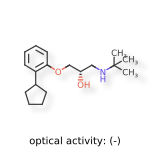
| Stereochemistry | ABSOLUTE |
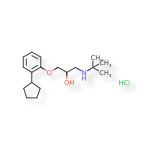
| Molecular Formula | C18H29NO2.ClH |
| Molecular Weight | 327.889 |
| Optical Activity | ( - ) |
| Defined Stereocenters | 1 / 1 |
| E/Z Centers | 0 |
| Charge | 0 |
SHOW SMILES / InChI
SMILES
Cl.CC(C)(C)NC[C@H](O)COC1=CC=CC=C1C2CCCC2
InChI
InChIKey=ITZWQFLTSRCDPC-RSAXXLAASA-N
InChI=1S/C18H29NO2.ClH/c1-18(2,3)19-12-15(20)13-21-17-11-7-6-10-16(17)14-8-4-5-9-14;/h6-7,10-11,14-15,19-20H,4-5,8-9,12-13H2,1-3H3;1H/t15-;/m0./s1
| Molecular Formula | ClH |
| Molecular Weight | 36.461 |
| Charge | 0 |
| Count |
|
| Stereochemistry | ACHIRAL |
| Additional Stereochemistry | No |
| Defined Stereocenters | 0 / 0 |
| E/Z Centers | 0 |
| Optical Activity | NONE |
| Molecular Formula | C18H29NO2 |
| Molecular Weight | 291.4284 |
| Charge | 0 |
| Count |
|
| Stereochemistry | ABSOLUTE |
| Additional Stereochemistry | No |
| Defined Stereocenters | 1 / 1 |
| E/Z Centers | 0 |
| Optical Activity | UNSPECIFIED |
Penbutolol is a new beta-adrenergic blocking drug approved for the treatment of hypertension. It is a noncardioselective beta-blocker and has intrinsic sympathomimetic activity. Penbutolol is marketed under the trade names Levatol, Levatolol, Lobeta, Paginol, Hostabloc, Betapressin. Penbutolol acts on the β1 adrenergic receptors in both the heart and the kidney. When β1 receptors are activated by catecholamines, they stimulate a coupled G protein that leads to the conversion of adenosine triphosphate (ATP) to cyclic adenosine monophosphate (cAMP). The increase in cAMP leads to activation of protein kinase A (PKA), which alters the movement of calcium ions in heart muscle and increases the heart rate. Penbutolol blocks the catecholamine activation of β1 adrenergic receptors and decreases heart rate, which lowers blood pressure. Levatol (Penbutolol) is indicated in the treatment of mild to moderate arterial hypertension. It may be used
alone or in combination with other antihypertensive agents, especially thiazide-type diuretics.
Approval Year
Targets
| Primary Target | Pharmacology | Condition | Potency |
|---|---|---|---|
Target ID: CHEMBL273 |
2.4 nM [Ki] |
Conditions
| Condition | Modality | Targets | Highest Phase | Product |
|---|---|---|---|---|
| Primary | LEVATOL Approved UseLevatol® is indicated in the treatment of mild to moderate arterial hypertension. It may be used
alone or in combination with other antihypertensive agents, especially thiazide-type diuretics. Launch Date1987 |
Cmax
| Value | Dose | Co-administered | Analyte | Population |
|---|---|---|---|---|
285 μg/mL EXPERIMENT https://pubmed.ncbi.nlm.nih.gov/2906875 |
40 mg single, oral dose: 40 mg route of administration: Oral experiment type: SINGLE co-administered: |
PENBUTOLOL blood | Homo sapiens population: HEALTHY age: ADULT sex: MALE food status: FASTED |
T1/2
| Value | Dose | Co-administered | Analyte | Population |
|---|---|---|---|---|
1.21 h EXPERIMENT https://pubmed.ncbi.nlm.nih.gov/2906875 |
40 mg single, oral dose: 40 mg route of administration: Oral experiment type: SINGLE co-administered: |
PENBUTOLOL blood | Homo sapiens population: HEALTHY age: ADULT sex: MALE food status: FASTED |
Funbound
| Value | Dose | Co-administered | Analyte | Population |
|---|---|---|---|---|
2% |
40 mg single, oral dose: 40 mg route of administration: Oral experiment type: SINGLE co-administered: |
PENBUTOLOL plasma | Homo sapiens population: UNHEALTHY age: ADULT sex: UNKNOWN food status: UNKNOWN |
Doses
| Dose | Population | Adverse events |
|---|---|---|
4 mg 1 times / day single, intravenous Studied dose Dose: 4 mg, 1 times / day Route: intravenous Route: single Dose: 4 mg, 1 times / day Sources: |
unhealthy, 33- 62 years Health Status: unhealthy Age Group: 33- 62 years Sex: M Sources: |
|
120 mg 1 times / day steady, oral Studied dose Dose: 120 mg, 1 times / day Route: oral Route: steady Dose: 120 mg, 1 times / day Sources: |
unhealthy, 55.7 years (range: 43-64 years) Health Status: unhealthy Age Group: 55.7 years (range: 43-64 years) Sex: M+F Sources: |
|
40 mg 1 times / day steady, oral Recommended Dose: 40 mg, 1 times / day Route: oral Route: steady Dose: 40 mg, 1 times / day Sources: |
unhealthy, adult Health Status: unhealthy Age Group: adult Sources: |
Disc. AE: Asthenia, Nausea... AEs leading to discontinuation/dose reduction: Asthenia (0.6%) Sources: Nausea (0.8%) Depression (0.6%) Dizziness (0.6%) Headache (0.6%) |
AEs
| AE | Significance | Dose | Population |
|---|---|---|---|
| Asthenia | 0.6% Disc. AE |
40 mg 1 times / day steady, oral Recommended Dose: 40 mg, 1 times / day Route: oral Route: steady Dose: 40 mg, 1 times / day Sources: |
unhealthy, adult Health Status: unhealthy Age Group: adult Sources: |
| Depression | 0.6% Disc. AE |
40 mg 1 times / day steady, oral Recommended Dose: 40 mg, 1 times / day Route: oral Route: steady Dose: 40 mg, 1 times / day Sources: |
unhealthy, adult Health Status: unhealthy Age Group: adult Sources: |
| Dizziness | 0.6% Disc. AE |
40 mg 1 times / day steady, oral Recommended Dose: 40 mg, 1 times / day Route: oral Route: steady Dose: 40 mg, 1 times / day Sources: |
unhealthy, adult Health Status: unhealthy Age Group: adult Sources: |
| Headache | 0.6% Disc. AE |
40 mg 1 times / day steady, oral Recommended Dose: 40 mg, 1 times / day Route: oral Route: steady Dose: 40 mg, 1 times / day Sources: |
unhealthy, adult Health Status: unhealthy Age Group: adult Sources: |
| Nausea | 0.8% Disc. AE |
40 mg 1 times / day steady, oral Recommended Dose: 40 mg, 1 times / day Route: oral Route: steady Dose: 40 mg, 1 times / day Sources: |
unhealthy, adult Health Status: unhealthy Age Group: adult Sources: |
PubMed
| Title | Date | PubMed |
|---|---|---|
| Development of a list of potentially inappropriate drugs for the korean elderly using the delphi method. | 2010-12 |
|
| [Determination of fifteen beta-agonists in animal urine by high performance liquid chromatography-tandem mass spectrometry]. | 2010-08 |
|
| In vitro transdermal iontophoretic delivery of penbutolol sulfate. | 2009-01 |
|
| [Simultaneous determination of nine beta-agonist residues in animal derived foods by ultra performance liquid chromatography-tandem mass spectrometry]. | 2008-11 |
|
| Carvedilol in hypertension treatment. | 2008 |
|
| Stereospecific high-performance liquid chromatographic analysis of tramadol and its O-demethylated (M1) and N,O-demethylated (M5) metabolites in human plasma. | 2007-06-01 |
|
| Clinical review: aggressive management and extracorporeal support for drug-induced cardiotoxicity. | 2007 |
|
| Thermotropic liquid crystalline drugs. | 2005-07 |
|
| Screening for library-assisted identification and fully validated quantification of 22 beta-blockers in blood plasma by liquid chromatography-mass spectrometry with atmospheric pressure chemical ionization. | 2004-11-26 |
|
| [Pharmacology of beta blockers and their significance for therapy of hypertension]. | 2002-08 |
|
| Synthesis and evaluation of radiolabeled antagonists for imaging of beta-adrenoceptors in the brain with PET. | 2002-02 |
|
| 5-HT receptor subtypes involved in the spinal antinociceptive effect of acetaminophen in rats. | 2001-11-30 |
|
| High-performance liquid chromatography with chemiluminescence detection of penbutolol and its hydroxylated metabolite in rat plasma. | 2001-06-15 |
|
| Decrease in penbutolol protein binding as a consequence of treatment with some alkylating agents. | 1994 |
|
| (-)-Penbutolol as a blocker of central 5-HT1A receptor-mediated responses. | 1992-11-03 |
|
| [Validity of the use of penbutolol in essential arterial hypertension]. | 1990-06 |
|
| Penbutolol and carteolol: two new beta-adrenergic blockers with partial agonism. | 1990-05 |
|
| Decrease in penbutolol central response as a cause of changes in its serum protein binding. | 1990-03 |
|
| Effect of oral penbutolol on renal haemodynamics of hypertensive patients with renal insufficiency. | 1985-08-28 |
|
| A comparative study of atenolol and penbutolol in hypertensive patients. | 1983-07 |
|
| Single daily dose penbutolol in the treatment of hypertension: a double blind crossover comparison with propranolol. | 1980-06 |
|
| Clinical electrophysiological properties of penbutolol: a non-selective beta-blocking agent. | 1980 |
|
| The effect of clonidine and penbutolol, respectively on catecholamines in blood and urine, plasma renin activity and urinary aldosterone in hypertensive patients. | 1975-02 |
Patents
Sample Use Guides
The usual starting and maintenance dose of Levatol (Penbutolol), used alone or in combination with other
antihypertensive agents, such as thiazide-type diuretics, is 20 mg given once daily.
Doses of 40 mg and 80 mg have been well-tolerated but have not been shown to give a greater
antihypertensive effect. The full effect of a 20- or 40-mg dose is seen by the end of 2 weeks. A
dose of 10 mg also lowers blood pressure, but the full effect is not seen for 4 to 6 weeks.
Route of Administration:
Oral
| Substance Class |
Chemical
Created
by
admin
on
Edited
Wed Apr 02 17:30:18 GMT 2025
by
admin
on
Wed Apr 02 17:30:18 GMT 2025
|
| Record UNII |
N93927D8LN
|
| Record Status |
Validated (UNII)
|
| Record Version |
|
-
Download
| Name | Type | Language | ||
|---|---|---|---|---|
|
Preferred Name | English | ||
|
Common Name | English | ||
|
Common Name | English | ||
|
Systematic Name | English | ||
|
Systematic Name | English | ||
|
Systematic Name | English |
| Code System | Code | Type | Description | ||
|---|---|---|---|---|---|
|
28291-30-7
Created by
admin on Wed Apr 02 17:30:18 GMT 2025 , Edited by admin on Wed Apr 02 17:30:18 GMT 2025
|
PRIMARY | |||
|
70394517
Created by
admin on Wed Apr 02 17:30:18 GMT 2025 , Edited by admin on Wed Apr 02 17:30:18 GMT 2025
|
PRIMARY | |||
|
N93927D8LN
Created by
admin on Wed Apr 02 17:30:18 GMT 2025 , Edited by admin on Wed Apr 02 17:30:18 GMT 2025
|
PRIMARY |
| Related Record | Type | Details | ||
|---|---|---|---|---|
|
PARENT -> SALT/SOLVATE |
|
||
|
RACEMATE -> ENANTIOMER |
|
| Related Record | Type | Details | ||
|---|---|---|---|---|
|
ACTIVE MOIETY |
|