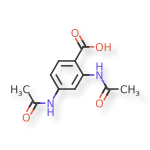
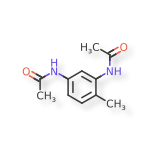
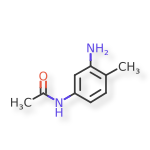
Details
| Stereochemistry | ACHIRAL |
| Molecular Formula | C7H10N2 |
| Molecular Weight | 122.1677 |
| Optical Activity | NONE |
| Defined Stereocenters | 0 / 0 |
| E/Z Centers | 0 |
| Charge | 0 |
SHOW SMILES / InChI
SMILES
CC1=CC=C(N)C=C1N
InChI
InChIKey=VOZKAJLKRJDJLL-UHFFFAOYSA-N
InChI=1S/C7H10N2/c1-5-2-3-6(8)4-7(5)9/h2-4H,8-9H2,1H3
| Molecular Formula | C7H10N2 |
| Molecular Weight | 122.1677 |
| Charge | 0 |
| Count |
|
| Stereochemistry | ACHIRAL |
| Additional Stereochemistry | No |
| Defined Stereocenters | 0 / 0 |
| E/Z Centers | 0 |
| Optical Activity | NONE |
Approval Year
PubMed
| Title | Date | PubMed |
|---|---|---|
| Validation of a genotoxicity test based on p53R2 gene expression in human lymphoblastoid cells. | 2011-09-18 |
|
| New short term prediction method for chemical carcinogenicity by hepatic transcript profiling following 28-day toxicity tests in rats. | 2011 |
|
| High-density real-time PCR-based in vivo toxicogenomic screen to predict organ-specific toxicity. | 2011 |
|
| Toxicogenomics applied to in vitro carcinogenicity testing with Balb/c 3T3 cells revealed a gene signature predictive of chemical carcinogens. | 2010-11 |
|
| Analysis of primary aromatic amines originated from azo dyes in commercial textile products in Japan. | 2010-08 |
|
| Evaluation of a liver micronucleus assay in young rats (IV): a study using a double-dosing/single-sampling method by the Collaborative Study Group for the Micronucleus Test (CSGMT)/Japanese Environmental Mutagen Society (JEMS)-Mammalian Mutagenicity Study Group (MMS). | 2010-04-30 |
|
| Safety evaluation of food contact paper and board using chemical tests and in vitro bioassays: role of known and unknown substances. | 2010-03 |
|
| Integration of in vivo genotoxicity and short-term carcinogenicity assays using F344 gpt delta transgenic rats: in vivo mutagenicity of 2,4-diaminotoluene and 2,6-diaminotoluene structural isomers. | 2010-03 |
|
| The GSTP1 Ile105 Val polymorphism modifies the metabolism of toluene di-isocyanate. | 2010-02 |
|
| Validation of a liquid chromatography-mass spectrometry method for determining the migration of primary aromatic amines from cooking utensils and its application to actual samples. | 2010-01 |
|
| Determination of aromatic amines in food products and composite food packaging bags by capillary electrophoresis coupled with transient isotachophoretic stacking. | 2009-10-23 |
|
| Graphite- and soot-mediated reduction of 2,4-dinitrotoluene and hexahydro-1,3,5-trinitro-1,3,5-triazine. | 2009-09-15 |
|
| Current implant surface technology: an examination of their nanostructure and their influence on fibroblast alignment and biocompatibility. | 2009-06-16 |
|
| Is toluene diamine a sensitizer and is there cross-reactivity between toluene diamine and toluene diisocyanate? | 2009-06 |
|
| [Application of IR spectrum to the research on mechanism of synthesis of 2,4-toluene dicarbamate catalyzed by zinc acetate]. | 2009-02 |
|
| Evaluation of a liver micronucleus assay with 12 chemicals using young rats (II): a study by the Collaborative Study Group for the Micronucleus Test/Japanese Environmental Mutagen Society-Mammalian Mutagenicity Study Group. | 2009-01 |
|
| Syrian hamster embryo (SHE) cell transformation assay with conditioned media (without X-ray irradiated feeder layer) using 2,4-diaminotoluene, 2,6-diaminotoluene and chloral hydrate. | 2008-07-31 |
|
| Single-step treatment of 2,4-dinitrotoluene via zero-valent metal reduction and chemical oxidation. | 2008-06-30 |
|
| Experimental evidence for in situ natural attenuation of 2,4- and 2,6-dinitrotoluene in marine sediment. | 2008-01 |
|
| [Determination and analysis of toluene diisocyanate metabolites in mice using gas chromatography-mass spectrometry]. | 2007-09 |
|
| Biological monitoring of TDI-derived amines in polyurethane foam production. | 2007-09 |
|
| Removal of dinitrotoluenes from water via reduction with iron and peroxidase-catalyzed oxidative polymerization: a comparison between Arthromyces ramosus peroxidase and soybean peroxidase. | 2007-04 |
|
| Increasing selectivity for TNT-based explosive detection by synchronous luminescence and derivative spectroscopy with quantum yields of selected aromatic amines. | 2007-01 |
|
| Effects of toluene-2,4-diamine on red sea bream, Pagrus major: biochemical and histological evaluation. | 2007 |
|
| Differences in gene expression profiles in the liver between carcinogenic and non-carcinogenic isomers of compounds given to rats in a 28-day repeat-dose toxicity study. | 2006-12-15 |
|
| Prediction of estrogen receptor agonists and characterization of associated molecular descriptors by statistical learning methods. | 2006-11 |
|
| Induction of LacZ mutations in Muta Mouse can distinguish carcinogenic from non-carcinogenic analogues of diaminotoluenes and nitronaphthalenes. | 2006-09-19 |
|
| Exposure of hairdressing apprentices to airborne hazardous substances. | 2006-08-07 |
|
| 2,4-Toluene diisocyanate suppressed the calcium signaling of ligand gated ion channel receptors. | 2006-02-15 |
|
| Differences in the biotransformation of 2,4,6-trinitrotoluene (TNT) between wild and axenically grown isolates of Myriophyllum aquaticum. | 2006 |
|
| Different results of the Salmonella umu test between three isomers of phenylenediamine (PDA) derivatives. | 2006 |
|
| Risk evaluation of occupational exposure to methylene dianiline and toluene diamine in polyurethane foam. | 2005-12 |
|
| 2,4-Diaminotoluene (2,4-DAT)-induced DNA damage, DNA repair and micronucleus formation in the human hepatoma cell line HepG2. | 2005-09-15 |
|
| Upper reference limits for biomarkers of exposure to aromatic diisocyanates. | 2005-08 |
|
| Improvement in the GC-MS method for determining urinary toluene-diamine and its application to the biological monitoring of workers exposed to toluene-diisocyanate. | 2005-07 |
|
| Hemoglobin adducts in workers exposed to nitrotoluenes. | 2005-01 |
|
| Hydrolytic stability of toluene diisocyanate and polymeric methylenediphenyl diisocyanate based polyureas under environmental conditions. | 2004-02-15 |
|
| 2,4-Diaminotoluene. | 2004 |
|
| [Assessment of the emission of volatile organic compounds from polyurethane foams]. | 2004 |
|
| Mutagenicity of nitroaromatic degradation compounds. | 2003-10 |
|
| Development, validation and characterization of an analytical method for the quantification of hydrolysable urinary metabolites and plasma protein adducts of 2,4- and 2,6-toluene diisocyanate, 1,5-naphthalene diisocyanate and 4,4'-methylenediphenyl diisocyanate. | 2003-08-29 |
|
| Toxicology of toluene diisocyanate. | 2002-12 |
|
| Evaluation of carcinogenic responses in the Eker rat following short-term exposure to selected nephrotoxins and carcinogens. | 2002-10-10 |
|
| Contact leukoderma secondary to occupational toluenediamine sulfate exposure. | 2002-08 |
|
| [Fast optimization of stepwise gradient conditions for ternary mobile phase in reversed-phase high performance liquid chromatography]. | 2002-07 |
|
| 2,4-Diaminotoluene. | 2002 |
|
| Interaction with the aromatic hydrocarbon receptor, CYP1A induction, and mutagenicity of a series of diaminotoluenes: implications for their carcinogenicity. | 1996-07 |
|
| Reduction and Acetylation of 2,4-Dinitrotoluene by a Pseudomonas aeruginosa Strain. | 1996-07 |
|
| Reproductive toxicity of 2,4-toluenediamine in the rat. 3. Effects on androgen-binding protein levels, selected seminiferous tubule characteristics, and spermatogenesis. | 1988 |
|
| Locus specificity of mutagenicity of 2,4-diaminotoluene in both L5178Y mouse lymphoma and AT3-2 Chinese hamster ovary cells. | 1984-02 |
Patents
| Substance Class |
Chemical
Created
by
admin
on
Edited
Mon Mar 31 19:57:01 GMT 2025
by
admin
on
Mon Mar 31 19:57:01 GMT 2025
|
| Record UNII |
IS1AKN4HYB
|
| Record Status |
Validated (UNII)
|
| Record Version |
|
-
Download
| Name | Type | Language | ||
|---|---|---|---|---|
|
Preferred Name | English | ||
|
Systematic Name | English | ||
|
Systematic Name | English | ||
|
Common Name | English | ||
|
Common Name | English | ||
|
Systematic Name | English | ||
|
Systematic Name | English | ||
|
Systematic Name | English | ||
|
Systematic Name | English | ||
|
Common Name | English |
| Classification Tree | Code System | Code | ||
|---|---|---|---|---|
|
NCI_THESAURUS |
C45178
Created by
admin on Mon Mar 31 19:57:01 GMT 2025 , Edited by admin on Mon Mar 31 19:57:01 GMT 2025
|
| Code System | Code | Type | Description | ||
|---|---|---|---|---|---|
|
2,4-Diaminotoluene
Created by
admin on Mon Mar 31 19:57:01 GMT 2025 , Edited by admin on Mon Mar 31 19:57:01 GMT 2025
|
PRIMARY | |||
|
C44306
Created by
admin on Mon Mar 31 19:57:01 GMT 2025 , Edited by admin on Mon Mar 31 19:57:01 GMT 2025
|
PRIMARY | NCIT | ||
|
95-80-7
Created by
admin on Mon Mar 31 19:57:01 GMT 2025 , Edited by admin on Mon Mar 31 19:57:01 GMT 2025
|
PRIMARY | |||
|
34237
Created by
admin on Mon Mar 31 19:57:01 GMT 2025 , Edited by admin on Mon Mar 31 19:57:01 GMT 2025
|
PRIMARY | |||
|
DTXSID4020402
Created by
admin on Mon Mar 31 19:57:01 GMT 2025 , Edited by admin on Mon Mar 31 19:57:01 GMT 2025
|
PRIMARY | |||
|
202-453-1
Created by
admin on Mon Mar 31 19:57:01 GMT 2025 , Edited by admin on Mon Mar 31 19:57:01 GMT 2025
|
PRIMARY | |||
|
300000053682
Created by
admin on Mon Mar 31 19:57:01 GMT 2025 , Edited by admin on Mon Mar 31 19:57:01 GMT 2025
|
PRIMARY | |||
|
IS1AKN4HYB
Created by
admin on Mon Mar 31 19:57:01 GMT 2025 , Edited by admin on Mon Mar 31 19:57:01 GMT 2025
|
PRIMARY | |||
|
2849
Created by
admin on Mon Mar 31 19:57:01 GMT 2025 , Edited by admin on Mon Mar 31 19:57:01 GMT 2025
|
PRIMARY | |||
|
7261
Created by
admin on Mon Mar 31 19:57:01 GMT 2025 , Edited by admin on Mon Mar 31 19:57:01 GMT 2025
|
PRIMARY |
| Related Record | Type | Details | ||
|---|---|---|---|---|
|
METABOLITE -> PARENT |
|
||
|
METABOLITE -> PARENT |
|
||
|
METABOLITE -> PARENT |
|