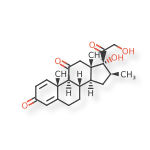
Details
| Stereochemistry | ABSOLUTE |
| Molecular Formula | C26H32O8 |
| Molecular Weight | 472.5275 |
| Optical Activity | UNSPECIFIED |
| Defined Stereocenters | 7 / 7 |
| E/Z Centers | 0 |
| Charge | 0 |
SHOW SMILES / InChI
SMILES
C[C@H]1C[C@H]2[C@@H]3CCC4=CC(=O)C=C[C@]4(C)[C@H]3C(=O)C[C@]2(C)[C@@]1(O)C(=O)COC(=O)CCC(O)=O
InChI
InChIKey=NSUOIXNBPZQTLB-JINKDHKVSA-N
InChI=1S/C26H32O8/c1-14-10-18-17-5-4-15-11-16(27)8-9-24(15,2)23(17)19(28)12-25(18,3)26(14,33)20(29)13-34-22(32)7-6-21(30)31/h8-9,11,14,17-18,23,33H,4-7,10,12-13H2,1-3H3,(H,30,31)/t14-,17-,18-,23+,24-,25-,26-/m0/s1
| Molecular Formula | C26H32O8 |
| Molecular Weight | 472.5275 |
| Charge | 0 |
| Count |
|
| Stereochemistry | ABSOLUTE |
| Additional Stereochemistry | No |
| Defined Stereocenters | 7 / 7 |
| E/Z Centers | 0 |
| Optical Activity | UNSPECIFIED |
Meprednisone, also known as NSC-63278 and Betapar, is a glucocorticoid receptor agonist.It has anti-inflammatory and immunosuppressive activity. It was approved since 1978, but its marketing in USA was discontinied since. Meprednisone is marketed in Argentina under trade name Copytren for treatment of rheumatic diseases, diseases of collagen, dermatological, gastrointestinal, respiratory and ophtalmological diseases.
Approval Year
Targets
| Primary Target | Pharmacology | Condition | Potency |
|---|---|---|---|
Target ID: CHEMBL2034 Sources: http://medkoo.com/products/10909 |
Conditions
| Condition | Modality | Targets | Highest Phase | Product |
|---|---|---|---|---|
| Palliative | BETAPAR Approved UseMeprednisone (16-β-methylprednisone) is a steroid anti-inflammatory with poor mineralocorticoid action due to the methylation of prednisone at the carbon 16 level. Corticosteroids have anti-inflammatory and immunosuppressive activity. The mechanism of anti-inflammatory action is due to the decrease of the tissue response to the inflammatory processes, without modifying the underlying causes. Steroids diffuse through the cell membrane and bind to specific cytoplasmic receptors. Then, this complex enters the nucleus, where it binds to other transcriptional factors and to DNA producing induction and repression of genes that lead to its anti-inflammatory, immunosuppressive and mild mineralocorticoid effect. Other effects are: suppression of pituitary corticotropin production leading to secondary adrenal insufficiency, decreased absorption and increased calcium excretion, increased surfactant factor production in type 2 pneumocytes, protein catabolism in lymphoid, muscle, Connective tissue and skin, hepatic gluconeogenesis with decreased peripheral glucose utilization, decreased formation and increased bone resorption. The mechanism by which corticosteroids decrease immunity involves inhibition of cell-mediated immune reactions, reduction of T lymphocyte, monocyte and eosinophil concentration, decreased binding of immunoglobulins to cell-surface receptors, and release and / or synthesis of interleukins. Launch Date1978 |
|||
| Palliative | BETAPAR Approved UseMeprednisone (16-β-methylprednisone) is a steroid anti-inflammatory with poor mineralocorticoid action due to the methylation of prednisone at the carbon 16 level. Corticosteroids have anti-inflammatory and immunosuppressive activity. The mechanism of anti-inflammatory action is due to the decrease of the tissue response to the inflammatory processes, without modifying the underlying causes. Steroids diffuse through the cell membrane and bind to specific cytoplasmic receptors. Then, this complex enters the nucleus, where it binds to other transcriptional factors and to DNA producing induction and repression of genes that lead to its anti-inflammatory, immunosuppressive and mild mineralocorticoid effect. Other effects are: suppression of pituitary corticotropin production leading to secondary adrenal insufficiency, decreased absorption and increased calcium excretion, increased surfactant factor production in type 2 pneumocytes, protein catabolism in lymphoid, muscle, Connective tissue and skin, hepatic gluconeogenesis with decreased peripheral glucose utilization, decreased formation and increased bone resorption. The mechanism by which corticosteroids decrease immunity involves inhibition of cell-mediated immune reactions, reduction of T lymphocyte, monocyte and eosinophil concentration, decreased binding of immunoglobulins to cell-surface receptors, and release and / or synthesis of interleukins. Launch Date1978 |
|||
| Primary | BETAPAR Approved UseMeprednisone (16-β-methylprednisone) is a steroid anti-inflammatory with poor mineralocorticoid action due to the methylation of prednisone at the carbon 16 level. Corticosteroids have anti-inflammatory and immunosuppressive activity. The mechanism of anti-inflammatory action is due to the decrease of the tissue response to the inflammatory processes, without modifying the underlying causes. Steroids diffuse through the cell membrane and bind to specific cytoplasmic receptors. Then, this complex enters the nucleus, where it binds to other transcriptional factors and to DNA producing induction and repression of genes that lead to its anti-inflammatory, immunosuppressive and mild mineralocorticoid effect. Other effects are: suppression of pituitary corticotropin production leading to secondary adrenal insufficiency, decreased absorption and increased calcium excretion, increased surfactant factor production in type 2 pneumocytes, protein catabolism in lymphoid, muscle, Connective tissue and skin, hepatic gluconeogenesis with decreased peripheral glucose utilization, decreased formation and increased bone resorption. The mechanism by which corticosteroids decrease immunity involves inhibition of cell-mediated immune reactions, reduction of T lymphocyte, monocyte and eosinophil concentration, decreased binding of immunoglobulins to cell-surface receptors, and release and / or synthesis of interleukins. Launch Date1978 |
|||
| Palliative | BETAPAR Approved UseMeprednisone (16-β-methylprednisone) is a steroid anti-inflammatory with poor mineralocorticoid action due to the methylation of prednisone at the carbon 16 level. Corticosteroids have anti-inflammatory and immunosuppressive activity. The mechanism of anti-inflammatory action is due to the decrease of the tissue response to the inflammatory processes, without modifying the underlying causes. Steroids diffuse through the cell membrane and bind to specific cytoplasmic receptors. Then, this complex enters the nucleus, where it binds to other transcriptional factors and to DNA producing induction and repression of genes that lead to its anti-inflammatory, immunosuppressive and mild mineralocorticoid effect. Other effects are: suppression of pituitary corticotropin production leading to secondary adrenal insufficiency, decreased absorption and increased calcium excretion, increased surfactant factor production in type 2 pneumocytes, protein catabolism in lymphoid, muscle, Connective tissue and skin, hepatic gluconeogenesis with decreased peripheral glucose utilization, decreased formation and increased bone resorption. The mechanism by which corticosteroids decrease immunity involves inhibition of cell-mediated immune reactions, reduction of T lymphocyte, monocyte and eosinophil concentration, decreased binding of immunoglobulins to cell-surface receptors, and release and / or synthesis of interleukins. Launch Date1978 |
|||
| Palliative | BETAPAR Approved UseMeprednisone (16-β-methylprednisone) is a steroid anti-inflammatory with poor mineralocorticoid action due to the methylation of prednisone at the carbon 16 level. Corticosteroids have anti-inflammatory and immunosuppressive activity. The mechanism of anti-inflammatory action is due to the decrease of the tissue response to the inflammatory processes, without modifying the underlying causes. Steroids diffuse through the cell membrane and bind to specific cytoplasmic receptors. Then, this complex enters the nucleus, where it binds to other transcriptional factors and to DNA producing induction and repression of genes that lead to its anti-inflammatory, immunosuppressive and mild mineralocorticoid effect. Other effects are: suppression of pituitary corticotropin production leading to secondary adrenal insufficiency, decreased absorption and increased calcium excretion, increased surfactant factor production in type 2 pneumocytes, protein catabolism in lymphoid, muscle, Connective tissue and skin, hepatic gluconeogenesis with decreased peripheral glucose utilization, decreased formation and increased bone resorption. The mechanism by which corticosteroids decrease immunity involves inhibition of cell-mediated immune reactions, reduction of T lymphocyte, monocyte and eosinophil concentration, decreased binding of immunoglobulins to cell-surface receptors, and release and / or synthesis of interleukins. Launch Date1978 |
Doses
| Dose | Population | Adverse events |
|---|---|---|
5 mg 1 times / day multiple, oral Recommended Dose: 5 mg, 1 times / day Route: oral Route: multiple Dose: 5 mg, 1 times / day Sources: |
unhealthy, 16-31 |
|
40 mg 2 times / day multiple, oral Studied dose Dose: 40 mg, 2 times / day Route: oral Route: multiple Dose: 40 mg, 2 times / day Sources: |
unhealthy, 71 |
Other AEs: Osteoporosis... |
AEs
| AE | Significance | Dose | Population |
|---|---|---|---|
| Osteoporosis | 40 mg 2 times / day multiple, oral Studied dose Dose: 40 mg, 2 times / day Route: oral Route: multiple Dose: 40 mg, 2 times / day Sources: |
unhealthy, 71 |
PubMed
| Title | Date | PubMed |
|---|---|---|
| [Fulminating sclerosant peritonitis. Spectacular response to treatment with steroids]. | 2010 |
|
| Henoch-Schönlein Purpura in adults. | 2008-04 |
|
| Screening of 397 chemicals and development of a quantitative structure--activity relationship model for androgen receptor antagonism. | 2008-04 |
|
| [Drug-induced lichenoid eruptions]. | 2006-04 |
|
| Prevention and treatment of rejection after simultaneous pancreas-kidney transplantation. | 2005-09 |
|
| 17alpha,21-Dihydroxy-16beta-methylpregna-1,4-diene-3,11,20-trione (meprednisone). | 2003-04 |
Patents
| Substance Class |
Chemical
Created
by
admin
on
Edited
Mon Mar 31 21:53:36 GMT 2025
by
admin
on
Mon Mar 31 21:53:36 GMT 2025
|
| Record UNII |
DT63904BCF
|
| Record Status |
Validated (UNII)
|
| Record Version |
|
-
Download
| Name | Type | Language | ||
|---|---|---|---|---|
|
Preferred Name | English | ||
|
Common Name | English | ||
|
Common Name | English | ||
|
Common Name | English | ||
|
Systematic Name | English |
| Code System | Code | Type | Description | ||
|---|---|---|---|---|---|
|
27303-92-0
Created by
admin on Mon Mar 31 21:53:36 GMT 2025 , Edited by admin on Mon Mar 31 21:53:36 GMT 2025
|
PRIMARY | |||
|
DT63904BCF
Created by
admin on Mon Mar 31 21:53:36 GMT 2025 , Edited by admin on Mon Mar 31 21:53:36 GMT 2025
|
PRIMARY | |||
|
DTXSID80693292
Created by
admin on Mon Mar 31 21:53:36 GMT 2025 , Edited by admin on Mon Mar 31 21:53:36 GMT 2025
|
PRIMARY | |||
|
53302055
Created by
admin on Mon Mar 31 21:53:36 GMT 2025 , Edited by admin on Mon Mar 31 21:53:36 GMT 2025
|
PRIMARY |
| Related Record | Type | Details | ||
|---|---|---|---|---|
|
|
ACTIVE MOIETY |