


Details
| Stereochemistry | ACHIRAL |
| Molecular Formula | C9H10Cl2N4.ClH |
| Molecular Weight | 281.569 |
| Optical Activity | NONE |
| Defined Stereocenters | 0 / 0 |
| E/Z Centers | 0 |
| Charge | 0 |
SHOW SMILES / InChI
SMILES
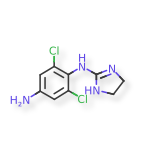
Cl.NC1=CC(Cl)=C(NC2=NCCN2)C(Cl)=C1
InChI
InChIKey=OTQYGBJVDRBCHC-UHFFFAOYSA-N
InChI=1S/C9H10Cl2N4.ClH/c10-6-3-5(12)4-7(11)8(6)15-9-13-1-2-14-9;/h3-4H,1-2,12H2,(H2,13,14,15);1H
| Molecular Formula | ClH |
| Molecular Weight | 36.461 |
| Charge | 0 |
| Count |
|
| Stereochemistry | ACHIRAL |
| Additional Stereochemistry | No |
| Defined Stereocenters | 0 / 0 |
| E/Z Centers | 0 |
| Optical Activity | NONE |
| Molecular Formula | C9H10Cl2N4 |
| Molecular Weight | 245.109 |
| Charge | 0 |
| Count |
|
| Stereochemistry | ACHIRAL |
| Additional Stereochemistry | No |
| Defined Stereocenters | 0 / 0 |
| E/Z Centers | 0 |
| Optical Activity | NONE |
DescriptionCurator's Comment: description was created based on several sources, including:
https://www.drugs.com/ppa/apraclonidine.html | https://dailymed.nlm.nih.gov/dailymed/drugInfo.cfm?setid=dc7d3a9f-c0b9-411c-9c62-0a14f1718b00
Curator's Comment: description was created based on several sources, including:
https://www.drugs.com/ppa/apraclonidine.html | https://dailymed.nlm.nih.gov/dailymed/drugInfo.cfm?setid=dc7d3a9f-c0b9-411c-9c62-0a14f1718b00
Apraclonidine (IOPIDINE) is an α2-adrenergic receptor agonist and a weak α1-adrenergic receptor agonist. It is used for the prevention and treatment of postsurgical intraocular pressure elevation. The following adverse events, occurring in less than 2% of patients, were reported in association with the use of IOPIDINE Ophthalmic Solution in laser surgery: ocular injection, upper lid elevation, irregular heart rate, nasal decongestion, ocular inflammation, conjunctival blanching, and mydriasis. Interactions with other agents have not been investigated.
Originator
Approval Year
Targets
| Primary Target | Pharmacology | Condition | Potency |
|---|---|---|---|
Target ID: P08913 Gene ID: 150.0 Gene Symbol: ADRA2A Target Organism: Homo sapiens (Human) |
|||
Conditions
| Condition | Modality | Targets | Highest Phase | Product |
|---|---|---|---|---|
| Preventing | IOPIDINE Approved UseApraclonidine hydrochloride ophthalmic solution) is indicated to control or prevent postsurgical elevations in intraocular pressure that occur in patients after argon laser trabeculplasty, argon laser iridotomy or Nd:YAG posterior capsulotomy. Launch Date1987 |
Cmax
| Value | Dose | Co-administered | Analyte | Population |
|---|---|---|---|---|
0.9 ng/mL |
1 drop 3 times / day multiple, ocular dose: 1 drop route of administration: Ocular experiment type: MULTIPLE co-administered: |
APRACLONIDINE plasma | Homo sapiens population: HEALTHY age: ADULT sex: UNKNOWN food status: UNKNOWN |
T1/2
| Value | Dose | Co-administered | Analyte | Population |
|---|---|---|---|---|
8 h |
1 drop 3 times / day multiple, ocular dose: 1 drop route of administration: Ocular experiment type: MULTIPLE co-administered: |
APRACLONIDINE plasma | Homo sapiens population: HEALTHY age: ADULT sex: UNKNOWN food status: UNKNOWN |
Funbound
| Value | Dose | Co-administered | Analyte | Population |
|---|---|---|---|---|
74.5% |
unknown, topical |
APRACLONIDINE plasma | Homo sapiens population: UNKNOWN age: UNKNOWN sex: UNKNOWN food status: UNKNOWN |
Doses
| Dose | Population | Adverse events |
|---|---|---|
0.5 % 2 times / day multiple, ophthalmic Recommended Dose: 0.5 %, 2 times / day Route: ophthalmic Route: multiple Dose: 0.5 %, 2 times / day Sources: |
unhealthy, adult Health Status: unhealthy Age Group: adult Sex: unknown Sources: |
Disc. AE: Allergic reaction... AEs leading to discontinuation/dose reduction: Allergic reaction (12.9%) Sources: |
AEs
| AE | Significance | Dose | Population |
|---|---|---|---|
| Allergic reaction | 12.9% Disc. AE |
0.5 % 2 times / day multiple, ophthalmic Recommended Dose: 0.5 %, 2 times / day Route: ophthalmic Route: multiple Dose: 0.5 %, 2 times / day Sources: |
unhealthy, adult Health Status: unhealthy Age Group: adult Sex: unknown Sources: |
PubMed
| Title | Date | PubMed |
|---|---|---|
| [Unilateral allergic contact dermatitis of the eyelid caused by Iopimax]. | 2009-12 |
|
| Current pharmacologic testing for Horner syndrome. | 2009-09 |
|
| Possible effect of systemic sympathicolytic drugs on apraclonidine test. | 2009-08 |
|
| Exposure to topical apraclonidine in children with glaucoma. | 2009-06-16 |
|
| Brimonidine and apraclonidine as vasoconstrictors in adjustable strabismus surgery. | 2009-04 |
|
| Ocular decompression retinopathy after trabeculectomy with mitomycin-C for angle recession glaucoma. | 2009-02-25 |
|
| Nd: YAG capsulotomy for posterior capsule opacification after combined clear corneal phacoemulsification and vitrectomy. | 2009-02 |
|
| [Usefulness of apraclonidine in the diagnosis of Horner syndrome]. | 2009-02 |
|
| False-negative apraclonidine testing in acute Horner syndrome. | 2009-02 |
|
| Topical apraclonidine to diagnose Bernard-Horner syndrome. | 2009 |
|
| Oral versus topical carbonic anhydrase inhibitors in ocular hypertension after scleral tunnel cataract surgery. | 2009 |
|
| Clinical efficacy and neuroprotective effects of brimonidine in the management of glaucoma and ocular hypertension. | 2009 |
|
| Recurrent serous macular detachment after topical ocular hypotensive medication. | 2008-11 |
|
| Fixed combination of topical brimonidine 0.2% and timolol 0.5% for glaucoma and uncontrolled intraocular pressure. | 2008-09 |
|
| Pupillary autonomic neuropathy simulating partial Horner syndrome in diabetes mellitus and its reversal with control of blood glucose. | 2008-09 |
|
| Positive apraclonidine test within two weeks of onset of Horner syndrome caused by carotid artery dissection. | 2008-09 |
|
| Use of 0.5% apraclonidine solution in evaluation of blepharoptosis. | 2008-07-23 |
|
| Post-penetrating keratoplasty glaucoma. | 2008-06-27 |
|
| The role of cyclosporine and mycophenolate in an orthotopic porcine-to-rat corneal xenotransplantation. | 2008-06 |
|
| False negative apraclonidine test in two patients with Horner syndrome. | 2008-05 |
|
| Central alpha-2 adrenergic eye drops: case series of 3 pediatric systemic poisonings. | 2008-03 |
|
| Effects of central corneal thickness on the efficacy of topical ocular hypotensive medications. | 2008-03 |
|
| Differences in the histopathology and matrix metalloproteinase expression in Tenon's tissue of primary open-angle glaucoma and primary angle-closure glaucoma. | 2008-03 |
|
| Acupuncture treatment for idiopathic Horner's syndrome in a dog. | 2008-03 |
|
| Medical management of primary open-angle glaucoma: Best practices associated with enhanced patient compliance and persistency. | 2008-02-02 |
|
| The pupil. | 2008-02 |
|
| [Efficacy of topic ocular hipotensive agents after posterior capsulotomy]. | 2008-01-13 |
|
| The acute morphologic changes that occur at the optic nerve head induced by medical reduction of intraocular pressure. | 2007-09 |
|
| Horner's syndrome, Pseudo-Horner's syndrome, and simple anisocoria. | 2007-09 |
|
| Congenital or acquired Horner's? | 2007-08-19 |
|
| Apraclonidine in the diagnosis of Horner's syndrome. | 2007-07 |
|
| Adverse effects of apraclonidine used in the diagnosis of Horner syndrome in infants. | 2007-06 |
|
| Pharmacologic reversal of Horner's syndrome-related ptosis with apraclonidine. | 2007-05 |
|
| Genomic and functional conservation of sedative-hypnotic targets in the zebrafish. | 2007-04 |
|
| Topical apraclonidine testing of pupillary sympathetic denervation in diabetic patients. | 2006-12 |
|
| Corneal thickness- and age-related biomechanical properties of the cornea measured with the ocular response analyzer. | 2006-12 |
|
| Efficacy of apraclonidine 0.5% in the diagnosis of Horner syndrome in pediatric patients under low or high illumination. | 2006-09 |
|
| Brinzolamide 1% versus apraclonidine 0.5% to prevent intraocular pressure elevation after neodymium:YAG laser posterior capsulotomy. | 2006-09 |
|
| Congenital Horner's syndrome and the usefulness of the apraclonidine test in its diagnosis. | 2006-09 |
|
| Antagonism by imidazoline-type drugs of muscarinic and other receptors in the guinea-pig ileum. | 2006-07 |
|
| The management of glaucoma and intraocular hypertension: current approaches and recent advances. | 2006-06 |
|
| Comparing efficacies of 0.5% apraclonidine with 4% cocaine in the diagnosis of horner syndrome in pediatric patients. | 2006-06 |
|
| The effect of topical apraclonidine on subconjunctival hemorrhage and flap adherence in LASIK patients. | 2006-06 |
|
| Reduction of anterior-segment vascularity with preoperative topical apraclonidine 1%. | 2006-04 |
|
| Topical apraclonidine testing discloses pupillary sympathetic denervation in diabetic patients. | 2006-03 |
|
| Effect of 0.5% apraclonidine on ptosis in Horner syndrome. | 2006-01-19 |
|
| Comparative efficacy of acetazolamide and apraclonidine in the control of intraocular pressure following phacoemulsification. | 2006 |
|
| Effect of apraclonidine versus dorzolamide on intraocular pressure after phacoemulsification. | 2005-12-17 |
|
| Apraclonidine and LASIK. | 2005-12 |
|
| Brimonidine 0.15% versus apraclonidine 0.5% for prevention of intraocular pressure elevation after anterior segment laser surgery. | 2005-09 |
Patents
Sample Use Guides
One drop of Ophthalmic Solution should be instilled in the scheduled operative eye one hour before initiating anterior segment laser surgery and a second drop should be instilled to the same eye immediately upon completion of the laser surgical procedure. Use a separate container for each single-drop dose and discard each container after use.
Route of Administration:
Topical
| Substance Class |
Chemical
Created
by
admin
on
Edited
Mon Mar 31 17:57:52 GMT 2025
by
admin
on
Mon Mar 31 17:57:52 GMT 2025
|
| Record UNII |
D2VW67N38H
|
| Record Status |
Validated (UNII)
|
| Record Version |
|
-
Download
| Name | Type | Language | ||
|---|---|---|---|---|
|
Preferred Name | English | ||
|
Official Name | English | ||
|
Common Name | English | ||
|
Common Name | English | ||
|
Code | English | ||
|
Common Name | English | ||
|
Common Name | English | ||
|
Common Name | English | ||
|
Common Name | English | ||
|
Common Name | English | ||
|
Common Name | English | ||
|
Code | English | ||
|
Common Name | English | ||
|
Common Name | English | ||
|
Common Name | English | ||
|
Systematic Name | English |
| Classification Tree | Code System | Code | ||
|---|---|---|---|---|
|
NCI_THESAURUS |
C29709
Created by
admin on Mon Mar 31 17:57:52 GMT 2025 , Edited by admin on Mon Mar 31 17:57:52 GMT 2025
|
| Code System | Code | Type | Description | ||
|---|---|---|---|---|---|
|
SUB12926MIG
Created by
admin on Mon Mar 31 17:57:52 GMT 2025 , Edited by admin on Mon Mar 31 17:57:52 GMT 2025
|
PRIMARY | |||
|
51763
Created by
admin on Mon Mar 31 17:57:52 GMT 2025 , Edited by admin on Mon Mar 31 17:57:52 GMT 2025
|
PRIMARY | |||
|
m2008
Created by
admin on Mon Mar 31 17:57:52 GMT 2025 , Edited by admin on Mon Mar 31 17:57:52 GMT 2025
|
PRIMARY | Merck Index | ||
|
91350
Created by
admin on Mon Mar 31 17:57:52 GMT 2025 , Edited by admin on Mon Mar 31 17:57:52 GMT 2025
|
PRIMARY | RxNorm | ||
|
CHEMBL647
Created by
admin on Mon Mar 31 17:57:52 GMT 2025 , Edited by admin on Mon Mar 31 17:57:52 GMT 2025
|
PRIMARY | |||
|
DBSALT000819
Created by
admin on Mon Mar 31 17:57:52 GMT 2025 , Edited by admin on Mon Mar 31 17:57:52 GMT 2025
|
PRIMARY | |||
|
1041609
Created by
admin on Mon Mar 31 17:57:52 GMT 2025 , Edited by admin on Mon Mar 31 17:57:52 GMT 2025
|
PRIMARY | |||
|
D2VW67N38H
Created by
admin on Mon Mar 31 17:57:52 GMT 2025 , Edited by admin on Mon Mar 31 17:57:52 GMT 2025
|
PRIMARY | |||
|
100000077408
Created by
admin on Mon Mar 31 17:57:52 GMT 2025 , Edited by admin on Mon Mar 31 17:57:52 GMT 2025
|
PRIMARY | |||
|
DTXSID6045749
Created by
admin on Mon Mar 31 17:57:52 GMT 2025 , Edited by admin on Mon Mar 31 17:57:52 GMT 2025
|
PRIMARY | |||
|
D2VW67N38H
Created by
admin on Mon Mar 31 17:57:52 GMT 2025 , Edited by admin on Mon Mar 31 17:57:52 GMT 2025
|
PRIMARY | |||
|
Z-50
Created by
admin on Mon Mar 31 17:57:52 GMT 2025 , Edited by admin on Mon Mar 31 17:57:52 GMT 2025
|
PRIMARY | |||
|
2789
Created by
admin on Mon Mar 31 17:57:52 GMT 2025 , Edited by admin on Mon Mar 31 17:57:52 GMT 2025
|
PRIMARY | |||
|
C47401
Created by
admin on Mon Mar 31 17:57:52 GMT 2025 , Edited by admin on Mon Mar 31 17:57:52 GMT 2025
|
PRIMARY | |||
|
73218-79-8
Created by
admin on Mon Mar 31 17:57:52 GMT 2025 , Edited by admin on Mon Mar 31 17:57:52 GMT 2025
|
PRIMARY |
| Related Record | Type | Details | ||
|---|---|---|---|---|
|
|
PARENT -> SALT/SOLVATE |
|
| Related Record | Type | Details | ||
|---|---|---|---|---|
|
|
ACTIVE MOIETY |
|