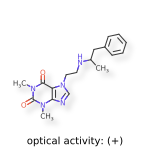
Details
| Stereochemistry | UNKNOWN |
| Molecular Formula | C18H23N5O2 |
| Molecular Weight | 341.4075 |
| Optical Activity | ( - ) |
| Defined Stereocenters | 0 / 1 |
| E/Z Centers | 0 |
| Charge | 0 |
SHOW SMILES / InChI
SMILES
CC(CC1=CC=CC=C1)NCCN2C=NC3=C2C(=O)N(C)C(=O)N3C
InChI
InChIKey=NMCHYWGKBADVMK-UHFFFAOYSA-N
InChI=1S/C18H23N5O2/c1-13(11-14-7-5-4-6-8-14)19-9-10-23-12-20-16-15(23)17(24)22(3)18(25)21(16)2/h4-8,12-13,19H,9-11H2,1-3H3
| Molecular Formula | C18H23N5O2 |
| Molecular Weight | 341.4075 |
| Charge | 0 |
| Count |
|
| Stereochemistry | RACEMIC |
| Additional Stereochemistry | No |
| Defined Stereocenters | 0 / 1 |
| E/Z Centers | 0 |
| Optical Activity | ( + / - ) |
Fenethylline (generic name Captagon) is a codrug of amphetamine and theophylline. In the fenetylline molecule, theophylline is covalently linked with amphetamine via an alkyl chain. It was formerly used to treat conditions such as ADHD, narcolepsy, and depression, but its use has been banned because of the potential for abuse. Amphetamine, an agonist for trace amine-associated receptor 1 (TAAR1) with enhancing dopamine signaling (an increase of irritability, aggression, etc.), is the main cause of Captagon addiction. Theophylline, an antagonist that blocks adenosine receptors (e.g. A2aR) in the brain responsible for restlessness and painlessness, may attenuate the behavioral sensitization caused by amphetamine. Fenethylline is included in a list of compounds to be considered by a World Health Organization (WHO) Expert Committee in April 1985 for possible international scheduling under the Convention on Psychotropic Substances, 1971. Fenethylline re-emerged because of its widespread abuse by Middle Eastern young adults. Terrorist groups such as the Islamic State to enhance what they consider desirable characteristics - aggressiveness, alertness, and fearlessness - in their recruits, promote it.
CNS Activity
Approval Year
| Substance Class |
Chemical
Created
by
admin
on
Edited
Mon Mar 31 23:18:02 GMT 2025
by
admin
on
Mon Mar 31 23:18:02 GMT 2025
|
| Record UNII |
CP55WHR66R
|
| Record Status |
Validated (UNII)
|
| Record Version |
|
-
Download
| Name | Type | Language | ||
|---|---|---|---|---|
|
Preferred Name | English | ||
|
Common Name | English | ||
|
Systematic Name | English |
| Code System | Code | Type | Description | ||
|---|---|---|---|---|---|
|
765207-54-3
Created by
admin on Mon Mar 31 23:18:02 GMT 2025 , Edited by admin on Mon Mar 31 23:18:02 GMT 2025
|
PRIMARY | |||
|
CP55WHR66R
Created by
admin on Mon Mar 31 23:18:02 GMT 2025 , Edited by admin on Mon Mar 31 23:18:02 GMT 2025
|
PRIMARY |
| Related Record | Type | Details | ||
|---|---|---|---|---|
|
|
ENANTIOMER -> ENANTIOMER |
|