


Details
| Stereochemistry | ACHIRAL |
| Molecular Formula | C12H11ClN2O5S.ClH |
| Molecular Weight | 367.205 |
| Optical Activity | NONE |
| Defined Stereocenters | 0 / 0 |
| E/Z Centers | 0 |
| Charge | 0 |
SHOW SMILES / InChI
SMILES
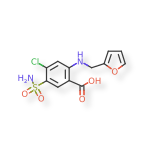
Cl.NS(=O)(=O)C1=C(Cl)C=C(NCC2=CC=CO2)C(=C1)C(O)=O
InChI
InChIKey=NXDBFIUCDBZBPP-UHFFFAOYSA-N
InChI=1S/C12H11ClN2O5S.ClH/c13-9-5-10(15-6-7-2-1-3-20-7)8(12(16)17)4-11(9)21(14,18)19;/h1-5,15H,6H2,(H,16,17)(H2,14,18,19);1H
| Molecular Formula | ClH |
| Molecular Weight | 36.461 |
| Charge | 0 |
| Count |
|
| Stereochemistry | ACHIRAL |
| Additional Stereochemistry | No |
| Defined Stereocenters | 0 / 0 |
| E/Z Centers | 0 |
| Optical Activity | NONE |
| Molecular Formula | C12H11ClN2O5S |
| Molecular Weight | 330.744 |
| Charge | 0 |
| Count |
|
| Stereochemistry | ACHIRAL |
| Additional Stereochemistry | No |
| Defined Stereocenters | 0 / 0 |
| E/Z Centers | 0 |
| Optical Activity | NONE |
DescriptionSources: http://www.drugbank.ca/drugs/DB00695Curator's Comment: Description was created based on several sources, including
https://www.drugs.com/pro/furosemide.html
Sources: http://www.drugbank.ca/drugs/DB00695
Curator's Comment: Description was created based on several sources, including
https://www.drugs.com/pro/furosemide.html
Furosemide, a sulfonamide-type loop diuretic structurally related to bumetanide, is used to manage hypertension and edema associated with congestive heart failure, cirrhosis, and renal disease, including the nephrotic syndrome. Furosemide inhibits water reabsorption in the nephron by blocking the sodium-potassium-chloride cotransporter (NKCC2) in the thick ascending limb of the loop of Henle. This is achieved through competitive inhibition at the chloride binding site on the cotransporter, thus preventing the transport of sodium from the lumen of the loop of Henle into the basolateral interstitium. Consequently, the lumen becomes more hypertonic while the interstitium becomes less hypertonic, which in turn diminishes the osmotic gradient for water reabsorption throughout the nephron. Because the thick ascending limb is responsible for 25% of sodium reabsorption in the nephron, furosemide is a very potent diuretic. Furosemide is sold under the brand name Lasix among others.
Approval Year
Targets
| Primary Target | Pharmacology | Condition | Potency |
|---|---|---|---|
Target ID: CHEMBL1874 Sources: http://www.drugbank.ca/drugs/DB00695 |
|||
Target ID: P05370 Gene ID: 24377.0 Gene Symbol: G6pdx Target Organism: Rattus norvegicus (Rat) |
0.13 mM [IC50] | ||
Target ID: P85968 Gene ID: 1.00360176E8 Gene Symbol: Pgd Target Organism: Rattus norvegicus (Rat) |
0.14 mM [IC50] | ||
Target ID: CHEMBL3286088 |
0.08 mM [IC50] | ||
Target ID: CHEMBL261 |
|||
Target ID: CHEMBL3510 |
52.0 nM [Ki] |
Conditions
| Condition | Modality | Targets | Highest Phase | Product |
|---|---|---|---|---|
| Primary | LASIX Approved UseEdema
Furosemide is indicated in adults and pediatric patients for the treatment of edema associated with congestive heart failure, cirrhosis of the liver, and renal disease, including the nephrotic syndrome. Furosemide is particularly useful when an agent with greater diuretic potential is desired.
Hypertension
Oral Furosemide may be used in adults for the treatment of hypertension alone or in combination with other antihypertensive agents. Launch Date1966 |
|||
| Primary | LASIX Approved UseEdema
Furosemide is indicated in adults and pediatric patients for the treatment of edema associated with congestive heart failure, cirrhosis of the liver, and renal disease, including the nephrotic syndrome. Furosemide is particularly useful when an agent with greater diuretic potential is desired.
Hypertension
Oral Furosemide may be used in adults for the treatment of hypertension alone or in combination with other antihypertensive agents. Launch Date1966 |
Cmax
| Value | Dose | Co-administered | Analyte | Population |
|---|---|---|---|---|
1315.34 ng/mL EXPERIMENT https://pubmed.ncbi.nlm.nih.gov/12854359 |
40 mg single, oral dose: 40 mg route of administration: Oral experiment type: SINGLE co-administered: |
FUROSEMIDE plasma | Homo sapiens population: HEALTHY age: ADULT sex: UNKNOWN food status: FASTED |
AUC
| Value | Dose | Co-administered | Analyte | Population |
|---|---|---|---|---|
3014.77 ng × h/mL EXPERIMENT https://pubmed.ncbi.nlm.nih.gov/12854359 |
40 mg single, oral dose: 40 mg route of administration: Oral experiment type: SINGLE co-administered: |
FUROSEMIDE plasma | Homo sapiens population: HEALTHY age: ADULT sex: UNKNOWN food status: FASTED |
T1/2
| Value | Dose | Co-administered | Analyte | Population |
|---|---|---|---|---|
3.1 h EXPERIMENT https://pubmed.ncbi.nlm.nih.gov/12854359 |
40 mg single, oral dose: 40 mg route of administration: Oral experiment type: SINGLE co-administered: |
FUROSEMIDE plasma | Homo sapiens population: HEALTHY age: ADULT sex: UNKNOWN food status: FASTED |
Funbound
| Value | Dose | Co-administered | Analyte | Population |
|---|---|---|---|---|
3.2% |
FUROSEMIDE plasma | Homo sapiens population: HEALTHY age: ADULT sex: UNKNOWN food status: UNKNOWN |
Overview
| CYP3A4 | CYP2C9 | CYP2D6 | hERG |
|---|---|---|---|
Drug as victim
| Target | Modality | Activity | Metabolite | Clinical evidence |
|---|---|---|---|---|
Page: 1.0 |
major | |||
| major | yes (co-administration study) Comment: probe drug substrate for renal transporters OAT1 and OAT3; clinical investigation of a probe drug cocktail containing substrates of key drug transporters (digoxin, furosemide, metformin and rosuvastatin) Page: 9.0 |
|||
| major | yes (co-administration study) Comment: probe drug substrate for renal transporters OAT1 and OAT3; clinical investigation of a probe drug cocktail containing substrates of key drug transporters (digoxin, furosemide, metformin and rosuvastatin) Page: 9.0 |
|||
Page: 6.0 |
no | |||
Page: 6.0 |
no | |||
Page: 6.0 |
no | |||
| yes | ||||
| yes | ||||
Page: 1.0 |
yes | |||
Page: 1.0 |
yes | |||
Page: 1.0 |
yes | |||
Page: 1.0 |
yes | |||
Page: 1.0 |
yes | |||
Page: 1.0 |
yes | |||
Page: 1.0 |
yes | yes (co-administration study) Comment: The time-averaged non-renal clearance (CLNR) of furosemide tended to be faster (but not significantly so) among smokers (3-methylcholanthrene (3-MC) type; a main inducer of CYP1A1/2 Page: 1.0 |
Tox targets
| Target | Modality | Activity | Metabolite | Clinical evidence |
|---|---|---|---|---|
Page: 8.0 |
PubMed
| Title | Date | PubMed |
|---|---|---|
| The intracellular localization of the mineralocorticoid receptor is regulated by 11beta-hydroxysteroid dehydrogenase type 2. | 2001-07-27 |
|
| Sensitivity of synaptic GABA(A) receptors to allosteric modulators in hippocampal oriens-alveus interneurons. | 2001-07 |
|
| The effects of enalapril-digoxin-diuretic combination therapy on nutritional and anthropometric indices in chronic congestive heart failure: preliminary findings in cardiac cachexia. | 2001-06 |
|
| Urolithiasis in the low birth weight infant: the role and efficacy of extracorporeal shock wave lithotripsy. | 2001-06 |
|
| Angiotensin converting enzyme inhibition worsens the excretory phase of diuretic renography for obstructive hydronephrosis. | 2001-06 |
|
| Supranormal differential renal function is real but may be pathological: assessment by 99m technetium mercaptoacetyltriglycine renal scan of congenital unilateral hydronephrosis. | 2001-06 |
|
| Dynamic characteristics and underlying mechanisms of renal blood flow autoregulation in the conscious dog. | 2001-06 |
|
| Perturbation of the pump-leak balance for Na(+) and K(+) in malaria-infected erythrocytes. | 2001-06 |
|
| [Extrarenal effects of furosemide on normal and ischemic cerebral tissue in the rat]. | 2001-05-11 |
|
| Ethanol-induced swelling in neonatal rat primary astrocyte cultures. | 2001-05-11 |
|
| Fatal portal hypertension, liver failure, and mitochondrial dysfunction after HIV-1 nucleoside analogue-induced hepatitis and lactic acidaemia. | 2001-05-05 |
|
| Heterogeneous susceptibility of GABA(A) receptor-mediated IPSCs to depolarization-induced suppression of inhibition in rat hippocampus. | 2001-05-01 |
|
| Natriuresis and "dilutional" hyponatremia after infusion of glycine 1.5%. | 2001-05 |
|
| Taurocholic acid-induced secretion in normal and cystic fibrosis mouse ileum. | 2001-05 |
|
| Pulmonary edema: new insight on pathogenesis and treatment. | 2001-05 |
|
| Effects of inhalation of albuterol sulphate, ipratroprium bromide and frusemide on breathing mechanics and gas exchange in healthy exercising horses. | 2001-05 |
|
| Long-term treatment of patients with inappropriate secretion of antidiuretic hormone by the vasopressin receptor antagonist conivaptan, urea, or furosemide. | 2001-05 |
|
| Chloride channels regulate HIT cell volume but cannot fully account for swelling-induced insulin secretion. | 2001-05 |
|
| Nephrocalcinosis induced by furosemide in an adult patient with incomplete renal tubular acidosis. | 2001-05 |
|
| Effects of albumin/furosemide mixtures on responses to furosemide in hypoalbuminemic patients. | 2001-05 |
|
| Diamidine compounds: selective uptake and targeting in Plasmodium falciparum. | 2001-05 |
|
| Identification and characterization of human organic anion transporter 3 expressing predominantly in the kidney. | 2001-05 |
|
| Interaction of serotonin and cholecystokinin in the lateral parabrachial nucleus to control sodium intake. | 2001-05 |
|
| Uptake mechanism of valproic acid in human placental choriocarcinoma cell line (BeWo). | 2001-04-13 |
|
| Deterioration of left ventricular chamber performance after bed rest : "cardiovascular deconditioning" or hypovolemia? | 2001-04-10 |
|
| Maxi K+ channels co-localised with CFTR in the apical membrane of an exocrine gland acinus: possible involvement in secretion. | 2001-04 |
|
| Effect of salicis cortex extract on human platelet aggregation. | 2001-04 |
|
| Improvement in site-specific intestinal absorption of furosemide by Eudragit L100-55. | 2001-04 |
|
| Acute effects of the anti-inflammatory cyclooxygenase-2 selective inhibitor, flosulide, on renal plasma flow and glomerular filtration rate in rats. | 2001-04 |
|
| Furosemide-probenecid interaction as a laboratory exercise for undergraduate education in clinical pharmacology. | 2001-04 |
|
| Pressure-independent enhancement of cardiac hypertrophy in natriuretic peptide receptor A-deficient mice. | 2001-04 |
|
| Aspirin inhibits the acute venodilator response to furosemide in patients with chronic heart failure. | 2001-04 |
|
| ATP stimulates calcium-dependent glutamate release from cultured astrocytes. | 2001-04 |
|
| Systemic sclerosis (scleroderma). A case of recovery of cardiomyopathy after vitamin E treatment. | 2001-04 |
|
| Chronic tubulointerstitial nephritis and distal renal tubular acidosis in a patient with frusemide abuse. | 2001-04 |
|
| [Generalized edema following insulin treatment of newly diagnosed diabetes mellitus]. | 2001-03-20 |
|
| Pediatric renal transplantation: anesthesia and perioperative complications. | 2001-03 |
|
| Long-term efficacy of torsemide compared with frusemide in cirrhotic patients with ascites. | 2001-03 |
|
| The appropriateness of drug use in an older nondemented and demented population. | 2001-03 |
|
| Multi-slice CT urography after diuretic injection: initial results. | 2001-03 |
|
| Humoral hypercalcemia of malignancy in squamous cell carcinoma of the skin: parathyroid hormone--related protein as a cause. | 2001-03 |
|
| Estimation of the probability for exceeding a threshold concentration of furosemide at various intervals after intravenous administration in horses. | 2001-03 |
|
| Effect of furosemide on basal lamina anionic sites in guinea pig labyrinth. | 2001-03 |
|
| Statistical evaluation of the regulatory guidelines for use of furosemide in race horses. | 2001-03 |
|
| Haemoconcentration, shear-stress increase and carotid artery diameter regulation after furosemide administration in older hypertensives. | 2001-03 |
|
| Towards evidence based emergency medicine: best BETs from the Manchester Royal Infirmary. Frusemide or nitrates in acute left ventricular failure. | 2001-01 |
|
| Role of the renal kallikrein-kinin system in the development of salt-sensitive hypertension. | 2001-01 |
|
| The loop diuretic torasemide interferes with endothelin-1 actions in the aorta of hypertensive rats. | 2001 |
|
| Effects of loop diuretics on angiotensin II-stimulated vascular smooth muscle cell growth. | 2001 |
|
| Should celecoxib be contraindicated in patients who are allergic to sulfonamides? Revisiting the meaning of 'sulfa' allergy. | 2001 |
Patents
Sample Use Guides
The usual initial dose of LASIX is 20 to 80 mg given as a single dose. Ordinarily a prompt diuresis ensues. If needed, the same dose can be administered 6 to 8 hours later or the dose may be increased. The dose may be raised by 20 or 40 mg and given not sooner than 6 to 8 hours after the previous dose until the desired diuretic effect has been obtained. The individually determined single dose should then be given once or twice daily (eg, at 8 am and 2 pm). The dose of LASIX may be carefully titrated up to 600 mg/day in patients with clinically severe edematous states.
Route of Administration:
Oral
| Substance Class |
Chemical
Created
by
admin
on
Edited
Wed Apr 02 13:51:04 GMT 2025
by
admin
on
Wed Apr 02 13:51:04 GMT 2025
|
| Record UNII |
95B2QX2E2W
|
| Record Status |
Validated (UNII)
|
| Record Version |
|
-
Download
| Name | Type | Language | ||
|---|---|---|---|---|
|
Preferred Name | English | ||
|
Common Name | English | ||
|
Systematic Name | English | ||
|
Systematic Name | English |
| Code System | Code | Type | Description | ||
|---|---|---|---|---|---|
|
54583777
Created by
admin on Wed Apr 02 13:51:04 GMT 2025 , Edited by admin on Wed Apr 02 13:51:04 GMT 2025
|
PRIMARY | |||
|
95B2QX2E2W
Created by
admin on Wed Apr 02 13:51:04 GMT 2025 , Edited by admin on Wed Apr 02 13:51:04 GMT 2025
|
PRIMARY | |||
|
42461-27-8
Created by
admin on Wed Apr 02 13:51:04 GMT 2025 , Edited by admin on Wed Apr 02 13:51:04 GMT 2025
|
PRIMARY |
| Related Record | Type | Details | ||
|---|---|---|---|---|
|
PARENT -> SALT/SOLVATE |
|
| Related Record | Type | Details | ||
|---|---|---|---|---|
|
ACTIVE MOIETY |
|