


Details
| Stereochemistry | ABSOLUTE |
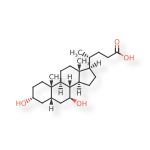
| Molecular Formula | C24H40O4.H2O4S |
| Molecular Weight | 490.65 |
| Optical Activity | UNSPECIFIED |
| Defined Stereocenters | 10 / 10 |
| E/Z Centers | 0 |
| Charge | 0 |
SHOW SMILES / InChI
SMILES
OS(O)(=O)=O.C[C@H](CCC(O)=O)[C@H]1CC[C@H]2[C@@H]3[C@@H](O)C[C@@H]4C[C@H](O)CC[C@]4(C)[C@H]3CC[C@]12C
InChI
InChIKey=NTHFOQKLSZUQTR-FUXQPCDDSA-N
InChI=1S/C24H40O4.H2O4S/c1-14(4-7-21(27)28)17-5-6-18-22-19(9-11-24(17,18)3)23(2)10-8-16(25)12-15(23)13-20(22)26;1-5(2,3)4/h14-20,22,25-26H,4-13H2,1-3H3,(H,27,28);(H2,1,2,3,4)/t14-,15+,16-,17-,18+,19+,20+,22+,23+,24-;/m1./s1
| Molecular Formula | C24H40O4 |
| Molecular Weight | 392.572 |
| Charge | 0 |
| Count |
|
| Stereochemistry | ABSOLUTE |
| Additional Stereochemistry | No |
| Defined Stereocenters | 10 / 10 |
| E/Z Centers | 0 |
| Optical Activity | UNSPECIFIED |
| Molecular Formula | H2O4S |
| Molecular Weight | 98.078 |
| Charge | 0 |
| Count |
|
| Stereochemistry | ACHIRAL |
| Additional Stereochemistry | No |
| Defined Stereocenters | 0 / 0 |
| E/Z Centers | 0 |
| Optical Activity | NONE |
DescriptionCurator's Comment: description was created based on several sources, including:
http://www.drugbank.ca/drugs/DB01586
Curator's Comment: description was created based on several sources, including:
http://www.drugbank.ca/drugs/DB01586
Ursodiol tablets, USP are bile acids indicated for the treatment of patients with primary biliary cirrhosis. Ursodiol (Ursodeoxycholic acid), a naturally occurring hydrophilic bile acid, derived from cholesterol, is present as a minor fraction of the total human bile acid pool. Ursodeoxycholic acid reduces elevated liver enzyme levels by facilitating bile flow through the liver and protecting liver cells. The main mechanism if anticholelithic. Although the exact process of ursodiol's anticholelithic action is not completely understood, it is thought that the drug is concentrated in bile and decreases biliary cholesterol by suppressing hepatic synthesis and secretion of cholesterol and by inhibiting its intestinal absorption. The reduced cholesterol saturation permits the gradual solubilization of cholesterol from gallstones, resulting in their eventual dissolution. In addition to the replacement and displacement of toxic bile acids, other mechanisms of action include cytoprotection of the injured bile duct epithelial cells (cholangiocytes) against toxic effects of bile acids, inhibition of apotosis of hepatocytes, immunomodulatory effects, and stimulation of bile secretion by hepatocytes and cholangiocytes. Neither accidental nor intentional overdosing with ursodeoxycholic acid has been reported. Doses of ursodeoxycholic acid in the range of 16-20 mg/kg/day have been tolerated for 6-37 months without symptoms by 7 patients. The LD50 for ursodeoxycholic acid in rats is over 5000 mg/kg given over 7-10 days and over 7500 mg/kg for mice. The most likely manifestation of severe overdose with ursodeoxycholic acid would probably be diarrhea, which should be treated symptomatically.
CNS Activity
Approval Year
Cmax
| Value | Dose | Co-administered | Analyte | Population |
|---|---|---|---|---|
15.2 μM EXPERIMENT https://pubmed.ncbi.nlm.nih.gov/22414767 |
15 mg/kg bw 1 times / day multiple, oral dose: 15 mg/kg bw route of administration: Oral experiment type: MULTIPLE co-administered: |
URSODIOL plasma | Homo sapiens population: HEALTHY age: ADULT sex: FEMALE food status: FED |
AUC
| Value | Dose | Co-administered | Analyte | Population |
|---|---|---|---|---|
49.8 μM × h EXPERIMENT https://pubmed.ncbi.nlm.nih.gov/22414767 |
15 mg/kg bw 1 times / day multiple, oral dose: 15 mg/kg bw route of administration: Oral experiment type: MULTIPLE co-administered: |
URSODIOL plasma | Homo sapiens population: HEALTHY age: ADULT sex: FEMALE food status: FED |
Doses
| Dose | Population | Adverse events |
|---|---|---|
50 mg/kg 3 times / day multiple, oral Highest studied dose Dose: 50 mg/kg, 3 times / day Route: oral Route: multiple Dose: 50 mg/kg, 3 times / day Sources: |
unhealthy, 37-65 |
|
500 mg 2 times / day multiple, oral Recommended Dose: 500 mg, 2 times / day Route: oral Route: multiple Dose: 500 mg, 2 times / day Sources: |
unhealthy Health Status: unhealthy Sources: |
Disc. AE: Nausea... AEs leading to discontinuation/dose reduction: Nausea (1.7%) Sources: |
AEs
| AE | Significance | Dose | Population |
|---|---|---|---|
| Nausea | 1.7% Disc. AE |
500 mg 2 times / day multiple, oral Recommended Dose: 500 mg, 2 times / day Route: oral Route: multiple Dose: 500 mg, 2 times / day Sources: |
unhealthy Health Status: unhealthy Sources: |
Overview
| CYP3A4 | CYP2C9 | CYP2D6 | hERG |
|---|---|---|---|
Drug as perpetrator
| Target | Modality | Activity | Metabolite | Clinical evidence |
|---|---|---|---|---|
| yes [Inhibition 20 uM] | ||||
| yes | no (co-administration study) Comment: UDCA did not lead to detectable changes in midazolam pharmacokinetics |
|||
| yes | weak (co-administration study) Comment: UDCA modestly decreased digoxin disposition without |
PubMed
| Title | Date | PubMed |
|---|---|---|
| Functional modulation of the glucocorticoid receptor and suppression of NF-kappaB-dependent transcription by ursodeoxycholic acid. | 2001-12-14 |
|
| Antiepileptic drugs increase plasma levels of 4beta-hydroxycholesterol in humans: evidence for involvement of cytochrome p450 3A4. | 2001-10-19 |
|
| Disrupted bile acid homeostasis reveals an unexpected interaction among nuclear hormone receptors, transporters, and cytochrome P450. | 2001-10-19 |
|
| Treatment of primary biliary cirrhosis. | 2001-10-12 |
|
| A preliminary trial of high-dose ursodeoxycholic acid in primary sclerosing cholangitis. | 2001-10 |
|
| [Correction of metabolic disturbances in patients with cholestasis]. | 2001-09-19 |
|
| The natural history of primary biliary cirrhosis: of genes and cooperation. | 2001-09 |
|
| Apolipoprotein E polymorphism, a marker of disease severity in primary biliary cirrhosis? | 2001-09 |
|
| Ursodeoxycholic acid and in vitro vasoactivity of hydrophobic bile acids. | 2001-09 |
|
| Geranylgeraniol, an intermediate product in mevalonate pathway, induces apoptotic cell death in human hepatoma cells: death receptor-independent activation of caspase-8 with down-regulation of Bcl-xL expression. | 2001-09 |
|
| Ten-year combination treatment with colchicine and ursodeoxycholic acid for primary biliary cirrhosis: a double-blind, placebo-controlled trial on symptomatic patients. | 2001-09 |
|
| Biliary excretion of tauroursodeoxycholate-3-sulfate in the rat. | 2001-09 |
|
| Crystal structure of human type III 3alpha-hydroxysteroid dehydrogenase/bile acid binding protein complexed with NADP(+) and ursodeoxycholate. | 2001-08-28 |
|
| Effect of bile acids on formation of azoxymethane-induced aberrant crypt foci in colostomized F344 rat colon. | 2001-08-28 |
|
| Micronuclei induction, cell cycle delay and apoptosis as markers of cellular stress caused by ursodeoxycholic acid in human lymphocytes. | 2001-08-22 |
|
| Stimulation of ATP secretion in the liver by therapeutic bile acids. | 2001-08-15 |
|
| Prevention and treatment of veno-occlusive disease. | 2001-08-04 |
|
| Prevention of colon cancer with ursodiol in ulcerative colitis. | 2001-08 |
|
| Lichenoid eruptions due to ursodeoxycholic acid administration. | 2001-08 |
|
| Ursodiol prevents UC-associated CRC. | 2001-08 |
|
| Ursodeoxycholic acid causing exacerbation of dermatitis herpetiformis. | 2001-08 |
|
| Jaundice in non-cirrhotic primary biliary cirrhosis: the premature ductopenic variant. | 2001-08 |
|
| [Effects of bile acid preparations on DNA biosynthesis, apoptosis, and necrosis in hepatocytes in vitro]. | 2001-07-14 |
|
| Ursodeoxycholic acid 'mechanisms of action and clinical use in hepatobiliary disorders'. | 2001-07 |
|
| Fetal bile acid metabolism: analysis of urinary 3beta-monohydroxy-delta(5) bile acid in preterm infants. | 2001-07 |
|
| Rapid progress of acute suppurative cholangitis to secondary sclerosing cholangitis sequentially followed-up by endoscopic retrograde cholangiography. | 2001-07 |
|
| A case of autoimmune hepatitis with a high titer of antimitochondrial antibody and normal gamma-globulinemia. | 2001-07 |
|
| Effects of ursodeoxycholic and cholic acid feeding on hepatocellular transporter expression in mouse liver. | 2001-07 |
|
| Bile acid hydrophobicity is correlated with induction of apoptosis and/or growth arrest in HCT116 cells. | 2001-06-01 |
|
| Effect of bile acids on the proliferative activity and apoptosis of rat hepatocytes. | 2001-06 |
|
| Effect of ursodeoxycholate in University of Wisconsin solution on long term preservation of rat livers. | 2001-06 |
|
| Ofloxacin and ursodeoxycholic acid versus ursodeoxycholic acid alone to prevent occlusion of biliary stents: a prospective, randomized trial. | 2001-06 |
|
| Effect of bezafibrate in primary biliary cirrhosis: a pilot study. | 2001-06 |
|
| Effect of bile salts on colonic mucus secretion in isolated vascularly perfused rat colon. | 2001-06 |
|
| Alterations in tight junctions differ between primary biliary cirrhosis and primary sclerosing cholangitis. | 2001-06 |
|
| Deoxycholic acid suppresses p53 by stimulating proteasome-mediated p53 protein degradation. | 2001-06 |
|
| Low in vivo toxicity of a novel cisplatin-ursodeoxycholic derivative (Bamet-UD2) with enhanced cytostatic activity versus liver tumors. | 2001-06 |
|
| Enhancement of endothelial nitric oxide production by chenodeoxycholic acids in patients with hepatobiliary diseases. | 2001-05 |
|
| Synthetic bile acid derivatives induce nonapoptotic death of human retinal pigment epithelial cells. | 2001-05 |
|
| Ursodeoxycholic acid for primary biliary cirrhosis: lesson for the future? | 2001-05 |
|
| Cytokine network in nonresponding chronic hepatitis C patients with genotype 1: role of triple therapy with interferon alpha, ribavirin, and ursodeoxycholate. | 2001-05 |
|
| Autoimmune liver disease. Current standards, future directions. | 2001-05 |
|
| High-dose ursodeoxycholic acid as a therapy for patients with primary sclerosing cholangitis. | 2001-05 |
|
| Isoursodeoxycholic acid: metabolism and therapeutic effects in primary biliary cirrhosis. | 2001-05 |
|
| Ursodeoxycholic acid for the treatment of intrahepatic cholestasis of pregnancy. | 2001-04 |
|
| Primary biliary cirrhosis: from induction to destruction. | 2001-04 |
|
| Genetic disorders and molecular mechanisms in cholestatic liver disease--a clinical approach. | 2001-04 |
|
| Drug-induced cholestasis. | 2001-04 |
|
| [Ursodeoxycholic acid as the main treatment of hepatobiliary diseases in children and teenagers]. | 2001 |
|
| Suppression of renal disease and mortality in the female NZB x NZW F1 mouse model of systemic lupus erythematosus (SLE) by chenodeoxycholic acid. | 2001 |
| Substance Class |
Chemical
Created
by
admin
on
Edited
Wed Apr 02 10:43:21 GMT 2025
by
admin
on
Wed Apr 02 10:43:21 GMT 2025
|
| Record UNII |
84SS8Q4EEQ
|
| Record Status |
Validated (UNII)
|
| Record Version |
|
-
Download
| Name | Type | Language | ||
|---|---|---|---|---|
|
Common Name | English | ||
|
Preferred Name | English | ||
|
Systematic Name | English | ||
|
Systematic Name | English |
| Code System | Code | Type | Description | ||
|---|---|---|---|---|---|
|
163203609
Created by
admin on Wed Apr 02 10:43:21 GMT 2025 , Edited by admin on Wed Apr 02 10:43:21 GMT 2025
|
PRIMARY | |||
|
84SS8Q4EEQ
Created by
admin on Wed Apr 02 10:43:21 GMT 2025 , Edited by admin on Wed Apr 02 10:43:21 GMT 2025
|
PRIMARY | |||
|
130588-30-6
Created by
admin on Wed Apr 02 10:43:21 GMT 2025 , Edited by admin on Wed Apr 02 10:43:21 GMT 2025
|
NON-SPECIFIC STOICHIOMETRY |
| Related Record | Type | Details | ||
|---|---|---|---|---|
|
PARENT -> SALT/SOLVATE |
|
| Related Record | Type | Details | ||
|---|---|---|---|---|
|
ACTIVE MOIETY |
|