Details
| Stereochemistry | ACHIRAL |
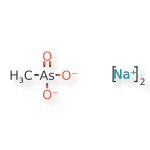
| Molecular Formula | CH3AsO3.2Na.6H2O |
| Molecular Weight | 292.0255 |
| Optical Activity | NONE |
| Defined Stereocenters | 0 / 0 |
| E/Z Centers | 0 |
| Charge | 0 |
SHOW SMILES / InChI
SMILES
O.O.O.O.O.O.[Na+].[Na+].C[As]([O-])([O-])=O
InChI
InChIKey=HPWNDUPOECNNLK-UHFFFAOYSA-L
InChI=1S/CH5AsO3.2Na.6H2O/c1-2(3,4)5;;;;;;;;/h1H3,(H2,3,4,5);;;6*1H2/q;2*+1;;;;;;/p-2
| Molecular Formula | Na |
| Molecular Weight | 22.98976928 |
| Charge | 1 |
| Count |
|
| Stereochemistry | ACHIRAL |
| Additional Stereochemistry | No |
| Defined Stereocenters | 0 / 0 |
| E/Z Centers | 0 |
| Optical Activity | NONE |
| Molecular Formula | H2O |
| Molecular Weight | 18.0153 |
| Charge | 0 |
| Count |
|
| Stereochemistry | ACHIRAL |
| Additional Stereochemistry | No |
| Defined Stereocenters | 0 / 0 |
| E/Z Centers | 0 |
| Optical Activity | NONE |
| Molecular Formula | CH5AsO3 |
| Molecular Weight | 139.9702 |
| Charge | 0 |
| Count |
|
| Stereochemistry | ACHIRAL |
| Additional Stereochemistry | No |
| Defined Stereocenters | 0 / 0 |
| E/Z Centers | 0 |
| Optical Activity | NONE |
Methylarsonic acid, monosodium salt is an organoarsenic compound formed from the methylation of inorganic arsenic by living organisms. Methylarsonate is used as a contact herbicide in either the monosodium or disodium salt form. It goes by the trade names Weed-E-Rad, Ansar 170 H.C., Ansar 529 H.C., DiTac and others. Methylarsonate is considered only slightly toxic, having an oral LD50 of 2200 mg/Kg for rats. The inhalation risk is greater with LD50 Rats >20 mg. Long term studies with people exposed to organoarsenicals has shown an increased risk of skin cancer (Spiewak, 2001), lung cancer and some liver cancers, although some recent studies have shown some arsenic containing compounds (specifically Arsine trioxide) may have anticarcinogenic properties (Wang, 2001). In mammals, Methylarsonate is also an intermediate in the detoxification of inorganic arsenic. In the arsenate detoxification I pathway, arsenite reacts with S-adenosyl-L-methionine to produce methylarsonate and S-adenosyl-L-homocysteine. Arsenite methyltransferase catalyzes this reaction. Methylarsonate then reacts with 2 glutathione molecules to produce glutathione disulfide and methylarsonite. This reaction is catalyzed by methylarsonate reductase. Methylarsonate is an organic arsenic compound with adverse effects similar to those of arsenic trioxide. Methylarsonate was formerly included in some vitamin and mineral preparations. It was once used to treat tuberculosis, chorea, and other affections in which the cacodylates were used.
CNS Activity
Approval Year
PubMed
| Title | Date | PubMed |
|---|---|---|
| Arsenic exposure disrupts the normal function of the FA/BRCA repair pathway. | 2014-11 |
|
| Methylarsonous acid causes oxidative DNA damage in cells independent of the ability to biomethylate inorganic arsenic. | 2014-02 |
|
| SLCO1B1 variants and urine arsenic metabolites in the Strong Heart Family Study. | 2013-11 |
|
| N-6-adenine-specific DNA methyltransferase 1 (N6AMT1) polymorphisms and arsenic methylation in Andean women. | 2013-07 |
|
| Evaluation of gene expression changes in human primary uroepithelial cells following 24-hr exposures to inorganic arsenic and its methylated metabolites. | 2013-03 |
|
| Methylation of arsenic by recombinant human wild-type arsenic (+3 oxidation state) methyltransferase and its methionine 287 threonine (M287T) polymorph: Role of glutathione. | 2012-10-01 |
|
| Alternative splicing variants of human arsenic (+3 oxidation state) methyltransferase. | 2011-11-11 |
|
| A pathway-based analysis of urinary arsenic metabolites and skin lesions. | 2011-04-01 |
|
| Adventitious arsenate reductase activity of the catalytic domain of the human Cdc25B and Cdc25C phosphatases. | 2010-02-02 |
|
| Effects of endogenous hydrogen peroxide and glutathione on the stability of arsenic metabolites in rat bile. | 2008-10-01 |
|
| Elevation of 8-hydroxydeoxyguanosine and cell proliferation via generation of oxidative stress by organic arsenicals contributes to their carcinogenicity in the rat liver and bladder. | 2007-06-15 |
|
| Molecular mechanisms of the diabetogenic effects of arsenic: inhibition of insulin signaling by arsenite and methylarsonous acid. | 2007-05 |
|
| Arsenic methylation, GSTT1, GSTM1, GSTP1 polymorphisms, and skin lesions. | 2007-03 |
|
| Mammalian glucose permease GLUT1 facilitates transport of arsenic trioxide and methylarsonous acid. | 2006-12-15 |
|
| Chronic exposure to methylated arsenicals stimulates arsenic excretion pathways and induces arsenic tolerance in rat liver cells. | 2006-05 |
|
| Preventive mechanism of cellular glutathione in monomethylarsonic acid-induced cytolethality. | 2005-08-01 |
|
| Developmentally restricted genetic determinants of human arsenic metabolism: association between urinary methylated arsenic and CYT19 polymorphisms in children. | 2005-06 |
|
| Biokinetics and subchronic toxic effects of oral arsenite, arsenate, monomethylarsonic acid, and dimethylarsinic acid in v-Ha-ras transgenic (Tg.AC) mice. | 2004-08 |
|
| Genetic variation in genes associated with arsenic metabolism: glutathione S-transferase omega 1-1 and purine nucleoside phosphorylase polymorphisms in European and indigenous Americans. | 2003-08 |
|
| Promoting effects of monomethylarsonic acid, dimethylarsinic acid and trimethylarsine oxide on induction of rat liver preneoplastic glutathione S-transferase placental form positive foci: a possible reactive oxygen species mechanism. | 2002-07-10 |
Sample Use Guides
Methylarsonate is considered only slightly toxic, having an oral LD50 of 2200 mg/Kg for rats.
Route of Administration:
Oral
Arsenate and arsenic trioxide (As(2) O(3) ) inhibited the proliferation of A375 and B16F10 cells significantly at concentration ranges of 0.1-20ug/ml (P<0.001), while the organic compounds arsenobetaine, arsenocholine, dimethylarsinic acid, methylarsonic acid, tetramethylarsonium and trimethylarsine oxide did not show any inhibitory effects even at 20ug/ml.
| Substance Class |
Chemical
Created
by
admin
on
Edited
Mon Mar 31 22:40:39 GMT 2025
by
admin
on
Mon Mar 31 22:40:39 GMT 2025
|
| Record UNII |
5UTW98B9D2
|
| Record Status |
Validated (UNII)
|
| Record Version |
|
-
Download
| Name | Type | Language | ||
|---|---|---|---|---|
|
Systematic Name | English | ||
|
Preferred Name | English | ||
|
Brand Name | English | ||
|
Systematic Name | English | ||
|
Brand Name | English | ||
|
Brand Name | English | ||
|
Brand Name | English | ||
|
Common Name | English | ||
|
Systematic Name | English | ||
|
Brand Name | English | ||
|
Systematic Name | English | ||
|
Brand Name | English | ||
|
Common Name | English | ||
|
Common Name | English |
| Code System | Code | Type | Description | ||
|---|---|---|---|---|---|
|
DTXSID5058438
Created by
admin on Mon Mar 31 22:40:39 GMT 2025 , Edited by admin on Mon Mar 31 22:40:39 GMT 2025
|
PRIMARY | |||
|
5UTW98B9D2
Created by
admin on Mon Mar 31 22:40:39 GMT 2025 , Edited by admin on Mon Mar 31 22:40:39 GMT 2025
|
PRIMARY | |||
|
5967-62-4
Created by
admin on Mon Mar 31 22:40:39 GMT 2025 , Edited by admin on Mon Mar 31 22:40:39 GMT 2025
|
PRIMARY | |||
|
30277
Created by
admin on Mon Mar 31 22:40:39 GMT 2025 , Edited by admin on Mon Mar 31 22:40:39 GMT 2025
|
PRIMARY | |||
|
160801
Created by
admin on Mon Mar 31 22:40:39 GMT 2025 , Edited by admin on Mon Mar 31 22:40:39 GMT 2025
|
PRIMARY |
| Related Record | Type | Details | ||
|---|---|---|---|---|
|
ANHYDROUS->SOLVATE |