


Details
| Stereochemistry | ABSOLUTE |
| Molecular Formula | C20H27N5O2.C10H18O |
| Molecular Weight | 523.71 |
| Optical Activity | UNSPECIFIED |
| Defined Stereocenters | 3 / 3 |
| E/Z Centers | 0 |
| Charge | 0 |
SHOW SMILES / InChI
SMILES
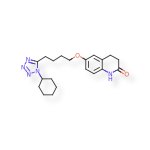
CC1(C)[C@@H]2CC[C@@]1(C)[C@@H](O)C2.O=C3CCC4=C(N3)C=CC(OCCCCC5=NN=NN5C6CCCCC6)=C4
InChI
InChIKey=GYOUKZRGDOIBGD-VTLWDLMQSA-N
InChI=1S/C20H27N5O2.C10H18O/c26-20-12-9-15-14-17(10-11-18(15)21-20)27-13-5-4-8-19-22-23-24-25(19)16-6-2-1-3-7-16;1-9(2)7-4-5-10(9,3)8(11)6-7/h10-11,14,16H,1-9,12-13H2,(H,21,26);7-8,11H,4-6H2,1-3H3/t;7-,8+,10+/m.1/s1
| Molecular Formula | C20H27N5O2 |
| Molecular Weight | 369.4607 |
| Charge | 0 |
| Count |
|
| Stereochemistry | ACHIRAL |
| Additional Stereochemistry | No |
| Defined Stereocenters | 0 / 0 |
| E/Z Centers | 0 |
| Optical Activity | NONE |
| Molecular Formula | C10H18O |
| Molecular Weight | 154.2493 |
| Charge | 0 |
| Count |
|
| Stereochemistry | ABSOLUTE |
| Additional Stereochemistry | No |
| Defined Stereocenters | 3 / 3 |
| E/Z Centers | 0 |
| Optical Activity | UNSPECIFIED |
DescriptionCurator's Comment: description was created based on several sources, including https://www.ncbi.nlm.nih.gov/pubmed/11830753
Curator's Comment: description was created based on several sources, including https://www.ncbi.nlm.nih.gov/pubmed/11830753
Cilostazol is a PDE3 inhibitor which is used for the treatment of intermittent claudication. The drug positively affects the platelet aggregation and may be used off-label as a measure to prevent coronary thrombosis/restenosis and stroke recurrence.
Originator
Approval Year
Targets
| Primary Target | Pharmacology | Condition | Potency |
|---|---|---|---|
Target ID: CHEMBL2094125 |
0.57 µM [IC50] |
Conditions
| Condition | Modality | Targets | Highest Phase | Product |
|---|---|---|---|---|
| Palliative | CILOSTAZOL Approved UseCilostazol tablets are indicated for the reduction of symptoms of intermittent claudication, as indicated by an increased walking distance. Launch Date2004 |
Cmax
| Value | Dose | Co-administered | Analyte | Population |
|---|---|---|---|---|
701 ng/mL EXPERIMENT https://www.ncbi.nlm.nih.gov/pubmed/31372190 |
100 mg single, oral dose: 100 mg route of administration: Oral experiment type: SINGLE co-administered: |
CILOSTAZOL plasma | Homo sapiens population: HEALTHY age: ADULT sex: FEMALE / MALE food status: FASTED |
AUC
| Value | Dose | Co-administered | Analyte | Population |
|---|---|---|---|---|
13724 ng × h/mL EXPERIMENT https://www.ncbi.nlm.nih.gov/pubmed/31372190 |
100 mg single, oral dose: 100 mg route of administration: Oral experiment type: SINGLE co-administered: |
CILOSTAZOL plasma | Homo sapiens population: HEALTHY age: ADULT sex: FEMALE / MALE food status: FASTED |
T1/2
| Value | Dose | Co-administered | Analyte | Population |
|---|---|---|---|---|
13.5 h EXPERIMENT https://www.ncbi.nlm.nih.gov/pubmed/31372190 |
100 mg single, oral dose: 100 mg route of administration: Oral experiment type: SINGLE co-administered: |
CILOSTAZOL plasma | Homo sapiens population: HEALTHY age: ADULT sex: FEMALE / MALE food status: FASTED |
Funbound
| Value | Dose | Co-administered | Analyte | Population |
|---|---|---|---|---|
3.5% |
CILOSTAZOL plasma | Homo sapiens population: UNKNOWN age: UNKNOWN sex: UNKNOWN food status: UNKNOWN |
PubMed
| Title | Date | PubMed |
|---|---|---|
| Adenosine receptors and phosphodiesterase inhibitors stimulate Cl- secretion in Calu-3 cells. | 2003-09 |
|
| A paclitaxel-eluting stent for the prevention of coronary restenosis. | 2003-04-17 |
|
| Pharmacotherapy as adjunctive treatment for serious foot wounds in the patient with diabetes: a case study. | 2003-04 |
|
| Effect of cilostazol on the ventricular escape rate and neurohumoral factors in patients with third-degree atrioventricular block. | 2003-04 |
|
| Cilostazol: an "intermittent claudication" remedy for the management of third-degree AV block. | 2003-04 |
|
| Effects of cilostazol on serum lipid concentrations and plasma fatty acid composition in type 2 diabetic patients with peripheral vascular disease. | 2003-02 |
|
| Inhibitory action of cilostazol, a phosphodiesterase III inhibitor, on catecholamine secretion from cultured bovine adrenal chromaffin cells. | 2003-01 |
|
| Meta-analysis of results from eight randomized, placebo-controlled trials on the effect of cilostazol on patients with intermittent claudication. | 2002-12-15 |
|
| Pharmacotherapy for peripheral arterial disease: emerging therapeutic options. | 2002-12-05 |
|
| Can claudication be improved with medication? | 2002-12 |
|
| Effect of cilostazol on treadmill walking, community-based walking ability, and health-related quality of life in patients with intermittent claudication due to peripheral arterial disease: meta-analysis of six randomized controlled trials. | 2002-12 |
|
| Pharmacologic therapy for peripheral arterial disease and claudication. | 2002-12 |
|
| Spontaneous recanalization of arterial occlusions: an unusual mechanism for symptomatic improvement. | 2002-12 |
|
| Clinical manifestation of atherosclerotic peripheral arterial disease and the role of cilostazol in treatment of intermittent claudication. | 2002-12 |
|
| Thermally-prepared polymorphic forms of cilostazol. | 2002-12 |
|
| Modulation of the erythropoietin-induced proliferative pathway by cAMP in vascular smooth muscle cells. | 2002-12 |
|
| Management of patients with intermittent claudication. | 2002-11 |
|
| Failure of pentoxifylline or cilostazol to improve blood and plasma viscosity, fibrinogen, and erythrocyte deformability in claudication. | 2002-10-09 |
|
| Effects of cilostazol, a selective cyclic AMP phosphodiesterase inhibitor on isolated rabbit spinal arterioles. | 2002-10 |
|
| Cilostazol, a potent phosphodiesterase type III inhibitor, selectively increases antiatherogenic high-density lipoprotein subclass LpA-I and improves postprandial lipemia in patients with type 2 diabetes mellitus. | 2002-10 |
|
| New mechanism of action for cilostazol: interplay between adenosine and cilostazol in inhibiting platelet activation. | 2002-10 |
|
| Debulking and stenting versus debulking only of coronary artery disease in patients treated with cilostazol (final results of ESPRIT). | 2002-09-15 |
|
| Comparison of the effects of cilostazol and milrinone on cAMP-PDE activity, intracellular cAMP and calcium in the heart. | 2002-09 |
|
| [State of treatment of coronary artery disease by drug releasing stents]. | 2002-09 |
|
| Identification of interaction sites of cyclic nucleotide phosphodiesterase type 3A with milrinone and cilostazol using molecular modeling and site-directed mutagenesis. | 2002-09 |
|
| Randomized comparison of cilostazol versus ticlopidine hydrochloride for antiplatelet therapy after coronary stent implantation for prevention of late restenosis. | 2002-08 |
|
| Polymorphic forms of cilostazol. | 2002-08 |
|
| Prevention of ventricular fibrillation by cilostazol, an oral phosphodiesterase inhibitor, in a patient with Brugada syndrome. | 2002-07 |
|
| Potential emerging therapeutic strategies to prevent restenosis in the peripheral vasculature. | 2002-07 |
|
| Cilostazol enhances IL-1beta-induced NO production and apoptosis in rat vascular smooth muscle via PKA-dependent pathway. | 2002-07 |
|
| [Effect of cilostazol on adhesion molecules of STZ-induced diabetic rats]. | 2002-06-10 |
|
| Peripheral arterial disease. | 2002-06 |
|
| [Antiproliferative coated stents and intracoronary brachytherapy: common traits and differences]. | 2002-06 |
|
| A rational approach to diagnosis and treatment of intermittent claudication. | 2002-05 |
|
| Effect of cilostazol in patients with intermittent claudication: a randomized, double-blind, placebo-controlled study. | 2002-04-16 |
|
| Pharmacokinetic and pharmacodynamic modeling of the antiplatelet and cardiovascular effects of cilostazol in healthy humans. | 2002-04 |
|
| The herbal medicine Dai-kenchu-to and one of its active components [6]-shogaol increase intestinal blood flow in rats. | 2002-03-15 |
|
| Treating peripheral arterial disease in patients with diabetes. | 2002-03 |
|
| Evidence-based symptom relief of intermittent claudication: efficacy and safety of cilostazol. | 2002-03 |
|
| The pharmacology of cilostazol. | 2002-03 |
|
| Recent advances in antiplatelet agents. | 2002-03 |
|
| Effects of a single oral dose of cilostazol on epicardial coronary arteries and hemodynamics in humans. | 2002-03 |
|
| Measuring treatment effects of cilostazol on clinical trial endpoints in patients with intermittent claudication. | 2002-03 |
|
| Cilostazol. | 2002-02-01 |
|
| A phosphodiesterase inhibitor, cilostazol, prevents the onset of silent brain infarction in Japanese subjects with Type II diabetes. | 2002-02 |
|
| [Etiology, pathogenesis and management of senile inflammatory pulmonary diseases]. | 2002-01 |
|
| Pharmacologic treatment for intermittent claudication. | 2002 |
|
| Cilostazol treatment of claudication in diabetic patients. | 2002 |
|
| Rapid ventricular tachycardias associated with cilostazol use. | 2002 |
|
| Three cases of digital ischemia successfully treated with cilostazol. | 2001-11 |
Sample Use Guides
The recommended dosage of cilostazol tablets is 100 mg b.i.d. taken at least half an hour before or 2 hours after breakfast and dinner.
Route of Administration:
Oral
In vitro assay of anti-platelet effects of cilostazol against collagen-induced aggregation using Multiplate produced a graded dose-dependent inhibition curve with IC50 value of 75.4 ± 2.4 uM while it showed a highly sensitive and all-or-none type inhibition response from 25 uM in PFA-100.
| Substance Class |
Chemical
Created
by
admin
on
Edited
Wed Apr 02 17:38:43 GMT 2025
by
admin
on
Wed Apr 02 17:38:43 GMT 2025
|
| Record UNII |
463NWV9Y86
|
| Record Status |
Validated (UNII)
|
| Record Version |
|
-
Download
| Name | Type | Language | ||
|---|---|---|---|---|
|
Preferred Name | English |
| Code System | Code | Type | Description | ||
|---|---|---|---|---|---|
|
463NWV9Y86
Created by
admin on Wed Apr 02 17:38:43 GMT 2025 , Edited by admin on Wed Apr 02 17:38:43 GMT 2025
|
PRIMARY | |||
|
169490784
Created by
admin on Wed Apr 02 17:38:43 GMT 2025 , Edited by admin on Wed Apr 02 17:38:43 GMT 2025
|
PRIMARY |
| Related Record | Type | Details | ||
|---|---|---|---|---|
|
PARENT -> SALT/SOLVATE |
|
| Related Record | Type | Details | ||
|---|---|---|---|---|
|
ACTIVE MOIETY |
|