


DescriptionCurator's Comment: description was created based on several sources, including
https://www.ncbi.nlm.nih.gov/mesh/68002741
Curator's Comment: description was created based on several sources, including
https://www.ncbi.nlm.nih.gov/mesh/68002741
Chlorotrianisene (TACE®) is a powerful synthetic, non-steroidal estrogen used to treat symptoms of menopause, deficiencies in ovary function (including underdevelopment of female sexual characteristics and some types of infertility), and in rare cases, prostate cancer. It may also be used to prevent breast engorgement following childbirth. Chlorotrianisene (TACE®) binds to the estrogen receptor on various estrogen receptor bearing cells. Target cells include cells in the female reproductive tract, the mammary gland, the hypothalamus, and the pituitary. Estrogens increase the hepatic synthesis of sex hormone binding globulin (SHBG), thyroid-binding globulin (TBG), and other serum proteins and suppress follicle-stimulating hormone (FSH) from the anterior pituitary.
Approval Year
Targets
| Primary Target | Pharmacology | Condition | Potency |
|---|---|---|---|
Target ID: CHEMBL2094114 |
Conditions
| Condition | Modality | Targets | Highest Phase | Product |
|---|---|---|---|---|
| Palliative | TACE Approved UseUsed to treat symptoms of menopause, deficiencies in ovary function (including underdevelopment of female sexual characteristics and some types of infertility), and in rare cases, prostate cancer. Chlorotrianisene may also be used to prevent breast engorgement following childbirth. |
|||
| Curative | TACE Approved UseUsed to treat symptoms of menopause, deficiencies in ovary function (including underdevelopment of female sexual characteristics and some types of infertility), and in rare cases, prostate cancer. Chlorotrianisene may also be used to prevent breast engorgement following childbirth. |
|||
| Palliative | TACE Approved UseUsed to treat symptoms of menopause, deficiencies in ovary function (including underdevelopment of female sexual characteristics and some types of infertility), and in rare cases, prostate cancer. Chlorotrianisene may also be used to prevent breast engorgement following childbirth. |
|||
| Preventing | TACE Approved UseUsed to treat symptoms of menopause, deficiencies in ovary function (including underdevelopment of female sexual characteristics and some types of infertility), and in rare cases, prostate cancer. Chlorotrianisene may also be used to prevent breast engorgement following childbirth. |
PubMed
| Title | Date | PubMed |
|---|---|---|
| FDA-approved drugs and other compounds tested as inhibitors of human glutathione transferase P1-1. | 2013-09-05 |
|
| Treatments for suppression of lactation. | 2009-01-21 |
|
| An inventory of yeast proteins associated with nucleolar and ribosomal components. | 2006 |
|
| Tracing the origins of COX-2 inhibitors' structures. | 2002-08 |
|
| The effect of chlorotrianisene as postpartum lactation suppression on blood coagulation factors. | 1979-07-01 |
|
| The choice of estrogen preparations in the treatment of prostatic cancer. | 1975-11-08 |
|
| Hydroxyurea in stage D carcinoma of the prostate: a pilot study. | 1975-09 |
Patents
Sample Use Guides
Rat pituitary gland cells (2 x 10^5/dish) were cultured for 8 days with medium containing chlorotrianisene (TACE) or its demethylated derivative,
1,1,2-tri(4-hydroxyphenyl)chloroethylene (TCE), alone or with E2 (0.1 or 1 nM). TCE was a partial estrogen with antiestrogenic properties against E2 (0.1 nM). The antiestrogenic effect could also be reversed by increasing the concentration of E2 10-fold. TACE was less estrogenic and a less potent E2 antagonist.
| Substance Class |
Protein
Created
by
admin
on
Edited
Tue Apr 01 17:04:44 GMT 2025
by
admin
on
Tue Apr 01 17:04:44 GMT 2025
|
| Protein Type | PEPTIDE |
| Protein Sub Type | |
| Sequence Origin | HUMAN |
| Sequence Type | COMPLETE |
| Record UNII |
37OV8A66E1
|
| Record Status |
Validated (UNII)
|
| Record Version |
|
-
Download
| Name | Type | Language | ||
|---|---|---|---|---|
|
Preferred Name | English | ||
|
Common Name | English | ||
|
Common Name | English | ||
|
Common Name | English | ||
|
Common Name | English | ||
|
Common Name | English |
| Code System | Code | Type | Description | ||
|---|---|---|---|---|---|
|
P78536
Created by
admin on Tue Apr 01 17:04:44 GMT 2025 , Edited by admin on Tue Apr 01 17:04:44 GMT 2025
|
PRIMARY | |||
|
37OV8A66E1
Created by
admin on Tue Apr 01 17:04:44 GMT 2025 , Edited by admin on Tue Apr 01 17:04:44 GMT 2025
|
PRIMARY | |||
|
37OV8A66E1
Created by
admin on Tue Apr 01 17:04:44 GMT 2025 , Edited by admin on Tue Apr 01 17:04:44 GMT 2025
|
PRIMARY |
| From | To |
|---|---|
| 1_11 | 1_119 |
| 1_151 | 1_255 |
| 1_209 | 1_239 |
| 1_320 | 1_341 |
| 1_359 | 1_368 |
| 1_364 | 1_377 |
| 1_379 | 1_386 |
| Glycosylation Type | HUMAN |
| Glycosylation Link Type | Site |
|---|---|
| N | 1_50 |
| N | 1_238 |
| N | 1_284 |
| N | 1_325 |
| N | 1_337 |
| N | 1_380 |
| Related Record | Type | Details | ||
|---|---|---|---|---|
|
INHIBITOR -> TARGET |
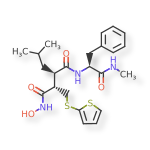
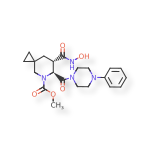
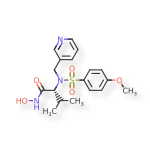
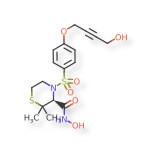
It also potently inhibits TNF?-converting enzyme (IC50 = 14.9 nM).
IC50
|
||
|
INHIBITOR -> TARGET |
|
||
|
|
INHIBITOR->OFF-TARGET |
IC50
|
||
|
INHIBITOR -> TARGET |
|
Structural Modifications
| Modification Type | Location Site | Location Type | Residue Modified | Extent | Fragment Name | Fragment Approval |
|---|---|---|---|---|---|---|
| AMINO_ACID_SUBSTITUTION | [1_553] [1_577] [1_605] | SITE_SPECIFIC | S | DEXFOSFOSERINE | VI4F0K069V | |
| AMINO_ACID_SUBSTITUTION | [1_521] [1_547] | SITE_SPECIFIC | T | THREONINE PHOSPHATE | 3L4WX7B1EI |
| Name | Property Type | Amount | Referenced Substance | Defining | Parameters | References |
|---|---|---|---|---|---|---|
| Molecular Formula | CHEMICAL |
|
||||
| MOL_WEIGHT | CHEMICAL |
|