


Details
| Stereochemistry | ACHIRAL |
| Molecular Formula | C9H9N3O2.ClH |
| Molecular Weight | 227.648 |
| Optical Activity | NONE |
| Defined Stereocenters | 0 / 0 |
| E/Z Centers | 0 |
| Charge | 0 |
SHOW SMILES / InChI
SMILES
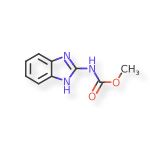
Cl.COC(=O)NC1=NC2=C(N1)C=CC=C2
InChI
InChIKey=JXBLYSQTCABEMR-UHFFFAOYSA-N
InChI=1S/C9H9N3O2.ClH/c1-14-9(13)12-8-10-6-4-2-3-5-7(6)11-8;/h2-5H,1H3,(H2,10,11,12,13);1H
| Molecular Formula | C9H9N3O2 |
| Molecular Weight | 191.1867 |
| Charge | 0 |
| Count |
|
| Stereochemistry | ACHIRAL |
| Additional Stereochemistry | No |
| Defined Stereocenters | 0 / 0 |
| E/Z Centers | 0 |
| Optical Activity | NONE |
| Molecular Formula | ClH |
| Molecular Weight | 36.461 |
| Charge | 0 |
| Count |
|
| Stereochemistry | ACHIRAL |
| Additional Stereochemistry | No |
| Defined Stereocenters | 0 / 0 |
| E/Z Centers | 0 |
| Optical Activity | NONE |
Carbendazim is a broad-spectrum benzimidazole antifungal with potential antimitotic and antineoplastic activities widely used as a fungicide in agriculture and home gardening, and as an antihelminthic in veterinary medicine. As a fungicide, carbendazim used for controls Ascomycetes, Fungi Imperfecti, and Basidiomycetes on a wide variety of crops, including bananas, cereals, cotton, fruits, grapes, mushrooms, ornamentals, peanuts, sugarbeet, soybeans, tobacco, and vegetables. Carbendazim is a chemically stable and relatively persistent fungicide which only metabolizes to a limited extent in plants and in soil. The only detected metabolite is 2-aminobenzimidazole, which constitutes less than 5% of the total residues in leaves. Carbendazim may be anticipated to metabolize in the animal into hydroxylated analogues which may appear in meat and milk products. Carbendazim acts as a mitotic poison by altering tubulin binding and microtubule formation. This has been proposed as a possible mechanism of action for the developmental abnormalities seen in animal studies with high concentrations.
Approval Year
PubMed
| Title | Date | PubMed |
|---|---|---|
| Pesticide residues on the external surfaces of field crop sprayers: occupational exposure. | 2005-06 |
|
| Determination of pesticides in apple-based infant foods using liquid chromatography electrospray ionization tandem mass spectrometry. | 2005-02-09 |
|
| Quantification of the particle method for chemotactic bioassay using Peronosporomycete zoospores. | 2005-01-26 |
|
| Dose-dependent effects of carbendazim on rat thymus. | 2004-12-08 |
|
| Pesticide levels in surface waters in an agricultural-forestry basin in Southern Chile. | 2004-11 |
|
| Modeling the dietary pesticide exposures of young children. | 2004-10-12 |
|
| Simultaneous separation and on-line concentration of amitrole and benzimidazole pesticides by capillary electrophoresis with a volatile migration buffer applicable to mass spectrometric detection. | 2004-10-08 |
|
| Endocrine-disrupting activity in carbendazim-induced reproductive and developmental toxicity in rats. | 2004-10-08 |
|
| Determination of tridemorph and other fungicide residues in fruit samples by liquid chromatography-electrospray tandem mass spectrometry. | 2004-08-06 |
|
| Pesticide residues on the external surfaces of field-crop sprayers: environmental impact. | 2004-08 |
|
| Repeated dose 28-day oral toxicity study in Wistar rats with a mixture of five pesticides often found as residues in food: alphacypermethrin, bromopropylate, carbendazim, chlorpyrifos and mancozeb. | 2004-08 |
|
| Implications of fungicidal effects of benzimidazole compounds on Duddingtonia flagrans in integrated nematode parasite management in livestock. | 2004-07 |
|
| 2,5-hexanedione and carbendazim coexposure synergistically disrupts rat spermatogenesis despite opposing molecular effects on microtubules. | 2004-07 |
|
| Determination of carbendazim, thiabendazole, and o-phenylphenol residues in lemons by HPLC following sample clean-up by ion-pairing. | 2004-06 |
|
| [Induction and genetic analysis of laboratory mutants of Gibberella zeae resistance to carbendazim]. | 2004-04 |
|
| A mini-bag technique for evaluation of fungicide effects on Trichoderma spp in mushroom compost. | 2004-04 |
|
| A benzimidazole fungicide, benomyl, and its metabolite, carbendazim, induce aromatase activity in a human ovarian granulose-like tumor cell line (KGN). | 2004-04 |
|
| Use of terrestrial model ecosystem data in environmental risk assessment for industrial chemicals, biocides and plant protection products in the EU. | 2004-03-03 |
|
| The use of integrated soil microcosms to assess the impact of carbendazim on soil ecosystems. | 2004-03-03 |
|
| Ring-testing and field-validation of a terrestrial model ecosystem (TME)--an instrument for testing potentially harmful substances: effects of carbendazim on organic matter breakdown and soil fauna feeding activity. | 2004-03-03 |
|
| Ring-testing and field-validation of a terrestrial model ecosystem (TME)--an instrument for testing potentially harmful substances: effects of carbendazim on nutrient cycling. | 2004-03-03 |
|
| Ring-testing and field-validation of a terrestrial model ecosystem (TME)--an instrument for testing potentially harmful substances: effects of carbendazim on earthworms. | 2004-03-03 |
|
| Ring-testing and field-validation of a terrestrial model ecosystem (TME)--an instrument for testing potentially harmful substances: effects of carbendazim on enchytraeids. | 2004-03-03 |
|
| Ring-testing and field-validation of a terrestrial model ecosystem (TME)--an instrument for testing potentially harmful substances: effects of carbendazim on soil microarthropod communities. | 2004-03-03 |
|
| Ring-testing and field-validation of a terrestrial model ecosystem (TME)--an instrument for testing potentially harmful substances: effects of carbendazim on nematodes. | 2004-03-03 |
|
| Ring-testing and field-validation of a terrestrial model ecosystem (TME)--an instrument for testing potentially harmful substances: effects of carbendazim on soil microbial parameters. | 2004-03-03 |
|
| Ring-testing and field-validation of a terrestrial model ecosystem (TME)--an instrument for testing potentially harmful substances: fate of the model chemical carbendazim. | 2004-03-03 |
|
| Optimization of a matrix solid-phase dispersion method for the determination analysis of carbendazim residue in plant material. | 2004-02-05 |
|
| [Pathogenicity of fungi isolated from American ginseng seeds and bioassay of fungicides against the pathogenic fungi]. | 2004-02 |
|
| Assessing structural and functional plankton responses to carbendazim toxicity. | 2004-02 |
|
| Biology and integrated control of Pestalotiopsis on container-grown ericaceous crops. | 2004-02 |
|
| Microwave-assisted extraction for the simultaneous determination of thiamethoxam, imidacloprid, and carbendazim residues in fresh and cooked vegetable samples. | 2004-01-14 |
|
| Discovering modes of action for therapeutic compounds using a genome-wide screen of yeast heterozygotes. | 2004-01-09 |
|
| Adsorption, transformation, and bioavailability of the fungicides carbendazim and iprodione in soil, alone and in combination. | 2004-01 |
|
| Re-identification and characterization of pathogens causing ugurassa (Flacourtia inermis) fruit anthracnose. | 2004-01 |
|
| Fungicidal impact on chickpea--Mesorhizobium symbiosis. | 2004 |
|
| Down regulation of humoral immunity in chickens due to carbendazim. | 2003-11-06 |
|
| Persistence of the fungicides thiabendazole, carbendazim and prochloraz-Mn in mushroom casing soil. | 2003-11 |
|
| Investigation of preconcentration strategies for the trace analysis of multi-residue pesticides in real samples by capillary electrophoresis. | 2003-10-03 |
|
| [Effects of pesticide-contamination on population size and denitrification activity of denitrifying bacteria in paddy soils]. | 2003-10 |
|
| Cynodontin: a fungal metabolite with antifungal properties. | 2003-08-13 |
|
| Carbendazim and metalaxyl residues in post-harvest treated apples. | 2003-08 |
|
| Occurrence of pesticide residues in mushrooms in Northern Ireland, July 1997-January 1999. | 2003-08 |
|
| Determination of seventeen polar/thermolabile pesticides in apples and apricots by liquid chromatography/mass spectrometry. | 2003-07-11 |
|
| The alga Chlamydomonas reinhardtii UVS11 gene is responsible for cell division delay and temporal decrease in histone H1 kinase activity caused by UV irradiation. | 2003-06-11 |
|
| [Genetics of resistance to carbendazim in Gibberella zeae]. | 2003-05 |
|
| Simultaneous analysis of carbamate pesticides in tap and raw water by LC/ESI/MS. | 2003-04 |
|
| Application of GRAM and TLD to the resolution and quantitation of real complex multicomponent mixtures by fluorescence spectroscopy. | 2003-04 |
|
| [Presearch on preventing the medicinal plant diseases with Trichoderma harzianum preparation]. | 2003-01 |
|
| Activity of some chemicals in the control of Botrytis cinerea on roses. | 2003 |
Patents
| Substance Class |
Chemical
Created
by
admin
on
Edited
Mon Mar 31 22:15:49 GMT 2025
by
admin
on
Mon Mar 31 22:15:49 GMT 2025
|
| Record UNII |
31SOI468G0
|
| Record Status |
Validated (UNII)
|
| Record Version |
|
-
Download
| Name | Type | Language | ||
|---|---|---|---|---|
|
Common Name | English | ||
|
Preferred Name | English | ||
|
Common Name | English | ||
|
Common Name | English | ||
|
Common Name | English |
| Code System | Code | Type | Description | ||
|---|---|---|---|---|---|
|
DTXSID8058370
Created by
admin on Mon Mar 31 22:15:49 GMT 2025 , Edited by admin on Mon Mar 31 22:15:49 GMT 2025
|
PRIMARY | |||
|
31900
Created by
admin on Mon Mar 31 22:15:49 GMT 2025 , Edited by admin on Mon Mar 31 22:15:49 GMT 2025
|
PRIMARY | |||
|
253-554-2
Created by
admin on Mon Mar 31 22:15:49 GMT 2025 , Edited by admin on Mon Mar 31 22:15:49 GMT 2025
|
PRIMARY | |||
|
31SOI468G0
Created by
admin on Mon Mar 31 22:15:49 GMT 2025 , Edited by admin on Mon Mar 31 22:15:49 GMT 2025
|
PRIMARY | |||
|
37574-18-8
Created by
admin on Mon Mar 31 22:15:49 GMT 2025 , Edited by admin on Mon Mar 31 22:15:49 GMT 2025
|
PRIMARY |
| Related Record | Type | Details | ||
|---|---|---|---|---|
|
|
PARENT -> SALT/SOLVATE |
| Related Record | Type | Details | ||
|---|---|---|---|---|
|
|
ACTIVE MOIETY |