


Details
| Stereochemistry | EPIMERIC |
| Molecular Formula | C6H14N4O2.C5H9NO3S |
| Molecular Weight | 337.396 |
| Optical Activity | UNSPECIFIED |
| Defined Stereocenters | 1 / 2 |
| E/Z Centers | 0 |
| Charge | 0 |
SHOW SMILES / InChI
SMILES
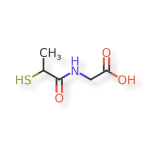
CC(S)C(=O)NCC(O)=O.N[C@@H](CCCNC(N)=N)C(O)=O
InChI
InChIKey=CFAXANACVDYTPS-WCCKRBBISA-N
InChI=1S/C6H14N4O2.C5H9NO3S/c7-4(5(11)12)2-1-3-10-6(8)9;1-3(10)5(9)6-2-4(7)8/h4H,1-3,7H2,(H,11,12)(H4,8,9,10);3,10H,2H2,1H3,(H,6,9)(H,7,8)/t4-;/m0./s1
| Molecular Formula | C5H9NO3S |
| Molecular Weight | 163.195 |
| Charge | 0 |
| Count |
|
| Stereochemistry | RACEMIC |
| Additional Stereochemistry | No |
| Defined Stereocenters | 0 / 1 |
| E/Z Centers | 0 |
| Optical Activity | ( + / - ) |
| Molecular Formula | C6H14N4O2 |
| Molecular Weight | 174.201 |
| Charge | 0 |
| Count |
|
| Stereochemistry | ABSOLUTE |
| Additional Stereochemistry | No |
| Defined Stereocenters | 1 / 1 |
| E/Z Centers | 0 |
| Optical Activity | UNSPECIFIED |
DescriptionSources: https://dailymed.nlm.nih.gov/dailymed/drugInfo.cfm?setid=494a714e-923c-cd57-df6c-12886afb265aCurator's Comment: description was created based on several sources, including:
http://www.drugbank.ca/drugs/DB06823
https://en.wikipedia.org/wiki/Tiopronin
Sources: https://dailymed.nlm.nih.gov/dailymed/drugInfo.cfm?setid=494a714e-923c-cd57-df6c-12886afb265a
Curator's Comment: description was created based on several sources, including:
http://www.drugbank.ca/drugs/DB06823
https://en.wikipedia.org/wiki/Tiopronin
Tiopronin is a prescription thiol drug used primarily in the treatment of severe homozygous cystinuria. Patients with cystinuria excrete high levels of cystine in their urine and are at risk for kidney stone formation. Tiopronin is used as a second-line therapy to control the rate of cystine precipitation and excretion, and prevent kidney stone formation. It is used after a failure of the non-pharmacological first line treatment consisting of increased fluid intake, restriction of sodium and protein, and urinary alkalinization. As cystinuria is a relatively rare disease, tiopronin is classified as an orphan drug and is not patented in the United States. It is similar to d-penicillamine in use and efficacy, but offers the advantage of far less adverse effects. Tiopronin is dosed on an individual basis using close monitoring of urinary cystine concentrations and urinary output. Tiopronin is a chelating agent. It works by removing extra cystine (the cause of kidney stones) from the urine, which keeps the kidney stones from forming. It works by reacting with urinary cysteine to form a more soluble, disulfide linked, tiopronin-cysteine complex.
Approval Year
Cmax
| Value | Dose | Co-administered | Analyte | Population |
|---|---|---|---|---|
3.6 μg/mL EXPERIMENT https://www.ncbi.nlm.nih.gov/pubmed/1505618 |
500 mg single, oral dose: 500 mg route of administration: Oral experiment type: SINGLE co-administered: |
TIOPRONIN plasma | Homo sapiens population: HEALTHY age: ADULT sex: MALE food status: UNKNOWN |
AUC
| Value | Dose | Co-administered | Analyte | Population |
|---|---|---|---|---|
29 μg × h/mL EXPERIMENT https://www.ncbi.nlm.nih.gov/pubmed/1505618 |
500 mg single, oral dose: 500 mg route of administration: Oral experiment type: SINGLE co-administered: |
TIOPRONIN plasma | Homo sapiens population: HEALTHY age: ADULT sex: MALE food status: UNKNOWN |
T1/2
| Value | Dose | Co-administered | Analyte | Population |
|---|---|---|---|---|
18.7 h EXPERIMENT https://www.ncbi.nlm.nih.gov/pubmed/1505618 |
500 mg single, oral dose: 500 mg route of administration: Oral experiment type: SINGLE co-administered: |
TIOPRONIN plasma | Homo sapiens population: HEALTHY age: ADULT sex: MALE food status: UNKNOWN |
Doses
| Dose | Population | Adverse events |
|---|---|---|
1 g 3 times / day multiple, oral Highest studied dose Dose: 1 g, 3 times / day Route: oral Route: multiple Dose: 1 g, 3 times / day Sources: |
unhealthy, 43-74 |
|
1 g 1 times / day multiple, oral Highest studied dose Dose: 1 g, 1 times / day Route: oral Route: multiple Dose: 1 g, 1 times / day Sources: |
unhealthy, 56.7 |
Other AEs: Proteinuria, Stomatitis... Other AEs: Proteinuria (4 patients) Sources: Stomatitis (3 patients) Itching (2 patients) Discomfort epigastric (1 patient) |
0.267 g 3 times / day multiple, oral Recommended Dose: 0.267 g, 3 times / day Route: oral Route: multiple Dose: 0.267 g, 3 times / day Sources: |
unhealthy Health Status: unhealthy Sources: |
Other AEs: Anemia, Nausea... Other AEs: Anemia (6%) Sources: Nausea (12%) Emesis Diarrhea (6%) Abdominal pain (6%) Oral ulceration (18%) Fever Weakness (12%) Fatigue Edema peripheral (6%) Chest pain (6%) Anorexia Arthralgia (12%) Proteinuria (6%) Impotence (6%) Cough (6%) Rash (12%) Ecchymosis Pruritus (6%) Urticaria Skin wrinkling (6%) |
0.267 g 3 times / day multiple, oral Recommended Dose: 0.267 g, 3 times / day Route: oral Route: multiple Dose: 0.267 g, 3 times / day Sources: |
unhealthy Health Status: unhealthy Sources: |
Other AEs: Anemia, Nausea... Other AEs: Anemia (2%) Sources: Nausea (25%) Emesis (10%) Diarrhea (18%) Abdominal pain Oral ulceration (12%) Fever (8%) Weakness (4%) Fatigue (14%) Edema peripheral (6%) Chest pain Anorexia (8%) Arthralgia Proteinuria (10%) Impotence Cough Rash (14%) Ecchymosis (6%) Pruritus (4%) Urticaria (8%) Skin wrinkling (6%) |
AEs
| AE | Significance | Dose | Population |
|---|---|---|---|
| Discomfort epigastric | 1 patient | 1 g 1 times / day multiple, oral Highest studied dose Dose: 1 g, 1 times / day Route: oral Route: multiple Dose: 1 g, 1 times / day Sources: |
unhealthy, 56.7 |
| Itching | 2 patients | 1 g 1 times / day multiple, oral Highest studied dose Dose: 1 g, 1 times / day Route: oral Route: multiple Dose: 1 g, 1 times / day Sources: |
unhealthy, 56.7 |
| Stomatitis | 3 patients | 1 g 1 times / day multiple, oral Highest studied dose Dose: 1 g, 1 times / day Route: oral Route: multiple Dose: 1 g, 1 times / day Sources: |
unhealthy, 56.7 |
| Proteinuria | 4 patients | 1 g 1 times / day multiple, oral Highest studied dose Dose: 1 g, 1 times / day Route: oral Route: multiple Dose: 1 g, 1 times / day Sources: |
unhealthy, 56.7 |
| Anorexia | 0.267 g 3 times / day multiple, oral Recommended Dose: 0.267 g, 3 times / day Route: oral Route: multiple Dose: 0.267 g, 3 times / day Sources: |
unhealthy Health Status: unhealthy Sources: |
|
| Ecchymosis | 0.267 g 3 times / day multiple, oral Recommended Dose: 0.267 g, 3 times / day Route: oral Route: multiple Dose: 0.267 g, 3 times / day Sources: |
unhealthy Health Status: unhealthy Sources: |
|
| Emesis | 0.267 g 3 times / day multiple, oral Recommended Dose: 0.267 g, 3 times / day Route: oral Route: multiple Dose: 0.267 g, 3 times / day Sources: |
unhealthy Health Status: unhealthy Sources: |
|
| Fatigue | 0.267 g 3 times / day multiple, oral Recommended Dose: 0.267 g, 3 times / day Route: oral Route: multiple Dose: 0.267 g, 3 times / day Sources: |
unhealthy Health Status: unhealthy Sources: |
|
| Fever | 0.267 g 3 times / day multiple, oral Recommended Dose: 0.267 g, 3 times / day Route: oral Route: multiple Dose: 0.267 g, 3 times / day Sources: |
unhealthy Health Status: unhealthy Sources: |
|
| Urticaria | 0.267 g 3 times / day multiple, oral Recommended Dose: 0.267 g, 3 times / day Route: oral Route: multiple Dose: 0.267 g, 3 times / day Sources: |
unhealthy Health Status: unhealthy Sources: |
|
| Arthralgia | 12% | 0.267 g 3 times / day multiple, oral Recommended Dose: 0.267 g, 3 times / day Route: oral Route: multiple Dose: 0.267 g, 3 times / day Sources: |
unhealthy Health Status: unhealthy Sources: |
| Nausea | 12% | 0.267 g 3 times / day multiple, oral Recommended Dose: 0.267 g, 3 times / day Route: oral Route: multiple Dose: 0.267 g, 3 times / day Sources: |
unhealthy Health Status: unhealthy Sources: |
| Rash | 12% | 0.267 g 3 times / day multiple, oral Recommended Dose: 0.267 g, 3 times / day Route: oral Route: multiple Dose: 0.267 g, 3 times / day Sources: |
unhealthy Health Status: unhealthy Sources: |
| Weakness | 12% | 0.267 g 3 times / day multiple, oral Recommended Dose: 0.267 g, 3 times / day Route: oral Route: multiple Dose: 0.267 g, 3 times / day Sources: |
unhealthy Health Status: unhealthy Sources: |
| Oral ulceration | 18% | 0.267 g 3 times / day multiple, oral Recommended Dose: 0.267 g, 3 times / day Route: oral Route: multiple Dose: 0.267 g, 3 times / day Sources: |
unhealthy Health Status: unhealthy Sources: |
| Abdominal pain | 6% | 0.267 g 3 times / day multiple, oral Recommended Dose: 0.267 g, 3 times / day Route: oral Route: multiple Dose: 0.267 g, 3 times / day Sources: |
unhealthy Health Status: unhealthy Sources: |
| Anemia | 6% | 0.267 g 3 times / day multiple, oral Recommended Dose: 0.267 g, 3 times / day Route: oral Route: multiple Dose: 0.267 g, 3 times / day Sources: |
unhealthy Health Status: unhealthy Sources: |
| Chest pain | 6% | 0.267 g 3 times / day multiple, oral Recommended Dose: 0.267 g, 3 times / day Route: oral Route: multiple Dose: 0.267 g, 3 times / day Sources: |
unhealthy Health Status: unhealthy Sources: |
| Cough | 6% | 0.267 g 3 times / day multiple, oral Recommended Dose: 0.267 g, 3 times / day Route: oral Route: multiple Dose: 0.267 g, 3 times / day Sources: |
unhealthy Health Status: unhealthy Sources: |
| Diarrhea | 6% | 0.267 g 3 times / day multiple, oral Recommended Dose: 0.267 g, 3 times / day Route: oral Route: multiple Dose: 0.267 g, 3 times / day Sources: |
unhealthy Health Status: unhealthy Sources: |
| Edema peripheral | 6% | 0.267 g 3 times / day multiple, oral Recommended Dose: 0.267 g, 3 times / day Route: oral Route: multiple Dose: 0.267 g, 3 times / day Sources: |
unhealthy Health Status: unhealthy Sources: |
| Impotence | 6% | 0.267 g 3 times / day multiple, oral Recommended Dose: 0.267 g, 3 times / day Route: oral Route: multiple Dose: 0.267 g, 3 times / day Sources: |
unhealthy Health Status: unhealthy Sources: |
| Proteinuria | 6% | 0.267 g 3 times / day multiple, oral Recommended Dose: 0.267 g, 3 times / day Route: oral Route: multiple Dose: 0.267 g, 3 times / day Sources: |
unhealthy Health Status: unhealthy Sources: |
| Pruritus | 6% | 0.267 g 3 times / day multiple, oral Recommended Dose: 0.267 g, 3 times / day Route: oral Route: multiple Dose: 0.267 g, 3 times / day Sources: |
unhealthy Health Status: unhealthy Sources: |
| Skin wrinkling | 6% | 0.267 g 3 times / day multiple, oral Recommended Dose: 0.267 g, 3 times / day Route: oral Route: multiple Dose: 0.267 g, 3 times / day Sources: |
unhealthy Health Status: unhealthy Sources: |
| Abdominal pain | 0.267 g 3 times / day multiple, oral Recommended Dose: 0.267 g, 3 times / day Route: oral Route: multiple Dose: 0.267 g, 3 times / day Sources: |
unhealthy Health Status: unhealthy Sources: |
|
| Arthralgia | 0.267 g 3 times / day multiple, oral Recommended Dose: 0.267 g, 3 times / day Route: oral Route: multiple Dose: 0.267 g, 3 times / day Sources: |
unhealthy Health Status: unhealthy Sources: |
|
| Chest pain | 0.267 g 3 times / day multiple, oral Recommended Dose: 0.267 g, 3 times / day Route: oral Route: multiple Dose: 0.267 g, 3 times / day Sources: |
unhealthy Health Status: unhealthy Sources: |
|
| Cough | 0.267 g 3 times / day multiple, oral Recommended Dose: 0.267 g, 3 times / day Route: oral Route: multiple Dose: 0.267 g, 3 times / day Sources: |
unhealthy Health Status: unhealthy Sources: |
|
| Impotence | 0.267 g 3 times / day multiple, oral Recommended Dose: 0.267 g, 3 times / day Route: oral Route: multiple Dose: 0.267 g, 3 times / day Sources: |
unhealthy Health Status: unhealthy Sources: |
|
| Emesis | 10% | 0.267 g 3 times / day multiple, oral Recommended Dose: 0.267 g, 3 times / day Route: oral Route: multiple Dose: 0.267 g, 3 times / day Sources: |
unhealthy Health Status: unhealthy Sources: |
| Proteinuria | 10% | 0.267 g 3 times / day multiple, oral Recommended Dose: 0.267 g, 3 times / day Route: oral Route: multiple Dose: 0.267 g, 3 times / day Sources: |
unhealthy Health Status: unhealthy Sources: |
| Oral ulceration | 12% | 0.267 g 3 times / day multiple, oral Recommended Dose: 0.267 g, 3 times / day Route: oral Route: multiple Dose: 0.267 g, 3 times / day Sources: |
unhealthy Health Status: unhealthy Sources: |
| Fatigue | 14% | 0.267 g 3 times / day multiple, oral Recommended Dose: 0.267 g, 3 times / day Route: oral Route: multiple Dose: 0.267 g, 3 times / day Sources: |
unhealthy Health Status: unhealthy Sources: |
| Rash | 14% | 0.267 g 3 times / day multiple, oral Recommended Dose: 0.267 g, 3 times / day Route: oral Route: multiple Dose: 0.267 g, 3 times / day Sources: |
unhealthy Health Status: unhealthy Sources: |
| Diarrhea | 18% | 0.267 g 3 times / day multiple, oral Recommended Dose: 0.267 g, 3 times / day Route: oral Route: multiple Dose: 0.267 g, 3 times / day Sources: |
unhealthy Health Status: unhealthy Sources: |
| Anemia | 2% | 0.267 g 3 times / day multiple, oral Recommended Dose: 0.267 g, 3 times / day Route: oral Route: multiple Dose: 0.267 g, 3 times / day Sources: |
unhealthy Health Status: unhealthy Sources: |
| Nausea | 25% | 0.267 g 3 times / day multiple, oral Recommended Dose: 0.267 g, 3 times / day Route: oral Route: multiple Dose: 0.267 g, 3 times / day Sources: |
unhealthy Health Status: unhealthy Sources: |
| Pruritus | 4% | 0.267 g 3 times / day multiple, oral Recommended Dose: 0.267 g, 3 times / day Route: oral Route: multiple Dose: 0.267 g, 3 times / day Sources: |
unhealthy Health Status: unhealthy Sources: |
| Weakness | 4% | 0.267 g 3 times / day multiple, oral Recommended Dose: 0.267 g, 3 times / day Route: oral Route: multiple Dose: 0.267 g, 3 times / day Sources: |
unhealthy Health Status: unhealthy Sources: |
| Ecchymosis | 6% | 0.267 g 3 times / day multiple, oral Recommended Dose: 0.267 g, 3 times / day Route: oral Route: multiple Dose: 0.267 g, 3 times / day Sources: |
unhealthy Health Status: unhealthy Sources: |
| Edema peripheral | 6% | 0.267 g 3 times / day multiple, oral Recommended Dose: 0.267 g, 3 times / day Route: oral Route: multiple Dose: 0.267 g, 3 times / day Sources: |
unhealthy Health Status: unhealthy Sources: |
| Skin wrinkling | 6% | 0.267 g 3 times / day multiple, oral Recommended Dose: 0.267 g, 3 times / day Route: oral Route: multiple Dose: 0.267 g, 3 times / day Sources: |
unhealthy Health Status: unhealthy Sources: |
| Anorexia | 8% | 0.267 g 3 times / day multiple, oral Recommended Dose: 0.267 g, 3 times / day Route: oral Route: multiple Dose: 0.267 g, 3 times / day Sources: |
unhealthy Health Status: unhealthy Sources: |
| Fever | 8% | 0.267 g 3 times / day multiple, oral Recommended Dose: 0.267 g, 3 times / day Route: oral Route: multiple Dose: 0.267 g, 3 times / day Sources: |
unhealthy Health Status: unhealthy Sources: |
| Urticaria | 8% | 0.267 g 3 times / day multiple, oral Recommended Dose: 0.267 g, 3 times / day Route: oral Route: multiple Dose: 0.267 g, 3 times / day Sources: |
unhealthy Health Status: unhealthy Sources: |
PubMed
| Title | Date | PubMed |
|---|---|---|
| Effect of change in cellular GSH levels on mitochondrial damage and cell viability loss due to mitomycin c in small cell lung cancer cells. | 2004-11-01 |
|
| Nanoparticles comprising a mixed monolayer for specific bindings with biomolecules. | 2004-09-29 |
|
| Complexation of polysaccharide and monosaccharide with thiolate boronic acid capped on silver nanoparticle. | 2004-09-15 |
|
| HPLC study of tyrosinase inhibition by thiopronine. | 2004-09 |
|
| Transport of meprin subunits through the secretory pathway: role of the transmembrane and cytoplasmic domains and oligomerization. | 2004-08-13 |
|
| Liquid chromatography analysis of N-(2-mercaptopropionyl)-glycine in biological samples by ThioGlo 3 derivatization. | 2004-08-05 |
|
| Delayed ischemic preconditioning activates nuclear-encoded electron-transfer-chain gene expression in parallel with enhanced postanoxic mitochondrial respiratory recovery. | 2004-08-03 |
|
| Polyherbal extract of septilin protects mice against whole body lethal dose of gamma radiation. | 2004-08 |
|
| Yellow nail syndrome in rheumatoid arthritis: a drug-induced disease? | 2004-08 |
|
| Exogenous NO triggers preconditioning via a cGMP- and mitoKATP-dependent mechanism. | 2004-08 |
|
| Oligonucleotide-displaced organic monolayer-protected silver nanoparticles and enhanced luminescence of their salted aggregates. | 2004-07-01 |
|
| The MAM (meprin/A5-protein/PTPmu) domain is a homophilic binding site promoting the lateral dimerization of receptor-like protein-tyrosine phosphatase mu. | 2004-06-25 |
|
| Protective effects of alpha-tocopherol and tiopronin against cisplatin-induced ototoxicity. | 2004-05 |
|
| The role of antioxidants in protection from ototoxic drugs. | 2004-05 |
|
| Cardioprotection of interleukin-2 is mediated via kappa-opioid receptors. | 2004-05 |
|
| Exogenous nitric oxide generates ROS and induces cardioprotection: involvement of PKG, mitochondrial KATP channels, and ERK. | 2004-04 |
|
| The effects of ionizing radiation on DNA: the role of thiols as radioprotectors. | 2004-03-26 |
|
| Protective effect of N2-mercaptopropionylglycine on rats and dogs liver during ischemia/reperfusion process. | 2004-03-19 |
|
| Reactive oxygen species precede protein kinase C-delta activation independent of adenosine triphosphate-sensitive mitochondrial channel opening in sevoflurane-induced cardioprotection. | 2004-03 |
|
| ROS-mediated ERK activation in delayed protection from anoxic preconditioning in neonatal rat cardiomyocytes. | 2004-03 |
|
| Evidence of myofibrillar protein oxidation induced by postischemic reperfusion in isolated rat hearts. | 2004-03 |
|
| Remote preconditioning by infrarenal aortic occlusion is operative via delta1-opioid receptors and free radicals in vivo in the rat heart. | 2004-02-15 |
|
| Activation of mitochondrial ATP-sensitive potassium channels delays ischemia-induced cellular uncoupling in rat heart. | 2004-01 |
|
| Delayed cardioprotection is mediated via a non-peptide delta opioid agonist, SNC-121, independent of opioid receptor stimulation. | 2004-01 |
|
| Bradykinin induces mitochondrial ROS generation via NO, cGMP, PKG, and mitoKATP channel opening and leads to cardioprotection. | 2004-01 |
|
| Au nanoparticle-enhanced surface plasmon resonance sensing of biocatalytic transformations. | 2003-12-15 |
|
| A simple and sensitive chemiluminescence method for the determination of tiopronin for a pharmaceutical formulation. | 2003-12-04 |
|
| Studies of urinary cystine precipitation in vitro: ontogeny of cystine nephrolithiasis and identification of meso-2,3-dimercaptosuccinic acid as a potential therapy for cystinuria. | 2003-12 |
|
| Urinary excretion of total cystine and the dibasic amino acids arginine, lysine and ornithine in relation to genetic findings in patients with cystinuria treated with sulfhydryl compounds. | 2003-12 |
|
| Inhibition of endogenous thioredoxin in the heart increases oxidative stress and cardiac hypertrophy. | 2003-11 |
|
| The cardioprotective effect of sevoflurane depends on protein kinase C activation, opening of mitochondrial K(+)(ATP) channels, and the production of reactive oxygen species. | 2003-11 |
|
| Cardiac nerves affect myocardial stunning through reactive oxygen and nitric oxide mechanisms. | 2003-10-31 |
|
| Heterophase ligand exchange and metal transfer between monolayer protected clusters. | 2003-09-24 |
|
| Modifications of myosin-regulatory light chain correlate with function of stunned myocardium. | 2003-07 |
|
| Cystine crystal volume determination: a useful tool in the management of cystinuric patients. | 2003-07 |
|
| Adenosine and opioid receptor-mediated cardioprotection in the rat: evidence for cross-talk between receptors. | 2003-07 |
|
| Oxygen dependency of the adrenergic Na/H exchange in rainbow trout erythrocytes is diminished by a hydroxyl radical scavenger. | 2003-06 |
|
| [An observation of the effects of Tiopronin on the oxygen free radicals in severely scalded rats receiving delayed fluid resuscitation]. | 2003-04 |
|
| Mitochondrial adenosine triphosphate-regulated potassium channel opening acts as a trigger for isoflurane-induced preconditioning by generating reactive oxygen species. | 2003-04 |
|
| Cardiac ischemia causes inhibition of the Na/K ATPase by a labile cytosolic compound whose production is linked to oxidant stress. | 2003-03-15 |
|
| [Cystinuria - Cystine Stones: Recommendations for Diagnosis, Therapy and Follow-up]. | 2003-03 |
|
| [Long-term study of tiopronin in patients with cystinuria]. | 2003-02 |
|
| Involvement of reactive oxygen species in cardiac preconditioning in rats. | 2003-02 |
|
| Effects of N-(2-mercaptopropionyl)-glycine on mitochondrial function in ischemic-reperfused heart. | 2003-02 |
|
| The cardioprotective and mitochondrial depolarising properties of exogenous nitric oxide in mouse heart. | 2003-02 |
|
| Paradoxical effects of thiol reagents on Jurkat cells and a new thiol-sensitive mutant form of human mitochondrial superoxide dismutase. | 2003-01-01 |
|
| Possible underlying mechanism for hydrogen peroxide-induced electromechanical suppression in human atrial myocardium. | 2003-01 |
|
| Effects of sulfhydryl compounds on pancreatic cytoprotection in acute necrotic pancreatitis. | 2003-01 |
|
| Meprin proteolytic complexes at the cell surface and in extracellular spaces. | 2003 |
|
| Enhancement of antiradiation potential of some aminothiols by beta-carotene. | 2003 |
Patents
Sample Use Guides
In Vivo Use Guide
Sources: https://dailymed.nlm.nih.gov/dailymed/drugInfo.cfm?setid=494a714e-923c-cd57-df6c-12886afb265a
Curator's Comment: Urinary cystine should be measured at 1 month after THIOLA treatment, and every 3 months thereafter. THIOLA dosage should be readjusted depending on the urinary cystine value.
THIOLA (Tiopronin) may be begun at a dosage of 800 mg/day in adult patients with cystine stones. In a multiclinic trial, average dose of THIOLA was about 1000 mg/day. In children, initial dosage may be based on 15 mg/kg/day. Whenever possible, THIOLA should be given in divided doses 3 times/day at least one hour before or 2 hours after meals.
Route of Administration:
Oral
Tiopronin (2 mM) completely prevents the Cisplatin-induced increase in enzyme leakage and substantially blocks the decrease of 3-(4,5-dimethylthiazol-2-yl)-2,5-diphenyltetrazolium bromide (MTT) reduction caused by Cisplatin. Tiopronin also significantly protects the renal slices from cisplatin-induced toxic effects. Tiopronin protects against cisplatin-induced nephrotoxicity by acting as an alternative target for Cisplatin both intra- and extracellularly and thus protects against cisplatin-induced depletion of glutathione in the kidney cell
| Substance Class |
Chemical
Created
by
admin
on
Edited
Mon Mar 31 19:14:50 GMT 2025
by
admin
on
Mon Mar 31 19:14:50 GMT 2025
|
| Record UNII |
306C40V64U
|
| Record Status |
Validated (UNII)
|
| Record Version |
|
-
Download
| Name | Type | Language | ||
|---|---|---|---|---|
|
Preferred Name | English | ||
|
Common Name | English | ||
|
Systematic Name | English | ||
|
Systematic Name | English | ||
|
Common Name | English | ||
|
Common Name | English |
| Code System | Code | Type | Description | ||
|---|---|---|---|---|---|
|
306C40V64U
Created by
admin on Mon Mar 31 19:14:50 GMT 2025 , Edited by admin on Mon Mar 31 19:14:50 GMT 2025
|
PRIMARY | |||
|
56843946
Created by
admin on Mon Mar 31 19:14:50 GMT 2025 , Edited by admin on Mon Mar 31 19:14:50 GMT 2025
|
PRIMARY | |||
|
SUB00582MIG
Created by
admin on Mon Mar 31 19:14:50 GMT 2025 , Edited by admin on Mon Mar 31 19:14:50 GMT 2025
|
PRIMARY | |||
|
DTXSID90988585
Created by
admin on Mon Mar 31 19:14:50 GMT 2025 , Edited by admin on Mon Mar 31 19:14:50 GMT 2025
|
PRIMARY | |||
|
100000085321
Created by
admin on Mon Mar 31 19:14:50 GMT 2025 , Edited by admin on Mon Mar 31 19:14:50 GMT 2025
|
PRIMARY | |||
|
68883-14-7
Created by
admin on Mon Mar 31 19:14:50 GMT 2025 , Edited by admin on Mon Mar 31 19:14:50 GMT 2025
|
PRIMARY |
| Related Record | Type | Details | ||
|---|---|---|---|---|
|
|
PARENT -> SALT/SOLVATE |
| Related Record | Type | Details | ||
|---|---|---|---|---|
|
|
ACTIVE MOIETY |