


Details
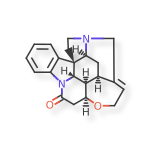
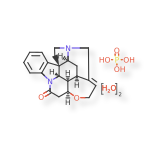
| Stereochemistry | ABSOLUTE |
| Molecular Formula | C21H22N2O2.H3O4P |
| Molecular Weight | 432.4068 |
| Optical Activity | UNSPECIFIED |
| Defined Stereocenters | 6 / 6 |
| E/Z Centers | 0 |
| Charge | 0 |
SHOW SMILES / InChI
SMILES
OP(O)(O)=O.O=C1C[C@@H]2OCC=C3CN4CC[C@@]56[C@@H]4C[C@@H]3[C@@H]2[C@@H]5N1C7=C6C=CC=C7
InChI
InChIKey=VNIVZTFZIJTNDV-ZEYGOCRCSA-N
InChI=1S/C21H22N2O2.H3O4P/c24-18-10-16-19-13-9-17-21(6-7-22(17)11-12(13)5-8-25-16)14-3-1-2-4-15(14)23(18)20(19)21;1-5(2,3)4/h1-5,13,16-17,19-20H,6-11H2;(H3,1,2,3,4)/t13-,16-,17-,19-,20-,21+;/m0./s1
| Molecular Formula | C21H22N2O2 |
| Molecular Weight | 334.4116 |
| Charge | 0 |
| Count |
|
| Stereochemistry | ABSOLUTE |
| Additional Stereochemistry | No |
| Defined Stereocenters | 6 / 6 |
| E/Z Centers | 0 |
| Optical Activity | UNSPECIFIED |
| Molecular Formula | H3O4P |
| Molecular Weight | 97.9952 |
| Charge | 0 |
| Count |
|
| Stereochemistry | ACHIRAL |
| Additional Stereochemistry | No |
| Defined Stereocenters | 0 / 0 |
| E/Z Centers | 0 |
| Optical Activity | NONE |
DescriptionCurator's Comment: Description was created based on several sources, including
http://www.merckvetmanual.com/mvm/toxicology/strychnine_poisoning/overview_of_strychnine_poisoning.html
https://www.ncbi.nlm.nih.gov/pubmed/440838
Curator's Comment: Description was created based on several sources, including
http://www.merckvetmanual.com/mvm/toxicology/strychnine_poisoning/overview_of_strychnine_poisoning.html
https://www.ncbi.nlm.nih.gov/pubmed/440838
Strychnine is an indole alkaloid obtained from the seeds of the Indian tree Strychnos nux-vomica. It gets its scientific name “strychnos” from Carl Linnaeus, who classified it back in 1753, but it was known to the population of India way before then. Nux vomica originates in India. Strychnine-containing baits are currently labelled for below-ground use and are intended for the control of pocket gophers. Their use as indoor pesticides has been eliminated since 1989. In the past, strychnine has been used as a pesticide to control rats, moles, gophers, and coyotes. Strychnine is highly toxic to most domestic animals. Strychnine is a competitive antagonist at glycine receptors and thus a convulsant. It has been used as an analeptic, in the treatment of nonketotic hyperglycinemia and sleep apnea.
Approval Year
Doses
| Dose | Population | Adverse events |
|---|---|---|
250 mg single, oral |
unknown, 46 years |
Other AEs: Violent, Convulsions generalized... Other AEs: Violent (severe) Sources: Convulsions generalized (severe) |
15 g single, oral Dose: 15 g Route: oral Route: single Dose: 15 g Sources: |
unknown, 60 years Health Status: unknown Age Group: 60 years Sex: M Sources: |
Other AEs: Nausea, Vomiting... Other AEs: Nausea (severe) Sources: Vomiting (severe) |
AEs
| AE | Significance | Dose | Population |
|---|---|---|---|
| Convulsions generalized | severe | 250 mg single, oral |
unknown, 46 years |
| Violent | severe | 250 mg single, oral |
unknown, 46 years |
| Nausea | severe | 15 g single, oral Dose: 15 g Route: oral Route: single Dose: 15 g Sources: |
unknown, 60 years Health Status: unknown Age Group: 60 years Sex: M Sources: |
| Vomiting | severe | 15 g single, oral Dose: 15 g Route: oral Route: single Dose: 15 g Sources: |
unknown, 60 years Health Status: unknown Age Group: 60 years Sex: M Sources: |
Overview
| CYP3A4 | CYP2C9 | CYP2D6 | hERG |
|---|---|---|---|
OverviewOther
| Other Inhibitor | Other Substrate | Other Inducer |
|---|---|---|
Drug as perpetrator
| Target | Modality | Activity | Metabolite | Clinical evidence |
|---|---|---|---|---|
| yes [IC50 5.9 uM] | ||||
| yes |
Drug as victim
| Target | Modality | Activity | Metabolite | Clinical evidence |
|---|---|---|---|---|
| yes | ||||
| yes | ||||
| yes | ||||
| yes |
Tox targets
| Target | Modality | Activity | Metabolite | Clinical evidence |
|---|---|---|---|---|
PubMed
| Title | Date | PubMed |
|---|---|---|
| Identification of two novel Drosophila melanogaster histamine-gated chloride channel subunits expressed in the eye. | 2002-01-18 |
|
| Fluorescent labeling of drugs and simple organic compounds containing amine functional groups, utilizing dansyl chloride in Na(2)CO(3) buffer. | 2002-01-05 |
|
| Glycine receptors involved in synaptic transmission are selectively regulated by the cytoskeleton in mouse spinal neurons. | 2002-01 |
|
| Synaptically evoked membrane potential oscillations induced by substance P in lamprey motor neurons. | 2002-01 |
|
| A role for the human sperm glycine receptor/Cl(-) channel in the acrosome reaction initiated by recombinant ZP3. | 2002-01 |
|
| Centrally administered corticotropin-releasing hormone and peripheral injections of strychnine hydrochloride potentiate the acoustic startle response in preweanling rats. | 2001-12 |
|
| IgG isolated from LP-BM5 infected mouse brain activates ionotropic glutamate receptors. | 2001-12 |
|
| Strychnine alters response properties of trigeminal nociceptive neurons in the rat. | 2001-12 |
|
| NMDA receptor-dependent periodic oscillations in cultured spinal cord networks. | 2001-12 |
|
| GABAergic and glycinergic neural inhibition in excitatory frequency tuning of bat inferior collicular neurons. | 2001-12 |
|
| Glycine receptor-mediated inhibition of dopamine and non-dopamine neurons of the rat ventral tegmental area in vitro. | 2001-11-23 |
|
| Role of protein kinase C in opioid modulation of glycine-gated Cl(-) current in rat periaqueductal gray neuron. | 2001-11-16 |
|
| Glycine activates myenteric neurones in adult guinea-pigs. | 2001-11-01 |
|
| Enzymatic and non-enzymatic reduction of brucine N-oxide by aldehyde oxidase and catalase. | 2001-11 |
|
| Properties and interconnections of trigeminal interneurons of the lateral pontine reticular formation in the rat. | 2001-11 |
|
| Modulation of excitatory synaptic transmission by GABA(C) receptor-mediated feedback in the mouse inner retina. | 2001-11 |
|
| Anticonvulsant activities of ethanolic extract and aqueous fraction isolated from Delphinium denudatum. | 2001-11 |
|
| [Arsenic and strychnine against tired eyes]. | 2001-10-10 |
|
| [Are homeopathic studies better-fated in India?]. | 2001-10 |
|
| Subunit composition of strychnine-sensitive glycine receptors expressed by adult rat basolateral amygdala neurons. | 2001-10 |
|
| Characterization of the spontaneous synaptic activity of amacrine cells in the mouse retina. | 2001-10 |
|
| Excitatory synaptic currents in lumbosacral parasympathetic preganglionic neurons elicited from the lateral funiculus. | 2001-10 |
|
| The central nervous effects of Mitragyna africanus (Willd) stembark extract in rats. | 2001-10 |
|
| Synchronization of an embryonic network of identified spinal interneurons solely by electrical coupling. | 2001-09-27 |
|
| Approaches to the synthesis of (+/-)-strychnine via the cobalt-mediated [2 + 2 + 2] cycloaddition: rapid assembly of a classic framework. | 2001-09-26 |
|
| A novel generation of coupling reagents. Enantiodifferentiating coupling reagents prepared in situ from 2-chloro-4,6-dimethoxy-1,3,5-triazine (CDMT) and chiral tertiary amines. | 2001-09-21 |
|
| Iontophoresis in vivo demonstrates a key role for GABA(A) and glycinergic inhibition in shaping frequency response areas in the inferior colliculus of guinea pig. | 2001-09-15 |
|
| Osmoregulation of vasopressin secretion via activation of neurohypophysial nerve terminals glycine receptors by glial taurine. | 2001-09-15 |
|
| Sensitive and specific multiresidue methods for the determination of pesticides of various classes in clinical and forensic toxicology. | 2001-09-15 |
|
| Homeostatic plasticity induced by chronic block of AMPA/kainate receptors modulates the generation of rhythmic bursting in rat spinal cord organotypic cultures. | 2001-09 |
|
| [Effects of enflurane on respiratory neurons of the pre-Bötzinger complex in medullary slices of neonatal rats]. | 2001-09 |
|
| Mechanisms that initiate spontaneous network activity in the developing chick spinal cord. | 2001-09 |
|
| Electrophysiological evidence for vasopressin V(1) receptors on neonatal motoneurons, premotor and other ventral horn neurons. | 2001-09 |
|
| The release of spinal prostaglandin E2 and the effect of nitric oxide synthetase inhibition during strychnine-induced allodynia. | 2001-09 |
|
| Biogenetically inspired approach to the Strychnos alkaloids. Concise syntheses of (+/-)-akuammicine and (+/-)-strychnine. | 2001-08-22 |
|
| IPSC kinetics at identified GABAergic and mixed GABAergic and glycinergic synapses onto cerebellar Golgi cells. | 2001-08-15 |
|
| Dermal exposure to strychnine. | 2001-08-14 |
|
| Determination of berberine and strychnine in medicinal plants and herbal preparations by pressurized liquid extraction with capillary zone electrophoresis. | 2001-08 |
|
| Reversal of chloroquine and mefloquine resistance in Plasmodium falciparum by the two monoindole alkaloids, icajine and isoretuline. | 2001-08 |
|
| Anticonvulsant activities of the FS-1 subfraction isolated from roots of Delphinium denudatum. | 2001-08 |
|
| Developmental changes in 5-hydroxytryptamine-induced rhythmic activity in the spinal cord of rat fetuses in vitro. | 2001-07-06 |
|
| The generation of rhythmic activity in dissociated cultures of rat spinal cord. | 2001-07 |
|
| Spatiotemporal characterization of rhythmic activity in rat spinal cord slice cultures. | 2001-07 |
|
| Enflurane actions on spinal cords from mice that lack the beta3 subunit of the GABA(A) receptor. | 2001-07 |
|
| Intraspinal amino acid neurotransmitter activities are involved in the generation of rhythmic sympathetic nerve discharge in newborn rat spinal cord. | 2001-06-15 |
|
| Interactions between allosteric modulators and 4-DAMP and other antagonists at muscarinic receptors: potential significance of the distance between the N and carboxyl C atoms in the molecules of antagonists. | 2001-04 |
|
| Early expression of glycine and GABA(A) receptors in developing spinal cord neurons. Effects on neurite outgrowth. | 2001 |
|
| Is the vertebrate respiratory central pattern generator conserved? Insights from in-vitro and in-vivo amphibian models. | 2001 |
|
| The neuropharmacology of upper airway motor control in the awake and asleep states: implications for obstructive sleep apnoea. | 2001 |
|
| AMPA-evoked acetylcholine release from cultured spinal cord motoneurons and its inhibition by GABA and glycine. | 2001 |
Patents
| Substance Class |
Chemical
Created
by
admin
on
Edited
Mon Mar 31 19:51:58 GMT 2025
by
admin
on
Mon Mar 31 19:51:58 GMT 2025
|
| Record UNII |
09703TJV4U
|
| Record Status |
Validated (UNII)
|
| Record Version |
|
-
Download
| Name | Type | Language | ||
|---|---|---|---|---|
|
Common Name | English | ||
|
Preferred Name | English | ||
|
Common Name | English | ||
|
Common Name | English |
| Code System | Code | Type | Description | ||
|---|---|---|---|---|---|
|
20841677
Created by
admin on Mon Mar 31 19:51:58 GMT 2025 , Edited by admin on Mon Mar 31 19:51:58 GMT 2025
|
PRIMARY | |||
|
SUB15416MIG
Created by
admin on Mon Mar 31 19:51:58 GMT 2025 , Edited by admin on Mon Mar 31 19:51:58 GMT 2025
|
PRIMARY | |||
|
CHEMBL227934
Created by
admin on Mon Mar 31 19:51:58 GMT 2025 , Edited by admin on Mon Mar 31 19:51:58 GMT 2025
|
PRIMARY | |||
|
1733682
Created by
admin on Mon Mar 31 19:51:58 GMT 2025 , Edited by admin on Mon Mar 31 19:51:58 GMT 2025
|
PRIMARY | |||
|
509-42-2
Created by
admin on Mon Mar 31 19:51:58 GMT 2025 , Edited by admin on Mon Mar 31 19:51:58 GMT 2025
|
PRIMARY | |||
|
09703TJV4U
Created by
admin on Mon Mar 31 19:51:58 GMT 2025 , Edited by admin on Mon Mar 31 19:51:58 GMT 2025
|
PRIMARY | |||
|
100000077871
Created by
admin on Mon Mar 31 19:51:58 GMT 2025 , Edited by admin on Mon Mar 31 19:51:58 GMT 2025
|
PRIMARY | |||
|
DTXSID30965138
Created by
admin on Mon Mar 31 19:51:58 GMT 2025 , Edited by admin on Mon Mar 31 19:51:58 GMT 2025
|
PRIMARY | |||
|
208-098-9
Created by
admin on Mon Mar 31 19:51:58 GMT 2025 , Edited by admin on Mon Mar 31 19:51:58 GMT 2025
|
PRIMARY |
| Related Record | Type | Details | ||
|---|---|---|---|---|
|
|
PARENT -> SALT/SOLVATE | |||
|
SOLVATE->ANHYDROUS | |||
|
|
PARENT -> SALT/SOLVATE |
| Related Record | Type | Details | ||
|---|---|---|---|---|
|
|
ACTIVE MOIETY |