Details
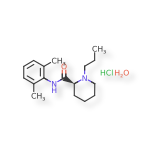
| Stereochemistry | ABSOLUTE |
| Molecular Formula | C17H26N2O |
| Molecular Weight | 274.4011 |
| Optical Activity | UNSPECIFIED |
| Defined Stereocenters | 1 / 1 |
| E/Z Centers | 0 |
| Charge | 0 |
SHOW SMILES / InChI
SMILES
CCCN1CCCC[C@@H]1C(=O)NC2=C(C)C=CC=C2C
InChI
InChIKey=ZKMNUMMKYBVTFN-OAHLLOKOSA-N
InChI=1S/C17H26N2O/c1-4-11-19-12-6-5-10-15(19)17(20)18-16-13(2)8-7-9-14(16)3/h7-9,15H,4-6,10-12H2,1-3H3,(H,18,20)/t15-/m1/s1
| Molecular Formula | C17H26N2O |
| Molecular Weight | 274.4011 |
| Charge | 0 |
| Count |
|
| Stereochemistry | ABSOLUTE |
| Additional Stereochemistry | No |
| Defined Stereocenters | 1 / 1 |
| E/Z Centers | 0 |
| Optical Activity | UNSPECIFIED |
DescriptionCurator's Comment: The description was created based on several sources, including
https://www.ncbi.nlm.nih.gov/pubmed/21550810 | https://www.ncbi.nlm.nih.gov/pubmed/18946303 | https://www.ncbi.nlm.nih.gov/pubmed/3239398
Curator's Comment: The description was created based on several sources, including
https://www.ncbi.nlm.nih.gov/pubmed/21550810 | https://www.ncbi.nlm.nih.gov/pubmed/18946303 | https://www.ncbi.nlm.nih.gov/pubmed/3239398
(R)-Ropivacaine (Dextroropivacaine) is a voltage-dependent potassium channel blocker with local anesthetic activity. (S)-Ropivacaine is a medication used for the production of local or regional anesthesia for surgery and for acute pain management. Ropivacaine shows a difference in channel blockade between two enantiomers, and R-Ropivacaine shows greater cardiotoxicity than (S)-Ropivacaine. (R)-Ropivacaine is the impurity in commercial formulations of Ropivacaine.
Approval Year
PubMed
| Title | Date | PubMed |
|---|---|---|
| Ropivacaine with or without clonidine improves pediatric tonsillectomy pain. | 2001-10 |
|
| A new posterior approach to the sciatic nerve block: a prospective, randomized comparison with the classic posterior approach. | 2001-10 |
|
| The pharmacokinetics of epidural ropivacaine in infants and young children. | 2001-10 |
|
| Antimicrobial activity of ropivacaine and other local anaesthetics. | 2001-10 |
|
| Analgesic effects of low-dose ropivacaine for interscalene brachial plexus block for outpatient shoulder surgery-a dose-finding study. | 2001-09-19 |
|
| Stability and compatibility of methylprednisolone acetate and ropivacaine hydrochloride in polypropylene syringes for epidural administration. | 2001-09-15 |
|
| A comparison of 0.5% ropivacaine and 1% mepivacaine for sciatic nerve block in the popliteal fossa. | 2001-09 |
|
| Ropivacaine 0.2% and lidocaine 0.5% for intravenous regional anesthesia in outpatient surgery. | 2001-09 |
|
| Post-thoracotomy analgesia. | 2001-09 |
|
| Systemic toxicity and resuscitation in bupivacaine-, levobupivacaine-, or ropivacaine-infused rats. | 2001-09 |
|
| Interscalene brachial plexus block with continuous intraarticular infusion of ropivacaine. | 2001-09 |
|
| Preincisional intravenous low-dose ketamine and local infiltration with ropivacaine reduces postoperative pain after laparoscopic cholecystectomy. | 2001-09 |
|
| Simultaneous determination of unbound ropivacaine in rat blood and brain using microdialysis. | 2001-08-25 |
|
| [Clinical and pharmacological characteristics of ropivacaine in sacral anesthesia]. | 2001-08-21 |
|
| Low dose intrathecal ropivacaine with or without sufentanil provides effective analgesia and does not impair motor strength during labour: a pilot study. | 2001-08-10 |
|
| [Assessment of nociceptive suppression in laparoscopic postoperative status: prospective, randomized and comparative study with a control group]. | 2001-08 |
|
| [Evaluation of antibacterial filters for peridural obstetrical anesthesia]. | 2001-08 |
|
| An evaluation of the infraclavicular block via a modified approach of the Raj technique. | 2001-08 |
|
| Does alkalinization of 0.75% ropivacaine promote a lumbar peridural block of higher quality? | 2001-07-21 |
|
| Clinical usefulness, safety, and plasma concentration of ropivacaine 0.5% for inguinal hernia repair in regional anesthesia. | 2001-07-21 |
|
| Effects of bupivacaine and ropivacaine on high-voltage-activated calcium currents of the dorsal horn neurons in newborn rats. | 2001-07 |
|
| Effect of ropivacaine on platelet function. | 2001-07 |
|
| Developments in local anaesthetic drugs. | 2001-07 |
|
| Pharmacokinetics and analgesic effect of ropivacaine following ilioinguinal/iliohypogastric nerve block in children. | 2001-07 |
|
| A comparison of five solutions of local anaesthetics and/or sufentanil for continuous, postoperative epidural analgesia after major urological surgery. | 2001-07 |
|
| A comparison of 1% prilocaine with 0.5% ropivacaine for outpatient-based surgery under axillary brachial plexus block. | 2001-07 |
|
| The effects of single or multiple injections on the volume of 0.5% ropivacaine required for femoral nerve blockade. | 2001-07 |
|
| Hyperbaric spinal ropivacaine for cesarean delivery: a comparison to hyperbaric bupivacaine. | 2001-07 |
|
| The dose-response relationship for clonidine added to a postoperative continuous epidural infusion of ropivacaine in children. | 2001-07 |
|
| Postoperative analgesia by combined continuous infusion and patient-controlled epidural analgesia (PCEA) following hip replacement: ropivacaine versus bupivacaine. | 2001-07 |
|
| Postoperative pain control using epidural catheters after anterior spinal fusion for adolescent scoliosis. | 2001-06-01 |
|
| Efficacy of varying concentrations of hyaluronidase in peribulbar anaesthesia. | 2001-06 |
|
| Convulsions after the administration of high dose ropivacaine following an interscalenic block. | 2001-06 |
|
| Clonidine as adjuvant for mepivacaine, ropivacaine and bupivacaine in axillary, perivascular brachial plexus block. | 2001-06 |
|
| Minimum local analgesic dose of plain ropivacaine vs. ropivacaine combined with sufentanil during epidural analgesia for labour. | 2001-06 |
|
| Direct injection of human plasma samples after ultrafiltration into programmed temperature vaporiser-gas chromatography-mass spectrometry with packed liner. | 2001-05-05 |
|
| Double-blind comparison of ropivacaine 7.5 mg ml(-1) with bupivacaine 5 mg ml(-1) for sciatic nerve block. | 2001-05 |
|
| [The effects of peridural anesthesia on duration of labor and mode of delivery]. | 2001-05 |
|
| [Peripheral nerve block. An overview of new developments in an old technique]. | 2001-05 |
|
| [Comparison of ropivacaine and bupivacaine for epidural analgesia during labor]. | 2001-05 |
|
| Dose-response study of epidural ropivacaine for labor analgesia. | 2001-05 |
|
| Improving postoperative analgesia after axillary brachial plexus anesthesia with 0.75% ropivacaine. A double-blind evaluation of adding clonidine. | 2001-05 |
|
| Ropivacaine in the horse: its pharmacological responses, urinary detection and mass spectral confirmation. | 2001-04 |
|
| [Ropivacaine 0.2% versus bupivacaine 0.125% plus sufentanil for continuous peridural analgesia following extended abdominal operations]. | 2001-04 |
|
| Caudal ropivacaine in infants: population pharmacokinetics and plasma concentrations. | 2001-04 |
|
| Intrathecal ropivacaine and clonidine for ambulatory knee arthroscopy: a dose-response study. | 2001-04 |
|
| Effects of bupivacaine and ropivacaine on hemodynamic parameters in rabbits. | 2001-03 |
|
| Differences of ropivacaine and bupivacaine relevant to antiinflammatory activity, platelet aggregation and antioxidant activity in vitro. | 2001-03 |
|
| Spinal anaesthesia with ropivacaine 5 mg ml(-1) in glucose 10 mg ml(-1) or 50 mg ml(-1). | 2001-02 |
|
| Structural determinants of potency and stereoselective block of hKv1.5 channels induced by local anesthetics. | 1998-07 |
Patents
Sample Use Guides
Human embryonic kidney 293 cells stably expressed human Kv1.1 channels were used for activity evaluation. Whole cell currents were measured with the voltage clamp method of the patch clamp technique using an EPC-9 amplifier. The currents were filtered at 1 kHz, and series resistance was actively compensated by at least 80%. A p/4 leak subtraction protocol was used in the study, with the exception of the experiments for frequency dependence. The patch electrodes were fabricated from borosilicate glass capillary tubes with filament using a Sutter P-97 puller. The pipettes had a
resistance of 2–4 M and were filled with a solution containing the following electrolyte concentrations: 160 mM KCl, 0.5 mM MgCl2, 10 mM HEPES, and 2 mM Na2ATP, with a pH of 7.25 adjusted with KOH. The extracellular solution consisted of 135 mM NaCl, 5 mM KCl, 2 mM CaCl2, 2 mM MgCl2, 5 mM HEPES, 10 mM sucrose, and 0.01 mg/ml phenol red, with a pH of 7.4 adjusted with NaOH. All experiments were performed at room temperature.
Dextroropivacaine was dissolved in the watery extracellular solution, yielding stock solutions of 1 mM and drug was applied on the cells by a perfusion system at concentrations 10mkM-1000mkM.
| Substance Class |
Chemical
Created
by
admin
on
Edited
Mon Mar 31 22:05:25 GMT 2025
by
admin
on
Mon Mar 31 22:05:25 GMT 2025
|
| Record UNII |
0494L275Q6
|
| Record Status |
Validated (UNII)
|
| Record Version |
|
-
Download
| Name | Type | Language | ||
|---|---|---|---|---|
|
Common Name | English | ||
|
Preferred Name | English | ||
|
Systematic Name | English | ||
|
Common Name | English | ||
|
Common Name | English | ||
|
Systematic Name | English |
| Code System | Code | Type | Description | ||
|---|---|---|---|---|---|
|
98717-16-9
Created by
admin on Mon Mar 31 22:05:25 GMT 2025 , Edited by admin on Mon Mar 31 22:05:25 GMT 2025
|
PRIMARY | |||
|
0494L275Q6
Created by
admin on Mon Mar 31 22:05:25 GMT 2025 , Edited by admin on Mon Mar 31 22:05:25 GMT 2025
|
PRIMARY | |||
|
10236329
Created by
admin on Mon Mar 31 22:05:25 GMT 2025 , Edited by admin on Mon Mar 31 22:05:25 GMT 2025
|
PRIMARY | |||
|
DTXSID701317045
Created by
admin on Mon Mar 31 22:05:25 GMT 2025 , Edited by admin on Mon Mar 31 22:05:25 GMT 2025
|
PRIMARY |
| Related Record | Type | Details | ||
|---|---|---|---|---|
|
PARENT -> IMPURITY |