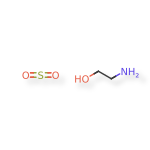
Details
| Stereochemistry | ACHIRAL |
| Molecular Formula | C2H7NO.O2S |
| Molecular Weight | 125.147 |
| Optical Activity | NONE |
| Defined Stereocenters | 0 / 0 |
| E/Z Centers | 0 |
| Charge | 0 |
SHOW SMILES / InChI
SMILES
O=S=O.NCCO
InChI
InChIKey=IZGMTUSWDTVKOI-UHFFFAOYSA-N
InChI=1S/C2H7NO.O2S/c3-1-2-4;1-3-2/h4H,1-3H2;
Sulfur dioxide (SO2) is a colorles, highly toxic gas with a choking or suffocating odor. It is used as a pharmaceutical aid and antioxidant. It reacts easily with other substances to form harmful compounds, such as sulfuric acid, sulfurous acid and sulfate particles. About 99% of the sulfur dioxide in air comes from human sources. The main source of sulfur dioxide in the air is industrial activity that processes materials that contain sulfur, eg the generation of electricity from coal, oil or gas that contains sulfur. Some mineral ores also contain sulfur, and sulfur dioxide is released when they are processed. In addition, industrial activities that burn fossil fuels containing sulfur can be important sources of sulfur dioxide. Sulfur dioxide affects human health when it is breathed in. It irritates the nose, throat, and airways to cause coughing, wheezing, shortness of breath, or a tight feeling around the chest. The effects of sulfur dioxide are felt very quickly and most people would feel the worst symptoms in 10 or 15 minutes after breathing it in. Sulfur dioxide is used to increase the
storage life and preserve the color and flavor of fruits and vegetables and as a disinfectant in breweries, wineries and food factories. It prevents the formation of nitroamines in beer and reduces free
chlorine after water treatment. It is used as a bleaching agent in the textile, paper pulp, wool and fresh produce industries and as a fumigant for grain and against lice and mites in veterinary practice. It
also serves as a chemical intermediate in the manufacture of chlorine dioxide, sodium sulfate, thionyl chloride and organic sulfonates. It is used as a reducing agent of iron in mineral processing, as a cleaning agent for metallic oxides, as an oxidizing agent in lithium batteries, as an oxygen scavenger and extractive solvent in petroleum refining, in glass manufacture and as a neutralizing agent. SO2 can be generated endogenously in mammals. In contrast to the toxic effects of SO2, protective effects have also been found in mammals. Endogenous SO2 has antioxidant, anti-inflammatory, anti-hypertension, and anti-atherogenic effects and regulates vascular tone and cardiac function in mammals. SO2 may have a dual role in regulating physiological and pathophysiological effects in mammals. Studies have shown that SO2 can also regulate levels of lipid metabolism. In male Sprague–Dawley rats on a normal or a high cholesterol diet, inhalation of 5 ppm and 10 ppm SO2
gas (for 14 days) increased plasma triglyceride levels and decreased
high-density lipoprotein cholesterol levels. However, in rats treated with a high cholesterol diet for 8 weeks,
plasma total cholesterol increased and high-density lipoproteincholesterol decreased. After treatment with an SO2 donor
the plasma levels of triglyceride and low-density lipoprotein cholesterol
were markedly decreased. In addition, the SO2 donor significantly
decreased atherosclerotic lesions. These data suggest
that SO2 regulates lipid metabolism. The mechanism may be related
to upregulation of the disturbed endogenous H2S pathway, increased
plasma glutathione peroxidase (GSH-Px), superoxide dismutase
(SOD) activities, aortic tissue SOD1 and SOD2 protein expression,
and decreased malondialdehyde generation. The antioxidant effect
of SO2 might involve one of these mechanisms, which could directly
prevent the progression of atherosclerotic lesions. Sulfur dioxide and its derivatives have significant vasodilatory effects. SO2 decreased
systolic blood pressure in spontaneously hypertensive rats which may
be related to its vasorelaxing effect. Compared
with exogenous SO2 vasoactive effects, it was discovered that endogenous SO2 had an important vasorelaxing function which is necessary
for maintaining normal blood vascular tone.
Approval Year
PubMed
| Title | Date | PubMed |
|---|---|---|
| Differential effects between one week and four weeks exposure to same mass of SO2 on synaptic plasticity in rat hippocampus. | 2016-07 |
|
| Endogenous 2-Arachidonoylglycerol Alleviates Cyclooxygenases-2 Elevation-Mediated Neuronal Injury From SO2 Inhalation via PPARγ Pathway. | 2015-10 |
|
| Air pollution and children's health: sickle cell disease. | 2015-02 |
|
| Risk assessment for cardiovascular and respiratory mortality due to air pollution and synoptic meteorology in 10 Canadian cities. | 2014-02 |
|
| Sulfur dioxide inhalation stimulated mitochondrial biogenesis in rat brains. | 2012-10-09 |
|
| Indoor air pollutants and health in the United Arab Emirates. | 2012-05 |
|
| The negative inotropic effects of gaseous sulfur dioxide and its derivatives in the isolated perfused rat heart. | 2012-03 |
|
| Cell type specificity of female lung cancer associated with sulfur dioxide from air pollutants in Taiwan: an ecological study. | 2012-01-04 |
|
| SO(2)-induced neurotoxicity is mediated by cyclooxygenases-2-derived prostaglandin E(2) and its downstream signaling pathway in rat hippocampal neurons. | 2011-12 |
|
| Air pollution and stillbirth: a population-based case-control study in Taiwan. | 2011-09 |
|
| Ambient air pollution and lipoprotein-associated phospholipase A₂ in survivors of myocardial infarction. | 2011-07 |
|
| Study on the association between ambient air pollution and daily cardiovascular and respiratory mortality in an urban district of Beijing. | 2011-06 |
|
| Ambient air pollution and birth weight in full-term infants in Atlanta, 1994-2004. | 2011-05 |
|
| Long-term exposure to ambient air pollution and mortality due to cardiovascular disease and cerebrovascular disease in Shenyang, China. | 2011 |
|
| Effect of sulfur dioxide on expression of proto-oncogenes and tumor suppressor genes from rats. | 2010-06 |
|
| Short-term association between sulfur dioxide and daily mortality: the Public Health and Air Pollution in Asia (PAPA) study. | 2010-04 |
|
| SO2 inhalation contributes to the development and progression of ischemic stroke in the brain. | 2010-04 |
|
| Sulfur dioxide and benzo(a)pyrene modulates CYP1A and tumor-related gene expression in rat liver. | 2010-04 |
|
| Expression of oncogenes and tumor suppressor genes in lungs of rats exposed to sulfur dioxide and benzo(a)pyrene. | 2010-03 |
|
| Expression of caspase and apoptotic signal pathway induced by sulfur dioxide. | 2010-03 |
|
| Air pollution and mortality in the Canary Islands: a time-series analysis. | 2010-02-12 |
|
| Effect of early life exposure to air pollution on development of childhood asthma. | 2010-02 |
|
| Baseline repeated measures from controlled human exposure studies: associations between ambient air pollution exposure and the systemic inflammatory biomarkers IL-6 and fibrinogen. | 2010-01 |
|
| Air pollution, aeroallergens, and emergency room visits for acute respiratory diseases and gastroenteric disorders among young children in six Italian cities. | 2009-11 |
|
| Acute effects of air pollution on pulmonary function, airway inflammation, and oxidative stress in asthmatic children. | 2009-04 |
|
| Risk of asthmatic episodes in children exposed to sulfur dioxide stack emissions from a refinery point source in Montreal, Canada. | 2009-04 |
|
| Effects of SO2 on respiratory system of adult Miyakejima resident 2 years after returning to the island. | 2009 |
|
| Short-term effects of ambient gaseous pollutants and particulate matter on daily mortality in Shanghai, China. | 2008 |
|
| Air pollution and mortality in Chile: susceptibility among the elderly. | 2007-04 |
|
| Exposures to air pollutants during pregnancy and preterm delivery. | 2006-06 |
|
| The association between low level exposures to ambient air pollution and term low birth weight: a retrospective cohort study. | 2006-02-17 |
|
| Effect of sulfur dioxide inhalation on CYP1A1 and CYP1A2 in rat liver and lung. | 2005-12-30 |
|
| Relation between ambient air quality and selected birth defects, seven county study, Texas, 1997-2000. | 2005-08-01 |
|
| Temperature, air pollution, and hospitalization for cardiovascular diseases among elderly people in Denver. | 2003-08 |
|
| The effect of sulfur dioxide inhalation on visual evoked potentials, antioxidant status, and lipid peroxidation in alloxan-induced diabetic rats. | 2000-08 |
Patents
Sample Use Guides
In male Sprague–Dawley rats on a
normal or a high cholesterol diet, inhalation of 5 ppm and 10 ppm SO2
gas (for 14 days) increased plasma triglyceride levels and decreased
high-density lipoprotein cholesterol levels
Route of Administration:
Respiratory
| Name | Type | Language | ||
|---|---|---|---|---|
|
Common Name | English | ||
|
Preferred Name | English | ||
|
Systematic Name | English | ||
|
Systematic Name | English |
| Code System | Code | Type | Description | ||
|---|---|---|---|---|---|
|
DTXSID00215677
Created by
admin on Tue Apr 01 17:05:38 GMT 2025 , Edited by admin on Tue Apr 01 17:05:38 GMT 2025
|
PRIMARY | |||
|
ZUM2B44TJC
Created by
admin on Tue Apr 01 17:05:38 GMT 2025 , Edited by admin on Tue Apr 01 17:05:38 GMT 2025
|
PRIMARY | |||
|
265-707-0
Created by
admin on Tue Apr 01 17:05:38 GMT 2025 , Edited by admin on Tue Apr 01 17:05:38 GMT 2025
|
PRIMARY | |||
|
6455115
Created by
admin on Tue Apr 01 17:05:38 GMT 2025 , Edited by admin on Tue Apr 01 17:05:38 GMT 2025
|
PRIMARY | |||
|
65345-27-9
Created by
admin on Tue Apr 01 17:05:38 GMT 2025 , Edited by admin on Tue Apr 01 17:05:38 GMT 2025
|
PRIMARY |
SUBSTANCE RECORD