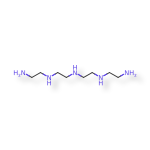
Details
| Stereochemistry | ACHIRAL |
| Molecular Formula | C8H23N5 |
| Molecular Weight | 189.3017 |
| Optical Activity | NONE |
| Defined Stereocenters | 0 / 0 |
| E/Z Centers | 0 |
| Charge | 0 |
SHOW SMILES / InChI
SMILES
NCCNCCNCCNCCN
InChI
InChIKey=FAGUFWYHJQFNRV-UHFFFAOYSA-N
InChI=1S/C8H23N5/c9-1-3-11-5-7-13-8-6-12-4-2-10/h11-13H,1-10H2
DescriptionSources: http://www.google.com/patents/WO1993000915A1?cl=enhttp://www.huntsman.com/performance_products/Media%20Library/a_MC348531CFA3EA9A2E040EBCD2B6B7B06/Products_MC348531D0B9FA9A2E040EBCD2B6B7B06/Amines_MC348531D0BECA9A2E040EBCD2B6B7B06/Ethyleneamines_MC348531D0CD3A9A2E040EBCD2B6B7B06/files/tetraethylenepentamine_tepa.pdfCurator's Comment: Description was created based on several sources, including
https://www.ncbi.nlm.nih.gov/pubmed/26581493 | http://pubs.acs.org/doi/abs/10.1021/ic50099a028?journalCode=inocaj | http://pubs.acs.org/doi/abs/10.1021/ic50048a017?journalCode=inocaj | https://clinicaltrials.gov/ct2/show/NCT01484470 | https://www.ncbi.nlm.nih.gov/pubmed/18209724 | https://www.ncbi.nlm.nih.gov/pubmed/16219531
Sources: http://www.google.com/patents/WO1993000915A1?cl=enhttp://www.huntsman.com/performance_products/Media%20Library/a_MC348531CFA3EA9A2E040EBCD2B6B7B06/Products_MC348531D0B9FA9A2E040EBCD2B6B7B06/Amines_MC348531D0BECA9A2E040EBCD2B6B7B06/Ethyleneamines_MC348531D0CD3A9A2E040EBCD2B6B7B06/files/tetraethylenepentamine_tepa.pdf
Curator's Comment: Description was created based on several sources, including
https://www.ncbi.nlm.nih.gov/pubmed/26581493 | http://pubs.acs.org/doi/abs/10.1021/ic50099a028?journalCode=inocaj | http://pubs.acs.org/doi/abs/10.1021/ic50048a017?journalCode=inocaj | https://clinicaltrials.gov/ct2/show/NCT01484470 | https://www.ncbi.nlm.nih.gov/pubmed/18209724 | https://www.ncbi.nlm.nih.gov/pubmed/16219531
Tetraethylenepentamine (TEPA) is a low-molecular-weight linear polyamine exerting metal-chelating properties. TEPA is widely used in industrial applications. The principal hazards that arise in working with TEPA are those associated with similar organic amines; namely, a corrosive action on skin and eyes. TEPA biological activity was attributed to its effect on cellular Cu levels as (a) treatment with TEPA resulted in reduction of cellular Cu, and (b) excess of Cu reversed TEPA's activity and accelerated differentiation. TEPA was shown to attenuate the differentiation of ex vivo cultured hematopoietic cells resulting in preferential expansion of early progenitors. A phase I/II trial was performed to test the feasibility and safety of transplantation of CD133+ cord blood (CB) hematopoietic progenitors cultured in media containing stem cell factor, FLT-3 ligand, interleukin-6, thrombopoietin and TEPA. Transplanting a population of CD133+ CB cells which were expanded ex vivo for 21 days using SCF, FLT3, IL-6, TPO and the copper chelator TEPA (StemEx) was feasible. The expanded cells were well tolerated, with no infusion-related adverse events observed.
Approval Year
Targets
| Primary Target | Pharmacology | Condition | Potency |
|---|---|---|---|
Target ID: WP408 |
|||
Target ID: CHEMBL2363057 |
|||
Target ID: CHEMBL2364175 |
Conditions
| Condition | Modality | Targets | Highest Phase | Product |
|---|---|---|---|---|
| Primary | StemEx Approved UseUnknown |
|||
| Palliative | COLESTID Approved UseCOLESTID Granules and FLAVORED COLESTID Granules are indicated as adjunctive therapy to diet for the reduction of elevated serum total and low-density lipoprotein (LDL) cholesterol in patients with primary hypercholesterolemia (elevated low density lipoproteins [LDL] cholesterol) who do not respond adequately to diet. Generally, COLESTID and FLAVORED COLESTID have no clinically significant effect on serum
triglycerides, but with its use triglyceride levels may be raised in some patients. Launch Date1977 |
PubMed
| Title | Date | PubMed |
|---|---|---|
| Functional polycarbonates and their self-assemblies as promising non-viral vectors. | 2009-10-01 |
|
| Primary biliary cirrhosis. | 2009-09 |
|
| Removal of Reactive Black 5 from aqueous solutions using magnetic chitosan resins. | 2009-08-15 |
|
| Chitosan based oligoamine polymers: synthesis, characterization, and gene delivery. | 2009-07-01 |
|
| Molecular nanocluster with a [Sn(4)Ga(4)Zn(2)Se(20)](8-) t3 supertetrahedral core. | 2009-06-01 |
|
| Role for copper in the cellular and regulatory effects of heme-hemopexin. | 2009-06 |
|
| Dyslipidemia treatment of patients with diabetes mellitus in a US managed care plan: a retrospective database analysis. | 2009-05-18 |
|
| Polyaspartamide-based oligo-ethylenimine brushes with high buffer capacity and low cytotoxicity for highly efficient gene delivery. | 2009-03-18 |
|
| Does nicotinic acid (niacin) lower blood pressure? | 2009-01 |
|
| Copper regulation of hypoxia-inducible factor-1 activity. | 2009-01 |
|
| Copper modulates the differentiation of mouse hematopoietic progenitor cells in culture. | 2009 |
|
| Management of complex lipid abnormalities with a fixed dose combination of simvastatin and extended release niacin. | 2009 |
|
| Preparation of polyurea capsules using electrocapillary emulsification. | 2008-10-15 |
|
| New advances in the treatment of Clostridium difficile infection (CDI). | 2008-10 |
|
| A capillary electrophoretic method for fingerprinting low molecular weight heparins. | 2008-09-15 |
|
| Bile acid sequestrants as a therapeutic option for glucose lowering in type 2 diabetes mellitus. | 2008-08-30 |
|
| Colesevelam HCl improves glycemic control and reduces LDL cholesterol in patients with inadequately controlled type 2 diabetes on sulfonylurea-based therapy. | 2008-08 |
|
| Synthesis of magnetic chelating resins functionalized with tetraethylenepentamine for adsorption of molybdate anions from aqueous solutions. | 2008-06-30 |
|
| Plasma PCSK9 levels are significantly modified by statins and fibrates in humans. | 2008-06-11 |
|
| Absorption spectroscopic and FTIR studies on EDA complexes between TNT (2,4,6-trinitrotoluene) with amines in DMSO and determination of the vertical electron affinity of TNT. | 2008-06 |
|
| Transplantation of ex vivo expanded cord blood cells using the copper chelator tetraethylenepentamine: a phase I/II clinical trial. | 2008-05 |
|
| Liver transplantation in a subject with familial hypercholesterolemia carrying the homozygous p.W577R LDL-receptor gene mutation. | 2008-03-15 |
|
| Thermodynamic and spectroscopic studies of lanthanides(III) complexation with polyamines in dimethyl sulfoxide. | 2008-02-04 |
|
| Pathogenesis and treatment of pruritus in cholestasis. | 2008 |
|
| Tetraethylenepentamine-directed controllable synthesis of wurtzite ZnSe nanostructures with tunable morphology. | 2008 |
|
| Efficient CO2 capturer derived from as-synthesized MCM-41 modified with amine. | 2008 |
|
| The 'forgotten' bile acid sequestrants: is now a good time to remember? | 2007-12-20 |
|
| The effect of the copper chelator tetraethylenepentamine on reactive oxygen species generation by human hematopoietic progenitor cells. | 2007-12 |
|
| In situ ligand reactions under hydrothermal conditions afford a novel zinc-substituted polyoxovanadate dimer. | 2007-10-29 |
|
| Fish-oil esters of plant sterols differ from vegetable-oil sterol esters in triglycerides lowering, carotenoid bioavailability and impact on plasminogen activator inhibitor-1 (PAI-1) concentrations in hypercholesterolemic subjects. | 2007-10-25 |
|
| Telmisartan/hydrochlorothiazide versus valsartan/hydrochlorothiazide in obese hypertensive patients with type 2 diabetes: the SMOOTH study. | 2007-10-02 |
|
| The use of colesevelam hydrochloride in the treatment of dyslipidemia: a review. | 2007-10 |
|
| One-dimensional indium sulfides with transition metal complexes of polyamines. | 2007-08-06 |
|
| Profiling recombinant major birch pollen allergen Bet v 1a and carbamylated variants with CZE and CIEF. | 2007-07 |
|
| Safety considerations with gastrointestinally active lipid-lowering drugs. | 2007-03-19 |
|
| Synthesis of a selenidostannate(IV), [Mn(tepa).Sn3Se7]n, demonstrating the transformation from achiral to chiral and dimeric to polymeric structure. | 2007-03-05 |
|
| Estimating the impact of adding C-reactive protein as a criterion for lipid lowering treatment in the United States. | 2007-02 |
|
| Colesevelam hydrochloride: reducing atherosclerotic coronary heart disease risk factors. | 2007 |
|
| Regression or reduction in progression of atherosclerosis, and avoidance of coronary events, with lovastatin in patients with or at high risk of cardiovascular disease: a review. | 2007 |
|
| Is the fixed-dose combination of telmisartan and hydrochlorothiazide a good approach to treat hypertension? | 2007 |
|
| Bile acid sequestrants and the treatment of type 2 diabetes mellitus. | 2007 |
|
| A preconcentration system using polyamine Metalfix-Chelamine resin for the on-line determination of palladium(II) and platinum(IV) by inductively coupled plasma optical emission spectrometry. | 2006-12-15 |
|
| Past, present, and future therapies for Clostridium difficile-associated disease. | 2006-12 |
|
| Complementary therapy to target LDL cholesterol: the role of the ezetimibe/simvastatin combination. | 2006 |
|
| Optimal lipid modification: the rationale for combination therapy. | 2005 |
|
| Effects of prolonged intensive lipid-lowering therapy on the characteristics of carotid atherosclerotic plaques in vivo by MRI: a case-control study. | 2001-10 |
|
| Interaction of l-malic acid with alkaline metals and open chain polyammonium cations in aqueous solution. | 2001-03-30 |
|
| Currently available hypolipidaemic drugs and future therapeutic developments. | 1995-10 |
|
| Inhibitors of hydroxymethylglutaryl coenzyme A reductase for treating hypercholesterolaemia. | 1990-09-29 |
|
| Treatment of heterozygous familial hypercholesterolemia with lipid-lowering drugs. | 1989-01-01 |
| Name | Type | Language | ||
|---|---|---|---|---|
|
Systematic Name | English | ||
|
Preferred Name | English | ||
|
Systematic Name | English | ||
|
Common Name | English | ||
|
Systematic Name | English | ||
|
Common Name | English | ||
|
Common Name | English | ||
|
Code | English | ||
|
Brand Name | English | ||
|
Code | English | ||
|
Systematic Name | English | ||
|
Systematic Name | English | ||
|
Brand Name | English | ||
|
Code | English | ||
|
Systematic Name | English | ||
|
Systematic Name | English | ||
|
Systematic Name | English | ||
|
Common Name | English |
| Classification Tree | Code System | Code | ||
|---|---|---|---|---|
|
Food Contact Sustance Notif, (FCN No.) |
FCN NO. 361
Created by
admin on Mon Mar 31 18:59:36 GMT 2025 , Edited by admin on Mon Mar 31 18:59:36 GMT 2025
|
||
|
CFR |
21 CFR 176.170
Created by
admin on Mon Mar 31 18:59:36 GMT 2025 , Edited by admin on Mon Mar 31 18:59:36 GMT 2025
|
| Code System | Code | Type | Description | ||
|---|---|---|---|---|---|
|
203-986-2
Created by
admin on Mon Mar 31 18:59:36 GMT 2025 , Edited by admin on Mon Mar 31 18:59:36 GMT 2025
|
PRIMARY | |||
|
49798
Created by
admin on Mon Mar 31 18:59:36 GMT 2025 , Edited by admin on Mon Mar 31 18:59:36 GMT 2025
|
PRIMARY | |||
|
5171
Created by
admin on Mon Mar 31 18:59:36 GMT 2025 , Edited by admin on Mon Mar 31 18:59:36 GMT 2025
|
PRIMARY | |||
|
YZD1C9KQ28
Created by
admin on Mon Mar 31 18:59:36 GMT 2025 , Edited by admin on Mon Mar 31 18:59:36 GMT 2025
|
PRIMARY | |||
|
88603
Created by
admin on Mon Mar 31 18:59:36 GMT 2025 , Edited by admin on Mon Mar 31 18:59:36 GMT 2025
|
PRIMARY | |||
|
C034269
Created by
admin on Mon Mar 31 18:59:36 GMT 2025 , Edited by admin on Mon Mar 31 18:59:36 GMT 2025
|
PRIMARY | |||
|
112-57-2
Created by
admin on Mon Mar 31 18:59:36 GMT 2025 , Edited by admin on Mon Mar 31 18:59:36 GMT 2025
|
PRIMARY | |||
|
8197
Created by
admin on Mon Mar 31 18:59:36 GMT 2025 , Edited by admin on Mon Mar 31 18:59:36 GMT 2025
|
PRIMARY | |||
|
DTXSID7026108
Created by
admin on Mon Mar 31 18:59:36 GMT 2025 , Edited by admin on Mon Mar 31 18:59:36 GMT 2025
|
PRIMARY | |||
|
Tetraethylenepentamine
Created by
admin on Mon Mar 31 18:59:36 GMT 2025 , Edited by admin on Mon Mar 31 18:59:36 GMT 2025
|
PRIMARY |
SUBSTANCE RECORD