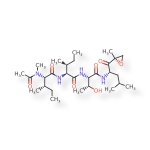
Details
| Stereochemistry | ABSOLUTE |
| Molecular Formula | C28H50N4O7 |
| Molecular Weight | 554.7192 |
| Optical Activity | UNSPECIFIED |
| Defined Stereocenters | 8 / 8 |
| E/Z Centers | 0 |
| Charge | 0 |
SHOW SMILES / InChI
SMILES
CC[C@H](C)[C@H](NC(=O)[C@H]([C@@H](C)CC)N(C)C(C)=O)C(=O)N[C@@H]([C@@H](C)O)C(=O)N[C@@H](CC(C)C)C(=O)[C@@]1(C)CO1
InChI
InChIKey=DOGIDQKFVLKMLQ-JTHVHQAWSA-N
InChI=1S/C28H50N4O7/c1-11-16(5)21(30-27(38)23(17(6)12-2)32(10)19(8)34)25(36)31-22(18(7)33)26(37)29-20(13-15(3)4)24(35)28(9)14-39-28/h15-18,20-23,33H,11-14H2,1-10H3,(H,29,37)(H,30,38)(H,31,36)/t16-,17-,18+,20-,21-,22-,23-,28+/m0/s1
DescriptionCurator's Comment: description was created based on several sources, including
https://www.ncbi.nlm.nih.gov/pubmed/1468981 |
https://www.ncbi.nlm.nih.gov/pubmed/10468620
Curator's Comment: description was created based on several sources, including
https://www.ncbi.nlm.nih.gov/pubmed/1468981 |
https://www.ncbi.nlm.nih.gov/pubmed/10468620
Epoxomicin was originally isolated from the culture medium of an Actinomycetes strain based on its in vivo antitumor activity against murine B16 melanoma. Epoxomicin is a selective proteasome inhibitor with anti-inflammatory activity. Despite its promising antitumor activity, epoxomicin did not draw much attention as a potential drug lead from the pharmaceutical industry, presumably because epoxomicin has seemingly poor drug-like properties, namely the presence of a peptide backbone and the labile epoxy ketone pharmacophore. Despite its drawbacks, epoxomicin’s pharmacophore was found to provide unprecedented selectivity for the proteasome. Epoxomicin also served as a scaffold for the generation of a synthetic tetrapeptide epoxyketone with improved activity.
Approval Year
Targets
| Primary Target | Pharmacology | Condition | Potency |
|---|---|---|---|
Target ID: CHEMBL4662 |
26.0 nM [IC50] | ||
Target ID: CHEMBL5620 |
|||
Target ID: CHEMBL3317334 |
|||
Target ID: CHEMBL3347256 |
Conditions
| Condition | Modality | Targets | Highest Phase | Product |
|---|---|---|---|---|
| Curative | Unknown Approved UseUnknown |
|||
| Primary | Unknown Approved UseUnknown |
|||
| Primary | Unknown Approved UseUnknown |
PubMed
| Title | Date | PubMed |
|---|---|---|
| Proteasome-independent HLA-B27 ligands arise mainly from small basic proteins. | 2007-05 |
|
| Extracellular proteasome in the human alveolar space: a new housekeeping enzyme? | 2007-05 |
|
| Apoptosis induced by proteasome inhibition in cancer cells: predominant role of the p53/PUMA pathway. | 2007-03-15 |
|
| Arkadia enhances Nodal/TGF-beta signaling by coupling phospho-Smad2/3 activity and turnover. | 2007-03 |
|
| PPARgamma inhibitors reduce tubulin protein levels by a PPARgamma, PPARdelta and proteasome-independent mechanism, resulting in cell cycle arrest, apoptosis and reduced metastasis of colorectal carcinoma cells. | 2007-02-01 |
|
| Turnover of StAR protein: roles for the proteasome and mitochondrial proteases. | 2007-02 |
|
| High-throughput bioluminescence screening of ubiquitin-proteasome pathway inhibitors from chemical and natural sources. | 2007-02 |
|
| [Artifitial increase of HIV-1 reverse transcriptase turnover through proteasome pathway]. | 2007-01-11 |
|
| SIVSM/HIV-2 Vpx proteins promote retroviral escape from a proteasome-dependent restriction pathway present in human dendritic cells. | 2007-01-09 |
|
| Proteasomal chymotrypsin-like peptidase activity is required for essential functions of human monocyte-derived dendritic cells. | 2007-01 |
|
| AbetaPP-overexpression and proteasome inhibition increase alphaB-crystallin in cultured human muscle: relevance to inclusion-body myositis. | 2006-12 |
|
| Comparison of the neurotoxic effects of proteasomal inhibitors in primary mesencephalic cultures. | 2006-12 |
|
| Proteasomal regulation of cardiac hypertrophy: is demolition necessary for building? | 2006-10-24 |
|
| Activation of the cardiac proteasome during pressure overload promotes ventricular hypertrophy. | 2006-10-24 |
|
| Deubiquitinating enzyme Ubp6 functions noncatalytically to delay proteasomal degradation. | 2006-10-06 |
|
| Cyclic AMP delays neutrophil apoptosis via stabilization of Mcl-1. | 2006-08-21 |
|
| Failure of proteasome inhibitor administration to provide a model of Parkinson's disease in rats and monkeys. | 2006-08 |
|
| Roles of the ubiquitin/proteasome pathway in pollen tube growth with emphasis on MG132-induced alterations in ultrastructure, cytoskeleton, and cell wall components. | 2006-08 |
|
| Histone H2A.z is essential for cardiac myocyte hypertrophy but opposed by silent information regulator 2alpha. | 2006-07-14 |
|
| Plasmodia express two threonine-peptidase complexes during asexual development. | 2006-07 |
|
| Presenilin-dependent intramembrane cleavage of ephrin-B1. | 2006-06-12 |
|
| HIV-1 reverse transcriptase targeted for proteasomal degradation as a prototype vaccine against drug-resistant HIV-1. | 2006-05-22 |
|
| Extracellular matrix metalloproteinase inducer (CD147) confers resistance of breast cancer cells to Anoikis through inhibition of Bim. | 2006-04-07 |
|
| Ubiquitin-proteasome system stress sensitizes ovarian cancer to proteasome inhibitor-induced apoptosis. | 2006-04-01 |
|
| The involvement of immunoproteasomes in induction of MHC class I-restricted immunity targeting Toxoplasma SAG1. | 2006-04 |
|
| Glial cell line-derived neurotrophic factor-dependent recruitment of Ret into lipid rafts enhances signaling by partitioning Ret from proteasome-dependent degradation. | 2006-03-08 |
|
| Major histocompatibility complex class I restricted T-cell autoreactivity in human peripheral blood mononuclear cells. | 2006-03 |
|
| Proteasome inhibitor-induced apoptosis in human monocyte-derived dendritic cells. | 2006-03 |
|
| Histone deacetylase inhibitor, trichostatin A induces ubiquitin-dependent cyclin D1 degradation in MCF-7 breast cancer cells. | 2006-02-20 |
|
| Antiviral activity of proteasome inhibitors in herpes simplex virus-1 infection: role of nuclear factor-kappaB. | 2006 |
|
| Detection of a proteasome in Pneumocystis carinii and its modulation by specific proteasome inhibitors. | 2006 |
|
| Proteasome inhibitors sensitize colon carcinoma cells to TRAIL-induced apoptosis via enhanced release of Smac/DIABLO from the mitochondria. | 2006 |
|
| Probing protein function with small molecules. | 2006 |
|
| Characterization of endoplasmic reticulum-associated degradation of a protein S mutant identified in a family of quantitative protein S deficiency. | 2006 |
|
| Role of the cytokine-induced SH2 domain-containing protein CIS in growth hormone receptor internalization. | 2005-11-11 |
|
| The proteasome metabolizes peptide-mediated nonviral gene delivery systems. | 2005-11 |
|
| Identification of mono-ubiquitinated LDH-A in skeletal muscle cells exposed to oxidative stress. | 2005-10-28 |
|
| [Development of BMP-related drugs]. | 2005-10 |
|
| Deubiquitination by proteasome is coordinated with substrate translocation for proteolysis in vivo. | 2005-07-15 |
|
| MAG induces regulated intramembrane proteolysis of the p75 neurotrophin receptor to inhibit neurite outgrowth. | 2005-06-16 |
|
| Cooperative cytotoxicity of proteasome inhibitors and tumor necrosis factor-related apoptosis-inducing ligand in chemoresistant Bcl-2-overexpressing cells. | 2005-06-01 |
|
| Dopaminergic neurons in rat ventral midbrain cultures undergo selective apoptosis and form inclusions, but do not up-regulate iHSP70, following proteasomal inhibition. | 2005-06 |
|
| Tau is not normally degraded by the proteasome. | 2005-05-01 |
|
| Evidence that insulin secretion influences SNAP-25 through proteasomal activation. | 2005-04-15 |
|
| Evidence for a protective role of Mcl-1 in proteasome inhibitor-induced apoptosis. | 2005-04-15 |
|
| Peroxisome proliferator-activated receptor gamma-independent ablation of cyclin D1 by thiazolidinediones and their derivatives in breast cancer cells. | 2005-04 |
|
| Transforming growth factor-beta differentially inhibits MyD88-dependent, but not TRAM- and TRIF-dependent, lipopolysaccharide-induced TLR4 signaling. | 2005-02-18 |
|
| Presentation of endogenously synthesized MHC class II-restricted epitopes by MHC class II cancer vaccines is independent of transporter associated with Ag processing and the proteasome. | 2005-02-15 |
|
| Development and characterization of proteasome inhibitors. | 2005 |
|
| Assaying degradation and deubiquitination of a ubiquitinated substrate by purified 26S proteasomes. | 2005 |
| Name | Type | Language | ||
|---|---|---|---|---|
|
Common Name | English | ||
|
Preferred Name | English | ||
|
Systematic Name | English | ||
|
Systematic Name | English | ||
|
Common Name | English |
| Code System | Code | Type | Description | ||
|---|---|---|---|---|---|
|
Epoxomicin
Created by
admin on Mon Mar 31 21:05:06 GMT 2025 , Edited by admin on Mon Mar 31 21:05:06 GMT 2025
|
PRIMARY | |||
|
DTXSID5044073
Created by
admin on Mon Mar 31 21:05:06 GMT 2025 , Edited by admin on Mon Mar 31 21:05:06 GMT 2025
|
PRIMARY | |||
|
134381-21-8
Created by
admin on Mon Mar 31 21:05:06 GMT 2025 , Edited by admin on Mon Mar 31 21:05:06 GMT 2025
|
PRIMARY | |||
|
Y0900I3U8U
Created by
admin on Mon Mar 31 21:05:06 GMT 2025 , Edited by admin on Mon Mar 31 21:05:06 GMT 2025
|
PRIMARY | |||
|
m4956
Created by
admin on Mon Mar 31 21:05:06 GMT 2025 , Edited by admin on Mon Mar 31 21:05:06 GMT 2025
|
PRIMARY | Merck Index | ||
|
11226684
Created by
admin on Mon Mar 31 21:05:06 GMT 2025 , Edited by admin on Mon Mar 31 21:05:06 GMT 2025
|
PRIMARY |
SUBSTANCE RECORD