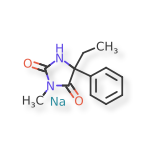
Details
| Stereochemistry | RACEMIC |
| Molecular Formula | C12H14N2O2.Na |
| Molecular Weight | 242.2495 |
| Optical Activity | ( + / - ) |
| Defined Stereocenters | 0 / 1 |
| E/Z Centers | 0 |
| Charge | 0 |
SHOW SMILES / InChI
SMILES
[NaH].CCC1(NC(=O)N(C)C1=O)C2=CC=CC=C2
InChI
InChIKey=JZINGIXUCWTNGL-UHFFFAOYSA-N
InChI=1S/C12H14N2O2.Na.H/c1-3-12(9-7-5-4-6-8-9)10(15)14(2)11(16)13-12;;/h4-8H,3H2,1-2H3,(H,13,16);;
DescriptionSources: http://www.drugbank.ca/drugs/DB00532Curator's Comment: Description was created based on several sources, including
https://www.drugs.com/mtm/mephenytoin.html
Sources: http://www.drugbank.ca/drugs/DB00532
Curator's Comment: Description was created based on several sources, including
https://www.drugs.com/mtm/mephenytoin.html
Mephenytoin is an antiepileptic drug which can be useful in the treatment of epilepsy. The primary site of action appears to be the motor cortex where spread of seizure activity is inhibited. Possibly by promoting sodium efflux from neurons, mephenytoin tends to stabilize the threshold against hyperexcitability caused by excessive stimulation or environmental changes capable of reducing membrane sodium gradient. This includes the reduction of posttetanic potentiation at synapses. Loss of posttetanic potentiation prevents cortical seizure foci from detonating adjacent cortical areas. Mephenytoin reduces the maximal activity of brain stem centers responsible for the tonic phase of tonic-clonic (grand mal) seizures. The mechanism of action of mephenytoin is not definitely known, but extensive research strongly suggests that its main mechanism is to block frequency-, use- and voltage-dependent neuronal sodium channels, and therefore limit repetitive firing of action potentials. Mephenytoin is no longer available in the US or the UK. It is still studied largely because of its interesting hydroxylation polymorphism.
CNS Activity
Approval Year
Targets
| Primary Target | Pharmacology | Condition | Potency |
|---|---|---|---|
Target ID: CHEMBL1980 Sources: http://www.drugbank.ca/drugs/DB00532 |
Conditions
| Condition | Modality | Targets | Highest Phase | Product |
|---|---|---|---|---|
| Primary | Mesantoin Approved UseFor the control of grand mal, focal, Jacksonian, and psychomotor seizures in those patients who have been refractory to less toxic anticonvulsants. Launch Date1946 |
Doses
| Dose | Population | Adverse events |
|---|---|---|
7200 mg single, oral Overdose |
unknown, 17 years |
Other AEs: Stupor... |
12000 mg single, oral Overdose Dose: 12000 mg Route: oral Route: single Dose: 12000 mg Sources: |
unknown, 26 years |
Other AEs: Coma... |
0.1 g 1 times / day multiple, oral Dose: 0.1 g, 1 times / day Route: oral Route: multiple Dose: 0.1 g, 1 times / day Sources: |
unhealthy, 31 years |
Disc. AE: Pancytopenia... AEs leading to discontinuation/dose reduction: Pancytopenia (grade 5, 1 patient) Sources: |
6.8 mg/kg 1 times / day multiple, oral Dose: 6.8 mg/kg, 1 times / day Route: oral Route: multiple Dose: 6.8 mg/kg, 1 times / day Sources: |
unhealthy, adult |
Disc. AE: Aplastic anemia... AEs leading to discontinuation/dose reduction: Aplastic anemia (grade 5, 1 patient) Sources: |
AEs
| AE | Significance | Dose | Population |
|---|---|---|---|
| Stupor | 7200 mg single, oral Overdose |
unknown, 17 years |
|
| Coma | 12000 mg single, oral Overdose Dose: 12000 mg Route: oral Route: single Dose: 12000 mg Sources: |
unknown, 26 years |
|
| Pancytopenia | grade 5, 1 patient Disc. AE |
0.1 g 1 times / day multiple, oral Dose: 0.1 g, 1 times / day Route: oral Route: multiple Dose: 0.1 g, 1 times / day Sources: |
unhealthy, 31 years |
| Aplastic anemia | grade 5, 1 patient Disc. AE |
6.8 mg/kg 1 times / day multiple, oral Dose: 6.8 mg/kg, 1 times / day Route: oral Route: multiple Dose: 6.8 mg/kg, 1 times / day Sources: |
unhealthy, adult |
PubMed
| Title | Date | PubMed |
|---|---|---|
| Appropriate phenotyping procedures for drug metabolizing enzymes and transporters in humans and their simultaneous use in the "cocktail" approach. | 2007-02 |
|
| CYP2C76-mediated species difference in drug metabolism: a comparison of pitavastatin metabolism between monkeys and humans. | 2007-01 |
|
| In vitro metabolism of tributyltin and triphenyltin by human cytochrome P-450 isoforms. | 2006-12-07 |
|
| The inhibitory effect of polyunsaturated fatty acids on human CYP enzymes. | 2006-11-25 |
|
| Effect of conjugated equine estrogens on oxidative metabolism in middle-aged and elderly postmenopausal women. | 2006-11 |
|
| Evaluation of the activity of CYP2C19 in Gujrati and Marwadi subjects living in Mumbai (Bombay). | 2006-10-24 |
|
| Validation of incorporating flurbiprofen into the Pittsburgh cocktail. | 2006-09 |
|
| Liver disease selectively modulates cytochrome P450--mediated metabolism. | 2006-09 |
|
| Effects of individual ginsenosides, ginkgolides and flavonoids on CYP2C19 and CYP2D6 activity in human liver microsomes. | 2006-09 |
|
| CYP2C76, a novel cytochrome P450 in cynomolgus monkey, is a major CYP2C in liver, metabolizing tolbutamide and testosterone. | 2006-08 |
|
| Cynomolgus monkey cytochrome P450 2C43: cDNA cloning, heterologous expression, purification and characterization. | 2006-05 |
|
| Investigation of sarizotan's impact on the pharmacokinetics of probe drugs for major cytochrome P450 isoenzymes: a combined cocktail trial. | 2006-04 |
|
| A common novel CYP2C19 gene variant causes ultrarapid drug metabolism relevant for the drug response to proton pump inhibitors and antidepressants. | 2006-01 |
|
| CYP2C19-mediated (S)-mephenytoin 4'-hydroxylation assayed by high-performance liquid chromatography with radiometric detection. | 2006 |
|
| Enantiospecific separation and quantitation of mephenytoin and its metabolites nirvanol and 4'-hydroxymephenytoin in human plasma and urine by liquid chromatography/tandem mass spectrometry. | 2006 |
|
| Effect of propiverine on cytochrome P450 enzymes: a cocktail interaction study in healthy volunteers. | 2005-12 |
|
| Automated assessment of time-dependent inhibition of human cytochrome P450 enzymes using liquid chromatography-tandem mass spectrometry analysis. | 2005-11 |
|
| Polymorphism of CYP2D6, CYP2C19, CYP2C9 and CYP2C8 in the Faroese population. | 2005-08 |
|
| Automated screening with confirmation of mechanism-based inactivation of CYP3A4, CYP2C9, CYP2C19, CYP2D6, and CYP1A2 in pooled human liver microsomes. | 2005-08 |
|
| Effect of age and postoperative time on cytochrome p450 enzyme activity following liver transplantation. | 2005-06 |
|
| Cytochrome P-450 activity is differentially altered in severely injured patients. | 2005-03 |
|
| High-throughput screening of inhibitory potential of nine cytochrome P450 enzymes in vitro using liquid chromatography/tandem mass spectrometry. | 2005 |
|
| Lack of interaction of milnacipran with the cytochrome p450 isoenzymes frequently involved in the metabolism of antidepressants. | 2005 |
|
| Studies of binding modes of (S)-mephenytoin to wild types and mutants of cytochrome P450 2C19 and 2C9 using homology modeling and computational docking. | 2004-12 |
|
| Bioequivalence revisited: influence of age and sex on CYP enzymes. | 2004-12 |
|
| Active-site characteristics of CYP2C19 and CYP2C9 probed with hydantoin and barbiturate inhibitors. | 2004-09-01 |
|
| Metabolism of human cytochrome P450 marker substrates in mouse: a strain and gender comparison. | 2004-09 |
|
| CYP2B6, CYP3A4, and CYP2C19 are responsible for the in vitro N-demethylation of meperidine in human liver microsomes. | 2004-09 |
|
| Comparison of inhibitory effects of the proton pump-inhibiting drugs omeprazole, esomeprazole, lansoprazole, pantoprazole, and rabeprazole on human cytochrome P450 activities. | 2004-08 |
|
| Assessment of drug-drug interaction potential of enfuvirtide in human immunodeficiency virus type 1-infected patients. | 2004-06 |
|
| Validated assays for human cytochrome P450 activities. | 2004-06 |
|
| Selective inhibition of CYP2B6-catalyzed bupropion hydroxylation in human liver microsomes in vitro. | 2004-06 |
|
| Omeprazole as a CYP2C19 marker in Chinese subjects: assessment of its gene-dose effect and intrasubject variability. | 2004-06 |
|
| The influence of St John's Wort on CYP2C19 activity with respect to genotype. | 2004-06 |
|
| Potential of pranlukast and zafirlukast in the inhibition of human liver cytochrome P450 enzymes. | 2004-05 |
|
| Identification and relative contributions of human cytochrome P450 isoforms involved in the metabolism of glibenclamide and lansoprazole: evaluation of an approach based on the in vitro substrate disappearance rate. | 2004-05 |
|
| Inhibition of cytochrome P450 activities by oleanolic acid and ursolic acid in human liver microsomes. | 2004-04-16 |
|
| Ethnic differences in genetic polymorphisms of CYP2D6, CYP2C19, CYP3As and MDR1/ABCB1. | 2004-04 |
|
| Key structural features of ligands for activation of human pregnane X receptor. | 2004-04 |
|
| Developmental expression of human hepatic CYP2C9 and CYP2C19. | 2004-03 |
|
| Inhibitory effects of the monoamine oxidase inhibitor tranylcypromine on the cytochrome P450 enzymes CYP2C19, CYP2C9, and CYP2D6. | 2004-02 |
|
| Quantification of mephenytoin and its metabolites 4'-hydroxymephenytoin and nirvanol in human urine using a simple sample processing method. | 2004 |
|
| Identification of the human cytochrome P450s responsible for the in vitro metabolism of a leukotriene B4 receptor antagonist, CP-195,543. | 2003-12 |
|
| Hepatic CYP2B6 expression: gender and ethnic differences and relationship to CYP2B6 genotype and CAR (constitutive androstane receptor) expression. | 2003-12 |
|
| Metabolism of citalopram enantiomers in CYP2C19/CYP2D6 phenotyped panels of healthy Swedes. | 2003-10 |
|
| Interferon-beta treatment in patients with multiple sclerosis does not alter CYP2C19 or CYP2D6 activity. | 2003-09 |
|
| Capillary electrophoresis to assess drug metabolism induced in vitro using single CYP450 enzymes (Supersomes): application to the chiral metabolism of mephenytoin and methadone. | 2003-08 |
|
| Artemisinin autoinduction is caused by involvement of cytochrome P450 2B6 but not 2C9. | 2003-07 |
|
| Cytochrome P450 inhibition using recombinant proteins and mass spectrometry/multiple reaction monitoring technology in a cassette incubation. | 2003-07 |
|
| In vitro inhibitory effect of 1-aminobenzotriazole on drug oxidations catalyzed by human cytochrome P450 enzymes: a comparison with SKF-525A and ketoconazole. | 2003 |
Patents
Sample Use Guides
The average dose of Mesantoin® (mephenytoin) for adults ranges from 2-6 tablets (0.2-0.6 Gm.) daily. In some instances it may be necessary to administer as much as 8 tablets or more daily in order to obtain full seizure control. Pediatric patients usually require from 1-4 tablets (0.1-0.4 Gm.) according to nature of seizures and age.
Route of Administration:
Oral
| Name | Type | Language | ||
|---|---|---|---|---|
|
Common Name | English | ||
|
Preferred Name | English | ||
|
Systematic Name | English |
| Code System | Code | Type | Description | ||
|---|---|---|---|---|---|
|
TYD93VML2K
Created by
admin on Wed Apr 02 12:48:22 GMT 2025 , Edited by admin on Wed Apr 02 12:48:22 GMT 2025
|
PRIMARY | |||
|
34915-71-4
Created by
admin on Wed Apr 02 12:48:22 GMT 2025 , Edited by admin on Wed Apr 02 12:48:22 GMT 2025
|
PRIMARY |
ACTIVE MOIETY
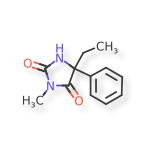
SUBSTANCE RECORD