Details
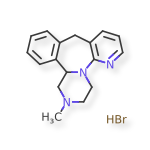
| Stereochemistry | RACEMIC |
| Molecular Formula | C17H19N3.BrH |
| Molecular Weight | 346.265 |
| Optical Activity | ( + / - ) |
| Defined Stereocenters | 0 / 1 |
| E/Z Centers | 0 |
| Charge | 0 |
SHOW SMILES / InChI
SMILES
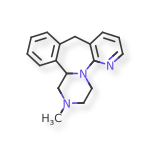
Br.CN1CCN2C(C1)C3=CC=CC=C3CC4=CC=CN=C24
InChI
InChIKey=JERFRCPECXNTRC-UHFFFAOYSA-N
InChI=1S/C17H19N3.BrH/c1-19-9-10-20-16(12-19)15-7-3-2-5-13(15)11-14-6-4-8-18-17(14)20;/h2-8,16H,9-12H2,1H3;1H
DescriptionCurator's Comment: Description was created based on several sources, including:
http://psychiatryonline.org/doi/10.1176/appi.books.9781585623860.as21#u2014-09-19T084532.264-0400d1e2463
http://www.accessdata.fda.gov/drugsatfda_docs/label/2010/020415s023s024.pdf
Curator's Comment: Description was created based on several sources, including:
http://psychiatryonline.org/doi/10.1176/appi.books.9781585623860.as21#u2014-09-19T084532.264-0400d1e2463
http://www.accessdata.fda.gov/drugsatfda_docs/label/2010/020415s023s024.pdf
Mirtazapine, originally known as ORG 3770, was first synthesized by the Department of Medicinal Chemistry of NV Organon in the Netherlands (Kaspersen et al. 1989). First approved for use in major depression in the Netherlands in 1994, mirtazapine was introduced in the United States in 1996. The antidepressant mirtazapine has a dual mode of action. It is a noradrenergic and specific serotonergic antidepressant (NaSSA) that acts by antagonizing the adrenergic alpha2-autoreceptors and alpha2-heteroreceptors as well as by blocking 5-HT2 and 5-HT3 receptors. It enhances, therefore, the release of norepinephrine and 5-HT1A-mediated serotonergic transmission. This dual mode of action may conceivably be responsible for mirtazapine's rapid onset of action.
Approval Year
Targets
| Primary Target | Pharmacology | Condition | Potency |
|---|---|---|---|
Target ID: CHEMBL2095158 |
7.0 null [pKi] | ||
Target ID: CHEMBL2094132 |
8.62 null [pKi] | ||
Target ID: CHEMBL224 |
8.1 null [pKi] |
Conditions
| Condition | Modality | Targets | Highest Phase | Product |
|---|---|---|---|---|
| Primary | REMERON Approved UseREMERON (mirtazapine) Tablets are indicated for the treatment of major depressive disorder. The efficacy of REMERON in the treatment of major depressive disorder was established in 6-week controlled trials of outpatients whose diagnoses corresponded most closely to the Diagnostic and Statistical Manual of Mental Disorders – 3rd edition (DSM-III) category of major depressive disorder (see CLINICAL PHARMACOLOGY). A major depressive episode (DSM-IV) implies a prominent and relatively persistent (nearly every day for at least 2 weeks) depressed or dysphoric mood that usually interferes with daily functioning, and includes at least 5 of the following 9 symptoms: depressed mood, loss of interest in usual activities, significant change in weight and/or appetite, insomnia or hypersomnia, psychomotor agitation or retardation, increased fatigue, feelings of guilt or worthlessness, slowed thinking or impaired concentration, a suicide attempt, or suicidal ideation. The effectiveness of REMERON in hospitalized depressed patients has not been adequately studied. The efficacy of REMERON in maintaining a response in patients with major depressive disorder for up to 40 weeks following 8 to 12 weeks of initial open-label treatment was demonstrated in a placebo-controlled trial. Nevertheless, the physician who elects to use REMERON for extended periods should periodically re-evaluate the long-term usefulness of the drug for the individual patient (see CLINICAL PHARMACOLOGY). Launch Date1996 |
Cmax
| Value | Dose | Co-administered | Analyte | Population |
|---|---|---|---|---|
32.3 μg/L |
15 mg single, oral dose: 15 mg route of administration: Oral experiment type: SINGLE co-administered: |
MIRTAZAPINE plasma | Homo sapiens population: HEALTHY age: ADULT sex: MALE food status: FED |
AUC
| Value | Dose | Co-administered | Analyte | Population |
|---|---|---|---|---|
345 μg × h/L |
15 mg single, oral dose: 15 mg route of administration: Oral experiment type: SINGLE co-administered: |
MIRTAZAPINE plasma | Homo sapiens population: HEALTHY age: ADULT sex: MALE food status: FED |
T1/2
| Value | Dose | Co-administered | Analyte | Population |
|---|---|---|---|---|
30 h |
15 mg single, oral dose: 15 mg route of administration: Oral experiment type: SINGLE co-administered: |
MIRTAZAPINE plasma | Homo sapiens population: UNKNOWN age: ADULT sex: FEMALE / MALE food status: UNKNOWN |
|
21.2 h |
15 mg single, oral dose: 15 mg route of administration: Oral experiment type: SINGLE co-administered: |
MIRTAZAPINE plasma | Homo sapiens population: HEALTHY age: ADULT sex: MALE food status: FED |
Funbound
| Value | Dose | Co-administered | Analyte | Population |
|---|---|---|---|---|
15% |
15 mg single, oral dose: 15 mg route of administration: Oral experiment type: SINGLE co-administered: |
MIRTAZAPINE plasma | Homo sapiens population: UNKNOWN age: ADULT sex: FEMALE / MALE food status: UNKNOWN |
|
15% |
15 mg single, oral dose: 15 mg route of administration: Oral experiment type: SINGLE co-administered: |
MIRTAZAPINE plasma | Homo sapiens population: HEALTHY age: ADULT sex: MALE food status: FED |
Overview
| CYP3A4 | CYP2C9 | CYP2D6 | hERG |
|---|---|---|---|
OverviewOther
| Other Inhibitor | Other Substrate | Other Inducer |
|---|---|---|
Drug as perpetrator
| Target | Modality | Activity | Metabolite | Clinical evidence |
|---|---|---|---|---|
| weak | ||||
| weak | ||||
| weak | no (co-administration study) Comment: mirtazapine caused no changes on the pharmacokinetics of paroxetine or amitriptyline |
|||
| yes | ||||
| yes |
Drug as victim
| Target | Modality | Activity | Metabolite | Clinical evidence |
|---|---|---|---|---|
| major | yes (co-administration study) Comment: ketoconazole increased mirtazapine AUC 50% Sources: https://www.accessdata.fda.gov/drugsatfda_docs/label/2020/020415s034s036,021208s024s026lbl.pdf Page: 18.0 |
|||
| minor | ||||
| yes | ||||
| yes | yes (co-administration study) Comment: cimetidine increaes mirtazapine AUC >50% Sources: https://www.accessdata.fda.gov/drugsatfda_docs/label/2020/020415s034s036,021208s024s026lbl.pdf Page: 17.0 |
|||
| yes | yes (co-administration study) Comment: amitriptyline caused no changes on the pharmacokinetics of mirtazapine Sources: https://www.accessdata.fda.gov/drugsatfda_docs/label/2020/020415s034s036,021208s024s026lbl.pdf Page: 17, 18 |
PubMed
| Title | Date | PubMed |
|---|---|---|
| Determination of mirtazapine and its demethyl metabolite in plasma by high-performance liquid chromatography with ultraviolet detection. Application to management of acute intoxication. | 2002-08-05 |
|
| Effects of antidepressants in rats trained to discriminate centrally administered isoproterenol. | 2002-08 |
|
| Synthesis and pharmacological testing of 1,2,3,4,10,14b-hexahydro-6-methoxy-2-methyldibenzo[c,f]pyrazino[1,2-a]azepin and its enantiomers in comparison with the two antidepressants mianserin and mirtazapine. | 2002-07-18 |
|
| Body weight changes associated with psychopharmacology. | 2002-07 |
|
| Mirtazapine in the treatment of panic disorder. | 2002-07 |
|
| Separation of new antidepressants and their metabolites by micellar electrokinetic capillary chromatography. | 2002-06-15 |
|
| Prevention of the stress-induced increase in the concentration of neuroactive steroids in rat brain by long-term administration of mirtazapine but not of fluoxetine. | 2002-06 |
|
| [Tolerability and efficacy of combined antidepressant therapy]. | 2002-05-25 |
|
| Acute and chronic hypertensive headache and hypertensive encephalopathy. | 2002-05 |
|
| Urinary incontinence with mirtazapine. | 2002-05 |
|
| Dystonia induced by mirtazapine. | 2002-05 |
|
| An open-label, crossover trial of mirtazapine (15 and 30 mg) in cancer patients with pain and other distressing symptoms. | 2002-05 |
|
| Psychotropic drugs and the ECG: focus on the QTc interval. | 2002-05 |
|
| Spectrophotometric, spectrofluorimetric, HPLC and CZE determination of mirtazapine in pharmaceutical tablets. | 2002-04-15 |
|
| Venlafaxine and mirtazapine: different mechanisms of antidepressant action, common opioid-mediated antinociceptive effects--a possible opioid involvement in severe depression? | 2002-04-05 |
|
| Prevalence of sexual dysfunction among newer antidepressants. | 2002-04 |
|
| Mirtazapine overdose with benign outcome. | 2002-04 |
|
| Mirtazapine may have the propensity for developing a restless legs syndrome? A case report. | 2002-04 |
|
| Serotonin syndrome and atypical antipsychotics. | 2002-04 |
|
| Severe serotonin syndrome induced by mirtazapine monotherapy. | 2002-04 |
|
| Induction of hyperlocomotion in mice exposed to a novel environment by inhibition of serotonin reuptake. A pharmacological characterization of diverse classes of antidepressant agents. | 2002-04 |
|
| In the rat forced swimming test, NA-system mediated interactions may prevent the 5-HT properties of some subacute antidepressant treatments being expressed. | 2002-04 |
|
| Mirtazapine, yohimbine or olanzapine augmentation therapy for serotonin reuptake-associated female sexual dysfunction: a randomized, placebo controlled trial. | 2002-03-12 |
|
| Molecular characterisation of antidepressant effects in the mouse brain using gene expression profiling. | 2002-03-12 |
|
| Mirtazapine-induced akathisia. | 2002-03-04 |
|
| Sequential catecholamine and serotonin depletion in mirtazapine-treated depressed patients. | 2002-03 |
|
| New antidepressants in the treatment of neuropathic pain. A review. | 2002-03 |
|
| Successful treatment of recurrent brief depression with reboxetine -- a single case analysis. | 2002-03 |
|
| Effect of repeated treatment with mirtazapine on the central alpha1-adrenergic receptors. | 2002-03 |
|
| Heart rate variability as predictor of nonresponse to mirtazapine in panic disorder: a preliminary study. | 2002-03 |
|
| Intravenous mirtazapine in the treatment of depressed inpatients. | 2002-02 |
|
| Mirtazapine, but not fluvoxamine, normalizes the blunted REM sleep response to clonidine in depressed patients: implications for subsensitivity of alpha(2)-adrenergic receptors in depression. | 2002-01-31 |
|
| A double-blind, placebo-controlled study of antidepressant augmentation with mirtazapine. | 2002-01-15 |
|
| A survey of prescribing practices in the treatment of depression. | 2002-01 |
|
| Chronic treatment with imipramine or mirtazapine antagonizes stress- and FG7142-induced increase in cortical norepinephrine output in freely moving rats. | 2002-01 |
|
| Permutation-validated principal components analysis of microarray data. | 2002 |
|
| Mania associated with mirtazapine augmentation of fluoxetine. | 2002 |
|
| Meta-analysis of placebo-controlled trials with mirtazapine using the core items of the Hamilton Depression Scale as evidence of a pure antidepressive effect in the short-term treatment of major depression. | 2001-12 |
|
| Comment: serotonin syndrome induced by fluvoxamine and mirtazapine. | 2001-12 |
|
| An open trial of mirtazapine in menopausal women with depression unresponsive to estrogen replacement therapy. | 2001-12 |
|
| First report of mirtazapine-induced arthralgia. | 2001-12 |
|
| Relative safety of mirtazapine overdose. | 2001-12 |
|
| [Interference in the serotoninergic and noradrenergic system. Faster out of depression]. | 2001-11-01 |
|
| Peripheral edema associated with mirtazapine. | 2001-11 |
|
| The effect of mirtazapine in panic disorder: an open label pilot study with a single-blind placebo run-in period. | 2001-11 |
|
| Trait anxiety and the effect of a single high dose of diazepam in unipolar depression. | 2001-10-31 |
|
| Efficacy of mirtazapine for prevention of depressive relapse: a placebo-controlled double-blind trial of recently remitted high-risk patients. | 2001-10 |
|
| [Pharmacotherapeutical approaches to insomnia patients with cardiac diseases and after heart transplantation]. | 2001-10 |
|
| Third-generation antidepressants: do they offer advantages over the SSRIs? | 2001 |
|
| Meta-analytical studies on new antidepressants. | 2001 |
Sample Use Guides
The recommended starting dose for REMERON® (mirtazapine) Tablets is 15 mg/day, administered in a single dose. In the controlled clinical trials establishing the efficacy of REMERON in the treatment of major depressive disorder, the effective dose range was generally 15 to 45 mg/day.
Route of Administration:
Oral
| Name | Type | Language | ||
|---|---|---|---|---|
|
Preferred Name | English | ||
|
Common Name | English | ||
|
Systematic Name | English |
| Code System | Code | Type | Description | ||
|---|---|---|---|---|---|
|
868363-97-7
Created by
admin on Mon Mar 31 22:12:06 GMT 2025 , Edited by admin on Mon Mar 31 22:12:06 GMT 2025
|
PRIMARY | |||
|
R24NHR59AG
Created by
admin on Mon Mar 31 22:12:06 GMT 2025 , Edited by admin on Mon Mar 31 22:12:06 GMT 2025
|
PRIMARY | |||
|
11609903
Created by
admin on Mon Mar 31 22:12:06 GMT 2025 , Edited by admin on Mon Mar 31 22:12:06 GMT 2025
|
PRIMARY |
ACTIVE MOIETY
SUBSTANCE RECORD