Details
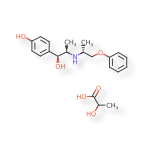
| Stereochemistry | MIXED |
| Molecular Formula | C18H23NO3.C3H6O3 |
| Molecular Weight | 391.4581 |
| Optical Activity | UNSPECIFIED |
| Defined Stereocenters | 3 / 4 |
| E/Z Centers | 0 |
| Charge | 0 |
SHOW SMILES / InChI
SMILES
CC(O)C(O)=O.C[C@H](COC1=CC=CC=C1)N[C@H](C)[C@@H](O)C2=CC=C(O)C=C2
InChI
InChIKey=HPSNBOLYHJERIY-BQZDIUEZSA-N
InChI=1S/C18H23NO3.C3H6O3/c1-13(12-22-17-6-4-3-5-7-17)19-14(2)18(21)15-8-10-16(20)11-9-15;1-2(4)3(5)6/h3-11,13-14,18-21H,12H2,1-2H3;2,4H,1H3,(H,5,6)/t13-,14-,18-;/m1./s1
DescriptionCurator's Comment: description was created based on several sources, including
https://www.ncbi.nlm.nih.gov/pubmed/22893038 | https://www.ncbi.nlm.nih.gov/pubmed/16388203 | https://www.ncbi.nlm.nih.gov/pubmed/11445487 | https://www.ncbi.nlm.nih.gov/pubmed/2874205
Curator's Comment: description was created based on several sources, including
https://www.ncbi.nlm.nih.gov/pubmed/22893038 | https://www.ncbi.nlm.nih.gov/pubmed/16388203 | https://www.ncbi.nlm.nih.gov/pubmed/11445487 | https://www.ncbi.nlm.nih.gov/pubmed/2874205
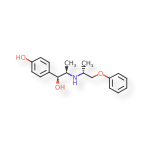
Isoxsuprine (used as isoxsuprine hydrochloride) is a drug used as a vasodilator in humans (under the trade name Duvadilan) and equines. Isoxsuprine is a β2 adrenoreceptor agonist that causes direct relaxation of uterine and vascular smooth muscle via β2 receptors. Isoxsuprine it is used in humans for treatment of premature labor, i.e. a tocolytic, and as a vasodilator for the treatment of cerebral vascular insufficiency, Raynaud's phenomenon, and other conditions. Isoxsuprine may increase the heart rate, cause changes in blood pressure, and irritate the GI tract. It should, therefore, be used with caution if combined with other drugs that affect blood pressure, such as sedatives and anesthetic drugs. Isoxsuprine is most commonly used to treat hoof-related problems in the horse, most commonly for laminitis and navicular disease, as its effects as a vasodilator are thought to increase circulation within the hoof to help counteract the problems associated with these conditions.
Approval Year
PubMed
| Title | Date | PubMed |
|---|---|---|
| Ritodrine and isoxsuprine in management of preterm labor. | 2010-11-26 |
|
| Development and validation of fixed-time method for the determination of isoxsuprine hydrochloride in commercial dosages forms. | 2010-09 |
|
| Discovery of novel CDK1 inhibitors by combining pharmacophore modeling, QSAR analysis and in silico screening followed by in vitro bioassay. | 2010-09 |
|
| Investigation of ractopamine-imprinted polymer for dispersive solid-phase extraction of trace beta-agonists in pig tissues. | 2010-07 |
|
| Spectrophotometric determination of isoxsuprine hydrochloride using 3-methyl-2-benzothiazolinone hydrazone hydrochloride in spiked human urine and pharmaceuticals. | 2010-06-15 |
|
| Use of N, N-diethyl-p-phenylenediamine sulphate for the spectrophotometric determination of some phenolic and amine drugs. | 2010-06 |
|
| Determination of beta-agonists in pig feed, pig urine and pig liver using capillary electrophoresis with electrochemical detection. | 2010-06 |
|
| Investigation of ractopamine molecularly imprinted stir bar sorptive extraction and its application for trace analysis of beta2-agonists in complex samples. | 2010-05-28 |
|
| Generic sample preparation combined with high-resolution liquid chromatography-time-of-flight mass spectrometry for unification of urine screening in doping-control laboratories. | 2010-04 |
|
| Management of pregnant female with meningioma for craniotomy. | 2010-01 |
|
| Simultaneous determination of ritodrine and isoxsuprine using coupling technique of synchronous fluorimetry and H-point standard addition method. | 2010-01 |
|
| Use of isoxsuprine hydrochloride as a tocolytic agent in the treatment of preterm labour: a systematic review of previous literature. | 2010 |
|
| Rapid classification of simulated street drug mixtures using Raman spectroscopy and principal component analysis. | 2009-07 |
|
| Molecularly imprinted polymer for the determination of trace ractopamine in pork using SPE followed by HPLC with fluorescence detection. | 2009-05 |
|
| Drugs to treat Alzheimer's disease. | 2009-04 |
|
| Pharmacokinetics of isoxsuprine hydrochloride administered orally and intramuscularly to female healthy volunteers. | 2009 |
|
| Rapid determination of ractopamine residues in edible animal products by enzyme-linked immunosorbent assay: development and investigation of matrix effects. | 2009 |
|
| Effects of alcohols on CE enantioseparation of basic drugs with native gamma-CD as chiral selector. | 2008-08 |
|
| Prophylactic oral betamimetics for preventing preterm labour in singleton pregnancies. | 2008-01-23 |
|
| A highly sensitive assay for ritodrine in human serum by hydrophilic interaction chromatography-tandem mass spectrometry. | 2008-01-01 |
|
| [Multi-residue analysis of 10 beta2-agonists in animal tissues using gas chromatography-mass spectrometry]. | 2008-01 |
|
| Use of isoxsuprine for treatment of clinical signs associated with presumptive atherosclerosis in a yellow-naped Amazon parrot (Amazona ochrocephala auropalliata). | 2007-09 |
|
| Synthesis and evaluation of uterine relaxant activity for a novel series of substituted p-hydroxyphenylethanolamines. | 2006-10-01 |
|
| A comparative study between nifedipine and isoxsuprine in the suppression of preterm labour. | 2006-01-03 |
|
| Qualitative and quantitative analysis of illicit drug mixtures on paper currency using Raman microspectroscopy. | 2005-12 |
|
| Design, synthesis and evaluation of racemic 1-(4-hydroxyphenyl)-2-[3-(substituted phenoxy)-2-hydroxy-1-propyl]amino-1-propanol hydrochlorides as novel uterine relaxants. | 2005-08-01 |
|
| Development of a monoclonal antibody-based enzyme-linked immuosorbent assay for the beta-adrenergic agonist zilpaterol. | 2005-05-04 |
|
| Search of chemical scaffolds for novel antituberculosis agents. | 2005-04 |
|
| Determination of beta-agonists in liver and retina by liquid chromatography-tandem mass spectrometry. | 2005-03-12 |
|
| Determination of beta-agonist residues in bovine urine using liquid chromatography-tandem mass spectrometry. | 2005-03-12 |
|
| An analgesic evaluation of isoxsuprine in horses. | 2004-11-10 |
|
| Determination of isoxsuprine hydrochloride by sequential injection visible spectrophotometry. | 2004-10-12 |
|
| Evaluation of MISPE for the multi-residue extraction of beta-agonists from calves urine. | 2004-05-05 |
|
| Enzyme-linked immunosorbent assay development for the beta-adrenergic agonist zilpaterol. | 2004-04-21 |
|
| A GC-MS method for the determination of isoxsuprine in biological fluids of the horse utilizing electron impact ionization. | 2004-02-28 |
|
| Infectious and uterus related complications during pregnancy and development of atopic and nonatopic asthma in children. | 2004-01 |
|
| The history of tocolysis. | 2003-04 |
|
| A simple kinetic spectrophotometric method for the determination of isoxsuprine in dosage forms. | 2002-08 |
|
| Fluorimetric determination of isoxsuprine hydrochloride in pharmaceuticals and biological fluids. | 2002-04-15 |
|
| Isoxsuprine hydrochloride in the horse: a review. | 2002-04 |
|
| Enantioseparation of chiral vasodilator drug isoxsuprine in high-performance liquid chromatography and capillary electrophoresis. | 2002-01-01 |
|
| Tricuspid regurgitation in a pair of twins at birth secondary to antenatal indomethacin. | 2001-10 |
|
| Therapeutic effects of high-dose isoxsuprine in the management of mixed-type impotence. | 2001-07 |
|
| Transient electrocardiographic changes suggesting myocardial ischaemia in newborn infants following tocolysis with beta-sympathomimetics. | 1990-07 |
|
| Myotonic muscular dystrophy associated with ritodrine tocolysis. | 1985-01-01 |
|
| Effect of intravenous infusion of betasympathomimetic agents on plasma renin activity during pregnancy. | 1978-11 |
|
| Effects of phentolamine, dihydroergocristine and isoxsuprine on the blood pressure and heart rate in normotensive, hypotensive and hypertensive rats. | 1975 |
|
| Soft tissue necrosis with noradrenaline and its prevention with isoxsuprine. | 1967-04 |
Patents
Sample Use Guides
Human myometrial strips were obtained from uteri at the time of cesarean section. The tissues were homogenized in 10 volume of buffer containing 10 mM Tris. HC1 0.25 M sucrose, 1 mM EDTA and 3mM MgCk, pH 7.4, using an Ultra-Turrax PRUhomogenizer. The homogenate was passed through four layers of gauze and centrifuged at 600 x g for 10 min at 4 °C to remove unbroken cells and connective tissue. The supernatant was centrifuged twice at 48 000 χ g for 20 min, with washing of the intermediate pellet. The final pellet was resuspended in assay buffer (50 mM Tris. HC1, 3 mM MgCk, pH 7.4). The membrane preparations were stored in liquid nitrogen until used. 100 μΐ aliquots of the membrane fraction were prepared in triplicate and incubated with 6 nM [3H]-DHA and the increasing concentration of the displacing agent (Isoxsuprine) in a final volume of 300 μΐ assay buffer. After incubation for 20 min at 25 °C, 2 ml of icecold buffer were added and immediately filtered over glassfiber filters
| Name | Type | Language | ||
|---|---|---|---|---|
|
Preferred Name | English | ||
|
Common Name | English | ||
|
Common Name | English | ||
|
Brand Name | English | ||
|
Systematic Name | English |
| Code System | Code | Type | Description | ||
|---|---|---|---|---|---|
|
QUO9G7633G
Created by
admin on Mon Mar 31 22:24:40 GMT 2025 , Edited by admin on Mon Mar 31 22:24:40 GMT 2025
|
PRIMARY | |||
|
300000031169
Created by
admin on Mon Mar 31 22:24:40 GMT 2025 , Edited by admin on Mon Mar 31 22:24:40 GMT 2025
|
PRIMARY | |||
|
58379-21-8
Created by
admin on Mon Mar 31 22:24:40 GMT 2025 , Edited by admin on Mon Mar 31 22:24:40 GMT 2025
|
PRIMARY | |||
|
118984419
Created by
admin on Mon Mar 31 22:24:40 GMT 2025 , Edited by admin on Mon Mar 31 22:24:40 GMT 2025
|
PRIMARY | |||
|
DTXSID40973941
Created by
admin on Mon Mar 31 22:24:40 GMT 2025 , Edited by admin on Mon Mar 31 22:24:40 GMT 2025
|
PRIMARY |
ACTIVE MOIETY
SUBSTANCE RECORD