Details
| Stereochemistry | ACHIRAL |
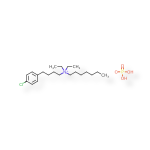
| Molecular Formula | C21H37ClN.H2O4P |
| Molecular Weight | 435.965 |
| Optical Activity | NONE |
| Defined Stereocenters | 0 / 1 |
| E/Z Centers | 0 |
| Charge | 0 |
SHOW SMILES / InChI
SMILES
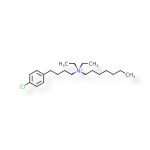
OP(O)([O-])=O.CCCCCCC[N+](CC)(CC)CCCCC1=CC=C(Cl)C=C1
InChI
InChIKey=HBLQZEWZVJXHKQ-UHFFFAOYSA-M
InChI=1S/C21H37ClN.H3O4P/c1-4-7-8-9-11-18-23(5-2,6-3)19-12-10-13-20-14-16-21(22)17-15-20;1-5(2,3)4/h14-17H,4-13,18-19H2,1-3H3;(H3,1,2,3,4)/q+1;/p-1
Clofilium is a quaternary ammonium compound that acts as potassium channel blocker. Clofilium is a class III agent. Clofilium increases atrial and ventricular effective refractory period without changing conduction time and, despite no apparent change in premature ventricular complex frequency, it can abolish the ability to induce ventricular tachycardia by programmed stimulation and is also well tolerated.
Approval Year
Targets
| Primary Target | Pharmacology | Condition | Potency |
|---|---|---|---|
| 2.0 nM [IC50] | |||
Target ID: Q5JUK3 Gene ID: 57582.0 Gene Symbol: KCNT1 Target Organism: Homo sapiens (Human) |
|||
Target ID: O95259 Gene ID: 3756.0 Gene Symbol: KCNH1 Target Organism: Homo sapiens (Human) |
255.0 nM [IC50] | ||
| 840.0 nM [IC50] |
Conditions
| Condition | Modality | Targets | Highest Phase | Product |
|---|---|---|---|---|
| Primary | Unknown Approved UseUnknown |
Overview
| CYP3A4 | CYP2C9 | CYP2D6 | hERG |
|---|---|---|---|
OverviewOther
| Other Inhibitor | Other Substrate | Other Inducer |
|---|---|---|
Drug as perpetrator
| Target | Modality | Activity | Metabolite | Clinical evidence |
|---|---|---|---|---|
| yes [Inhibition 20 uM] | ||||
| yes [Inhibition 20 uM] |
Tox targets
| Target | Modality | Activity | Metabolite | Clinical evidence |
|---|---|---|---|---|
PubMed
| Title | Date | PubMed |
|---|---|---|
| Modulation of drug block of the cardiac potassium channel KCNA5 by the drug transporters OCTN1 and MDR1. | 2010-11 |
|
| Activation of the TASK-2 channel after cell swelling is dependent on tyrosine phosphorylation. | 2010-10 |
|
| Emerging treatments in the management of schizophrenia - focus on sertindole. | 2010-09-07 |
|
| K+ channel openers restore verapamil-inhibited lung fluid resolution and transepithelial ion transport. | 2010-05-27 |
|
| Endogenous purinergic signaling is required for osmotic volume regulation of retinal glial cells. | 2010-03 |
|
| Uni- or bi-ventricular hypertrophy and susceptibility to drug-induced torsades de pointes. | 2010-01-30 |
|
| Stereoselective Inhibition of the hERG1 Potassium Channel. | 2010 |
|
| Involvement of A(1) adenosine receptors in osmotic volume regulation of retinal glial cells in mice. | 2009-09-12 |
|
| UTP regulation of ion transport in alveolar epithelial cells involves distinct mechanisms. | 2009-09 |
|
| ROS activate KCl cotransport in nonadherent Ehrlich ascites cells but K+ and Cl- channels in adherent Ehrlich Lettré and NIH3T3 cells. | 2009-07 |
|
| Pharmacological characteristics and clinical applications of K201. | 2009-05 |
|
| Molecular determinants of hERG channel block by terfenadine and cisapride. | 2008-11 |
|
| Dual pathway activated by tert-butyl hydroperoxide in human airway anion secretion. | 2008-11 |
|
| Importance of vagally mediated bradycardia for the induction of torsade de pointes in an in vivo model. | 2008-07 |
|
| Water and ion channels: crucial in the initiation and progression of apoptosis in central nervous system? | 2008-06 |
|
| Antitorsadogenic effects of ({+/-})-N-(2,6-dimethyl-phenyl)-(4[2-hydroxy-3-(2-methoxyphenoxy)propyl]-1-piperazine (ranolazine) in anesthetized rabbits. | 2008-06 |
|
| A gender-independent proarrhythmic action of 17beta-estradiol in anaesthetized rabbits. | 2007-12-01 |
|
| Involvement of KATP and KvLQT1 K+ channels in EGF-stimulated alveolar epithelial cell repair processes. | 2007-10 |
|
| Inhibition of the HERG potassium channel by the tricyclic antidepressant doxepin. | 2007-08-01 |
|
| K201, a multi-channel blocker, inhibits clofilium-induced torsades de pointes and attenuates an increase in repolarization. | 2007-01-19 |
|
| Arrhythmogenic mechanisms in the isolated perfused hypokalaemic murine heart. | 2007-01 |
|
| 5-Azacytidine induces changes in electrophysiological properties of human mesenchymal stem cells. | 2006-12 |
|
| Regulation of ENaC and CFTR expression with K+ channel modulators and effect on fluid absorption across alveolar epithelial cells. | 2006-12 |
|
| Distinct K+ conductive pathways are required for Cl- and K+ secretion across distal colonic epithelium. | 2006-10 |
|
| Use of a failing rabbit heart as a model to predict torsadogenicity. | 2006-09 |
|
| RSD1235 blocks late INa and suppresses early afterdepolarizations and torsades de pointes induced by class III agents. | 2006-06-01 |
|
| New insights about HERG blockade obtained from protein modeling, potential energy mapping, and docking studies. | 2006-05-01 |
|
| The role of late I and antiarrhythmic drugs in EAD formation and termination in Purkinje fibers. | 2006-05 |
|
| Functional IsK/KvLQT1 potassium channel in a new corticosteroid-sensitive cell line derived from the inner ear. | 2006-04-14 |
|
| Investigation of the role of TASK-2 channels in rat pulmonary arteries; pharmacological and functional studies following RNA interference procedures. | 2006-03 |
|
| Two-pore-domain potassium channels support anion secretion from human airway Calu-3 epithelial cells. | 2006-02 |
|
| Drug binding interactions in the inner cavity of HERG channels: molecular insights from structure-activity relationships of clofilium and ibutilide analogs. | 2006-02 |
|
| Tandem-pore domain potassium channels are functionally expressed in retinal (Müller) glial cells. | 2006-02 |
|
| Characterization of potassium channels involved in volume regulation of human spermatozoa. | 2005-12 |
|
| hERG1 channels are overexpressed in glioblastoma multiforme and modulate VEGF secretion in glioblastoma cell lines. | 2005-10-03 |
|
| In vivo targeting of ERG potassium channels in mice and dogs by a positron-emitting analogue of fluoroclofilium. | 2005-08-31 |
|
| The effects of putative K+ channel blockers on volume regulation of murine spermatozoa. | 2005-05 |
|
| Inhibitory effects of clofilium on membrane currents associated with Ca channels, NMDA receptor channels and Na+, K+-ATPase in cortical neurons. | 2005-03 |
|
| Volume regulation of mature and immature spermatozoa in a primate model, and possible ion channels involved. | 2004-11 |
|
| Structural determinants of HERG channel block by clofilium and ibutilide. | 2004-08 |
|
| Effects of chloride and potassium channel blockers on apoptotic cell shrinkage and apoptosis in cortical neurons. | 2004-06 |
|
| Volume changes and whole cell membrane currents activated during gradual osmolarity decrease in C6 glioma cells: contribution of two types of K+ channels. | 2004-06 |
|
| Molecular determinants for high-affinity block of human EAG potassium channels by antiarrhythmic agents. | 2004-05 |
|
| Functional evidence of a role for two-pore domain potassium channels in rat mesenteric and pulmonary arteries. | 2004-05 |
|
| Volume regulation is defective in renal proximal tubule cells isolated from KCNE1 knockout mice. | 2004-03 |
|
| Drug-related torsades de pointes in the isolated rabbit heart: comparison of clofilium, d,l-sotalol, and erythromycin. | 1998-09 |
|
| Mechanism of clofilium block of the human Kv1.5 delayed rectifier potassium channel. | 1995-01 |
|
| Cloning, expression, pharmacology and regulation of a delayed rectifier K+ channel in mouse heart. | 1991-10 |
|
| Broad sensitivity of rodent arrhythmia models to class I, II, III, and IV antiarrhythmic agents. | 1989-06 |
|
| Effects of antiarrhythmic agents on isoproterenol-induced ventricular fibrillation in heavy rats: a possible model of sudden cardiac death. | 1986-03 |
Sample Use Guides
In Vivo Use Guide
Curator's Comment: Humans: Clofilium was administered as a single bolus intravenously in doses ranging from 60 to 300 ug/kg during electrophysiologic testing. https://www.ncbi.nlm.nih.gov/pubmed/6881021
Eight dogs were given clofilium phosphate (0.34 mg/kg, iv). The maximum clofilium effect was a 31% decrease in threshold current and a 54% decrease in threshold energy.
Route of Administration:
Intravenous
In Vitro Use Guide
Curator's Comment: Clofilium (0.1-100 umol/l) inhibited high voltage-activated Ca2+ currents in concentration- and use-dependent manners. Clofilium acted as a potent antagonist of NMDA receptor channels, preferably blocked the NMDA steady-state current at a low concentration (0.1 umol/l). At concentrations of >100 umol/l, clofilium blocked both peak and steady-state NMDA currents in a voltage-independent manner. Clofilium also inhibited the Na+, K+-ATPase current with an IC50 of 7.5 umol/l. https://www.ncbi.nlm.nih.gov/pubmed/15637453
Clofilium at < or = 10(-6) M had no effect on WKY portal vein contractions and at < or = 3 x 10(-4) M had no effect on WKY or SHR quiescent mesenteric and intralobar pulmonary arteries. 3. Clofilium at 10(7) - 10(-5) M prolonged the WKY left ventricular action potentials and with 10(-6) and 10(-5)M this included after-depolarizations. 4. Clofilium at < or = 3 x 10(-5) M augmented the peak force, prolonged the contractions and did not cause arrhythmias in the absence and presence of isoprenaline on left ventricle strips from 12-month-old WKY.
| Name | Type | Language | ||
|---|---|---|---|---|
|
Preferred Name | English | ||
|
Official Name | English | ||
|
Code | English | ||
|
Common Name | English | ||
|
Common Name | English | ||
|
Common Name | English | ||
|
Common Name | English | ||
|
Systematic Name | English |
| Classification Tree | Code System | Code | ||
|---|---|---|---|---|
|
NCI_THESAURUS |
C47793
Created by
admin on Wed Apr 02 09:56:59 GMT 2025 , Edited by admin on Wed Apr 02 09:56:59 GMT 2025
|
| Code System | Code | Type | Description | ||
|---|---|---|---|---|---|
|
CHEMBL9484
Created by
admin on Wed Apr 02 09:56:59 GMT 2025 , Edited by admin on Wed Apr 02 09:56:59 GMT 2025
|
PRIMARY | |||
|
SUB06709MIG
Created by
admin on Wed Apr 02 09:56:59 GMT 2025 , Edited by admin on Wed Apr 02 09:56:59 GMT 2025
|
PRIMARY | |||
|
O1IXD77P8S
Created by
admin on Wed Apr 02 09:56:59 GMT 2025 , Edited by admin on Wed Apr 02 09:56:59 GMT 2025
|
PRIMARY | |||
|
100000084316
Created by
admin on Wed Apr 02 09:56:59 GMT 2025 , Edited by admin on Wed Apr 02 09:56:59 GMT 2025
|
PRIMARY | |||
|
C81432
Created by
admin on Wed Apr 02 09:56:59 GMT 2025 , Edited by admin on Wed Apr 02 09:56:59 GMT 2025
|
PRIMARY | |||
|
C022799
Created by
admin on Wed Apr 02 09:56:59 GMT 2025 , Edited by admin on Wed Apr 02 09:56:59 GMT 2025
|
PRIMARY | |||
|
DTXSID60987924
Created by
admin on Wed Apr 02 09:56:59 GMT 2025 , Edited by admin on Wed Apr 02 09:56:59 GMT 2025
|
PRIMARY | |||
|
4718
Created by
admin on Wed Apr 02 09:56:59 GMT 2025 , Edited by admin on Wed Apr 02 09:56:59 GMT 2025
|
PRIMARY | |||
|
68379-03-3
Created by
admin on Wed Apr 02 09:56:59 GMT 2025 , Edited by admin on Wed Apr 02 09:56:59 GMT 2025
|
PRIMARY | |||
|
6917809
Created by
admin on Wed Apr 02 09:56:59 GMT 2025 , Edited by admin on Wed Apr 02 09:56:59 GMT 2025
|
PRIMARY |
ACTIVE MOIETY
SUBSTANCE RECORD