Details
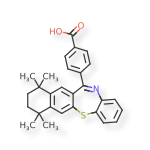
| Stereochemistry | ACHIRAL |
| Molecular Formula | C28H27NO2S |
| Molecular Weight | 441.584 |
| Optical Activity | NONE |
| Defined Stereocenters | 0 / 0 |
| E/Z Centers | 0 |
| Charge | 0 |
SHOW SMILES / InChI
SMILES
CC1(C)CCC(C)(C)C2=C1C=C3SC4=CC=CC=C4N=C(C5=CC=C(C=C5)C(O)=O)C3=C2
InChI
InChIKey=PFGCWQPTOKPRRK-UHFFFAOYSA-N
InChI=1S/C28H27NO2S/c1-27(2)13-14-28(3,4)21-16-24-19(15-20(21)27)25(17-9-11-18(12-10-17)26(30)31)29-22-7-5-6-8-23(22)32-24/h5-12,15-16H,13-14H2,1-4H3,(H,30,31)
DescriptionCurator's Comment: Description was created based on several sources, including https://www.ncbi.nlm.nih.gov/pubmed/26714014 https://www.ncbi.nlm.nih.gov/pubmed/24916544
Curator's Comment: Description was created based on several sources, including https://www.ncbi.nlm.nih.gov/pubmed/26714014 https://www.ncbi.nlm.nih.gov/pubmed/24916544
HX630 is a synthetic RXR pan-agonist. HX-630 has bein shown to exert anti-proliferative and pro-apoptotic effects in murine pituitary corticotroph tumor AtT20 cells, making HX-630 a new therapeutic candidate for Cushing’s disease. It might also serve as potential pharmacological tool for treating retina degenerative diseases and Alzheimer's disease.
Originator
Approval Year
Targets
| Primary Target | Pharmacology | Condition | Potency |
|---|---|---|---|
Target ID: CHEMBL2363070 |
|||
Target ID: CHEMBL2061 |
900.0 nM [Ki] | ||
Target ID: CHEMBL1870 |
400.0 nM [Ki] | ||
Target ID: CHEMBL2004 |
620.0 nM [Ki] | ||
Target ID: CHEMBL2008 |
320.0 nM [Ki] |
Conditions
| Condition | Modality | Targets | Highest Phase | Product |
|---|---|---|---|---|
| Primary | Unknown Approved UseUnknown |
|||
| Primary | Unknown Approved UseUnknown |
|||
| Primary | Unknown Approved UseUnknown |
PubMed
| Title | Date | PubMed |
|---|---|---|
| The ATRA-dependent overexpression of the glutamate transporter EAAC1 requires RARbeta induction. | 2009-09 |
|
| 9-cis-Retinoic acid (9cRA), a retinoid X receptor (RXR) ligand, exerts immunosuppressive effects on dendritic cells by RXR-dependent activation: inhibition of peroxisome proliferator-activated receptor gamma blocks some of the 9cRA activities, and precludes them to mature phenotype development. | 2007-05-15 |
|
| Regulation of retinoidal actions by diazepinylbenzoic acids. Retinoid synergists which activate the RXR-RAR heterodimers. | 1997-12-19 |
|
| Action mechanism of retinoid-synergistic dibenzodiazepines. | 1997-04-07 |
Patents
| Name | Type | Language | ||
|---|---|---|---|---|
|
Common Name | English | ||
|
Preferred Name | English |
| Code System | Code | Type | Description | ||
|---|---|---|---|---|---|
|
188844-52-2
Created by
admin on Mon Mar 31 22:25:46 GMT 2025 , Edited by admin on Mon Mar 31 22:25:46 GMT 2025
|
PRIMARY | |||
|
DTXSID80172254
Created by
admin on Mon Mar 31 22:25:46 GMT 2025 , Edited by admin on Mon Mar 31 22:25:46 GMT 2025
|
PRIMARY | |||
|
9889522
Created by
admin on Mon Mar 31 22:25:46 GMT 2025 , Edited by admin on Mon Mar 31 22:25:46 GMT 2025
|
PRIMARY | |||
|
N564S742U1
Created by
admin on Mon Mar 31 22:25:46 GMT 2025 , Edited by admin on Mon Mar 31 22:25:46 GMT 2025
|
PRIMARY |
ACTIVE MOIETY