Details
| Stereochemistry | ACHIRAL |
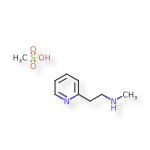
| Molecular Formula | C8H12N2.CH4O3S |
| Molecular Weight | 232.3 |
| Optical Activity | NONE |
| Defined Stereocenters | 0 / 0 |
| E/Z Centers | 0 |
| Charge | 0 |
SHOW SMILES / InChI
SMILES
CS(O)(=O)=O.CNCCC1=CC=CC=N1
InChI
InChIKey=FUWLKZQYMWTFBA-UHFFFAOYSA-N
InChI=1S/C8H12N2.CH4O3S/c1-9-7-5-8-4-2-3-6-10-8;1-5(2,3)4/h2-4,6,9H,5,7H2,1H3;1H3,(H,2,3,4)
DescriptionCurator's Comment: Description was created based on several sources, including https://www.ncbi.nlm.nih.gov/pubmed/11700150 | https://www.ncbi.nlm.nih.gov/pubmed/18447604 | https://www.ncbi.nlm.nih.gov/pubmed/19300572
Curator's Comment: Description was created based on several sources, including https://www.ncbi.nlm.nih.gov/pubmed/11700150 | https://www.ncbi.nlm.nih.gov/pubmed/18447604 | https://www.ncbi.nlm.nih.gov/pubmed/19300572
Betahistine is an orally administered, centrally acting histamine H1 receptor agonist with partial H3 antagonistic activity. It is proposed that betahistine may reduce peripherally the asymmetric functioning of the sensory vestibular organs in addition to increasing vestibulocochlear blood flow by antagonising local H3 heteroreceptors. Betahistine acts centrally by enhancing histamine synthesis within tuberomammillary nuclei of the posterior hypothalamus and histamine release within vestibular nuclei through antagonism of H3 autoreceptors. This mechanism, together with less specific effects of betahistine on alertness regulation through cerebral H1 receptors, should promote and facilitate central vestibular compensation. Betahistine is used to treat the symptoms associated with Ménière's disease, a condition of the inner ear which causes, vertigo (dizziness), tinnitus (ringing in the ears), hearing loss.
Approval Year
Targets
| Primary Target | Pharmacology | Condition | Potency |
|---|---|---|---|
Target ID: CHEMBL5076 |
31.0 µM [Ki] | ||
Target ID: CHEMBL4124 |
6.9 µM [Ki] |
Conditions
| Condition | Modality | Targets | Highest Phase | Product |
|---|---|---|---|---|
| Primary | Betahistine Approved UseBetahistine is used to treat the symptoms associated with Ménière's disease, a condition of the inner ear which causes, vertigo (dizziness), tinnitus (ringing in the ears), hearing loss. Launch Date1968 |
Cmax
| Value | Dose | Co-administered | Analyte | Population |
|---|---|---|---|---|
339.4 ng/mL EXPERIMENT https://pubmed.ncbi.nlm.nih.gov/14765546/ |
25 mg single, oral dose: 25 mg route of administration: Oral experiment type: SINGLE co-administered: |
2-PYRIDINEACETIC ACID plasma | Homo sapiens population: HEALTHY age: ADULT sex: MALE food status: FASTED |
AUC
| Value | Dose | Co-administered | Analyte | Population |
|---|---|---|---|---|
1196 ng × h/mL EXPERIMENT https://pubmed.ncbi.nlm.nih.gov/14765546/ |
25 mg single, oral dose: 25 mg route of administration: Oral experiment type: SINGLE co-administered: |
2-PYRIDINEACETIC ACID plasma | Homo sapiens population: HEALTHY age: ADULT sex: MALE food status: FASTED |
T1/2
| Value | Dose | Co-administered | Analyte | Population |
|---|---|---|---|---|
5.17 h EXPERIMENT https://pubmed.ncbi.nlm.nih.gov/14765546/ |
25 mg single, oral dose: 25 mg route of administration: Oral experiment type: SINGLE co-administered: |
2-PYRIDINEACETIC ACID plasma | Homo sapiens population: HEALTHY age: ADULT sex: MALE food status: FASTED |
Doses
| Dose | Population | Adverse events |
|---|---|---|
72 mg 3 times / day multiple, oral Highest studied dose Dose: 72 mg, 3 times / day Route: oral Route: multiple Dose: 72 mg, 3 times / day Sources: |
healthy, 20-31 |
|
728 mg 1 times / day single, oral Overdose Dose: 728 mg, 1 times / day Route: oral Route: single Dose: 728 mg, 1 times / day Sources: |
healthy, adult |
PubMed
| Title | Date | PubMed |
|---|---|---|
| Management of Ménière's disease in general practice: adherence to the UK National Health Service 'Prodigy' guidelines. | 2008-08 |
|
| Reversible sensorineural hearing loss in a girl with Kawasaki disease. | 2008-02-06 |
|
| Treating common ear problems in pregnancy: what is safe? | 2008-02 |
|
| Case report: a case of intractable Meniere's disease treated with autogenic training. | 2008-01-25 |
|
| Improving the quality of life in patients with vestibular disorders: the role of medical treatments and physical rehabilitation. | 2008-01 |
|
| A fixed combination of cinnarizine/dimenhydrinate for the treatment of patients with acute vertigo due to vestibular disorders : a randomized, reference-controlled clinical study. | 2008 |
|
| Patient baseline characteristics in an open-label multinational study of betahistine in recurrent peripheral vestibular vertigo: the OSVaLD study. | 2007-11 |
|
| 'Complementary ENT': a systematic review of commonly used supplements. | 2007-08 |
|
| Histaminergic ligands improve vestibular compensation in the cat: behavioural, neurochemical and molecular evidence. | 2007-07-30 |
|
| [Frequently occurring forms of dizziness and their treatment]. | 2007-05-21 |
|
| Histamine affects STAT6 phosphorylation via its effects on IL-4 secretion: role of H1 receptors in the regulation of IL-4 production. | 2007-03 |
|
| [Current methods for diagnosis and treatment of iatrogenic ototoxicity]. | 2007 |
|
| [Vestibular neuritis--a case description]. | 2007 |
|
| Role of apolipoprotein E in anxiety. | 2007 |
|
| [Fluctuating deafness]. | 2006-12 |
|
| [Treatment costs of otogenic vertigo]. | 2006-11-15 |
|
| Restoration of vestibular function: basic aspects and practical advances for rehabilitation. | 2006-09 |
|
| Betahistine in the treatment of vertiginous syndromes: a meta-analysis. | 2006-08 |
|
| [Efficacy of Betahistine Mesilate combined with Flunarizine Hydrochloride for treating tinnitus]. | 2006-04 |
|
| Betahistine increases ACh release from the cortex, but not histamine release from the nucleus basalis magnocellularis of freely-moving rats. 2. Histaminergic mechanisms in the CNS. | 2006-04 |
|
| [Assessment of betahistine dihydrochloride effectiveness in the treatment of vertigo of a different aetiology based on videonystagmography test results]. | 2006-03 |
|
| Role of H1 receptors in histamine-mediated up-regulation of STAT4 phosphorylation. | 2006-03 |
|
| Pharmacological advances in the treatment of neuro-otological and eye movement disorders. | 2006-02 |
|
| [Assessment of betahistine dihydrochloride effectiveness in the treatment of disturbance of balance system, based on analysis of doctors and patients questionnaires results]. | 2006 |
|
| [Clinical effectiveness of betahistine in monotherapy of vertigo for different etiology]. | 2006 |
|
| [Betaserk in therapy of cochleovestibular disordes]. | 2006 |
|
| Betahistine: a retrospective synopsis of safety data. | 2006 |
|
| [Betaserc in the treatment of vestibular dysfunctions of different etiology]. | 2006 |
|
| Histamine (H3) receptors modulate the excitatory amino acid receptor response of the vestibular afferents. | 2005-12-07 |
|
| Menière's disease. | 2005-12 |
|
| Optimizing the pharmacological component of integrated balance therapy. | 2005-11-15 |
|
| [Vertigo attacks -- current therapy]. | 2005-11 |
|
| Excitatory effect of histamine on neuronal activity of rat globus pallidus by activation of H2 receptors in vitro. | 2005-11 |
|
| Dose- and duration-dependent effects of betahistine dihydrochloride treatment on histamine turnover in the cat. | 2005-10-31 |
|
| West Nile virus infection and conjunctival exposure. | 2005-10 |
|
| [A clinical study on the effect of Yinxing Damo combined with betahistine hydrochloride injection on vertebral basilar artery ischemic vertigo]. | 2005-09 |
|
| Involvement of histamine H1 and H2 receptors in the regulation of STAT-1 phosphorylation: inverse agonism exhibited by the receptor antagonists. | 2005-07 |
|
| Effects of betahistine on the spatiotemporal response properties of vestibulospinal neurons to labyrinthine volleys. | 2005-05-16 |
|
| Benign paroxysmal positional vertigo: a study of two manoeuvres with and without betahistine. | 2005-04 |
|
| A national survey amongst UK otolaryngologists regarding the treatment of Ménière's disease. | 2005-02 |
|
| Efficacy and Tolerability of a Fixed Combination of Cinnarizine and Dimenhydrinate versus Betahistine in the Treatment of Otogenic Vertigo : A Double-Blind, Randomised Clinical Study. | 2005 |
|
| [Clinico-neurological and stabilometric analysis of betahistine (betaserc) efficacy in the patients with vertigo in the rehabilitation period of ischemic stroke]. | 2005 |
|
| [Efficacy of betaserk in experimental motor disease]. | 2005 |
|
| [Epidemiology, clinical features and betaserc therapy of vertigo in initial and reversible cerebrovascular pathology]. | 2005 |
|
| [Betaserk in the treatment of aftereffects of craniocerebral injury and vascular events]. | 2005 |
|
| [Betaserc and improvement of life quality in war veterans]. | 2005 |
|
| Meniere's disease. | 2004-12 |
|
| [Cerebral hemodynamics and statokinetic functions in patients with vertebral basilar vascular insufficiency]. | 2004 |
|
| Betahistine in vertebrobasilar insufficiency. | 2004 |
|
| Investigation of Betaserc in auditory and vestibular disturbances. | 2004 |
Sample Use Guides
The usual dose is one tablet (16mg) or two tablets (8mg) three times a day, preferably taken with meals.
Route of Administration:
Oral
| Name | Type | Language | ||
|---|---|---|---|---|
|
Common Name | English | ||
|
Preferred Name | English | ||
|
Systematic Name | English | ||
|
Systematic Name | English | ||
|
Common Name | English |
| Code System | Code | Type | Description | ||
|---|---|---|---|---|---|
|
380416-14-8
Created by
admin on Mon Mar 31 23:02:59 GMT 2025 , Edited by admin on Mon Mar 31 23:02:59 GMT 2025
|
PRIMARY | |||
|
6420033
Created by
admin on Mon Mar 31 23:02:59 GMT 2025 , Edited by admin on Mon Mar 31 23:02:59 GMT 2025
|
PRIMARY | |||
|
M2S8P6LJ5S
Created by
admin on Mon Mar 31 23:02:59 GMT 2025 , Edited by admin on Mon Mar 31 23:02:59 GMT 2025
|
PRIMARY |
ACTIVE MOIETY
SUBSTANCE RECORD