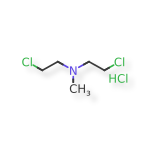
Details
| Stereochemistry | ACHIRAL |
| Molecular Formula | C5H11Cl2N.ClH |
| Molecular Weight | 192.514 |
| Optical Activity | NONE |
| Defined Stereocenters | 0 / 0 |
| E/Z Centers | 0 |
| Charge | 0 |
SHOW SMILES / InChI
SMILES
Cl.CN(CCCl)CCCl
InChI
InChIKey=QZIQJVCYUQZDIR-UHFFFAOYSA-N
InChI=1S/C5H11Cl2N.ClH/c1-8(4-2-6)5-3-7;/h2-5H2,1H3;1H
Mechlorethamine also known as mustine, brand name MUSTARGEN administered intravenously is the prototype anticancer chemotherapeutic drug, is indicated for the palliative treatment of Hodgkin's disease (Stages III and IV), lymphosarcoma, chronic myelocytic or chronic lymphocytic leukemia, polycythemia vera, mycosis fungoides, and bronchogenic carcinoma. In 2013 was approved orphan drug Valchlor (mechlorethamine) gel for the topical treatment of stage IA and IB mycosis fungoides-type cutaneous T-cell lymphoma (CTCL) in patients who have received prior skin-directed therapy. Mechlorethamine belongs to the group of nitrogen mustard alkylating agents. Alkylating agents work by three different mechanisms: attachment of alkyl groups to DNA bases, resulting in the DNA being fragmented by repair enzymes in their attempts to replace the alkylated bases, 2) DNA damage via the formation of cross-links (bonds between atoms in the DNA) which prevents DNA from being separated for synthesis or transcription, and 3) the induction of mispairing of the nucleotides leading to mutations all of which achieve the same end result - disruption of DNA function and cell death.
Approval Year
Targets
| Primary Target | Pharmacology | Condition | Potency |
|---|---|---|---|
Target ID: CHEMBL2311221 |
Conditions
| Condition | Modality | Targets | Highest Phase | Product |
|---|---|---|---|---|
| Palliative | MUSTARGEN Approved UseVALCHLOR is an alkylating drug indicated for the topical treatment of Stage IA and IB mycosis fungoides-type cutaneous T-cell lymphoma in patients who have received prior skin-directed therapy. VALCHLOR is an alkylating drug indicated for the topical treatment of Stage IA and IB mycosis fungoides-type cutaneous T-cell lymphoma in patients who have received prior skin-directed therapy (1). Launch Date1949 |
|||
| Palliative | MUSTARGEN Approved UseVALCHLOR is an alkylating drug indicated for the topical treatment of Stage IA and IB mycosis fungoides-type cutaneous T-cell lymphoma in patients who have received prior skin-directed therapy. VALCHLOR is an alkylating drug indicated for the topical treatment of Stage IA and IB mycosis fungoides-type cutaneous T-cell lymphoma in patients who have received prior skin-directed therapy (1). Launch Date1949 |
|||
| Palliative | MUSTARGEN Approved UseVALCHLOR is an alkylating drug indicated for the topical treatment of Stage IA and IB mycosis fungoides-type cutaneous T-cell lymphoma in patients who have received prior skin-directed therapy. VALCHLOR is an alkylating drug indicated for the topical treatment of Stage IA and IB mycosis fungoides-type cutaneous T-cell lymphoma in patients who have received prior skin-directed therapy (1). Launch Date1949 |
|||
| Palliative | MUSTARGEN Approved UseVALCHLOR is an alkylating drug indicated for the topical treatment of Stage IA and IB mycosis fungoides-type cutaneous T-cell lymphoma in patients who have received prior skin-directed therapy. VALCHLOR is an alkylating drug indicated for the topical treatment of Stage IA and IB mycosis fungoides-type cutaneous T-cell lymphoma in patients who have received prior skin-directed therapy (1). Launch Date1949 |
|||
| Palliative | MUSTARGEN Approved UseVALCHLOR is an alkylating drug indicated for the topical treatment of Stage IA and IB mycosis fungoides-type cutaneous T-cell lymphoma in patients who have received prior skin-directed therapy. VALCHLOR is an alkylating drug indicated for the topical treatment of Stage IA and IB mycosis fungoides-type cutaneous T-cell lymphoma in patients who have received prior skin-directed therapy (1). Launch Date1949 |
Cmax
| Value | Dose | Co-administered | Analyte | Population |
|---|---|---|---|---|
1.72 μg/mL EXPERIMENT https://www.ncbi.nlm.nih.gov/pubmed/11129502 |
0.2 mg/kg single, oral dose: 0.2 mg/kg route of administration: Oral experiment type: SINGLE co-administered: |
MECHLORETHAMINE plasma | Homo sapiens population: UNHEALTHY age: ADULT sex: FEMALE / MALE food status: FASTED |
AUC
| Value | Dose | Co-administered | Analyte | Population |
|---|---|---|---|---|
3.17 μg × h/mL EXPERIMENT https://www.ncbi.nlm.nih.gov/pubmed/11129502 |
0.2 mg/kg single, oral dose: 0.2 mg/kg route of administration: Oral experiment type: SINGLE co-administered: |
MECHLORETHAMINE plasma | Homo sapiens population: UNHEALTHY age: ADULT sex: FEMALE / MALE food status: FASTED |
T1/2
| Value | Dose | Co-administered | Analyte | Population |
|---|---|---|---|---|
0.16 h EXPERIMENT https://www.ncbi.nlm.nih.gov/pubmed/11129502 |
0.2 mg/kg single, oral dose: 0.2 mg/kg route of administration: Oral experiment type: SINGLE co-administered: |
MECHLORETHAMINE plasma | Homo sapiens population: UNHEALTHY age: ADULT sex: FEMALE / MALE food status: FASTED |
Doses
| Dose | Population | Adverse events |
|---|---|---|
0.4 mg/kg single, intravenous Recommended Dose: 0.4 mg/kg Route: intravenous Route: single Dose: 0.4 mg/kg Sources: |
unhealthy, 14-80 |
Disc. AE: Thrombocytopenia, Hemorrhage... AEs leading to discontinuation/dose reduction: Thrombocytopenia (severe, 3.8%) Sources: Hemorrhage (3.8%) |
0.4 mg/kg single, intravenous Recommended Dose: 0.4 mg/kg Route: intravenous Route: single Dose: 0.4 mg/kg Sources: |
unhealthy, 32-81 |
Disc. AE: Pancytopenia... AEs leading to discontinuation/dose reduction: Pancytopenia (5.6%) Sources: |
0.02 % 1 times / day multiple, topical Recommended Dose: 0.02 %, 1 times / day Route: topical Route: multiple Dose: 0.02 %, 1 times / day Sources: |
unhealthy, 44 |
Disc. AE: Contact dermatitis... AEs leading to discontinuation/dose reduction: Contact dermatitis (75%) Sources: |
0.016 % 1 times / day multiple, topical Recommended Dose: 0.016 %, 1 times / day Route: topical Route: multiple Dose: 0.016 %, 1 times / day Sources: |
unhealthy Health Status: unhealthy Sources: |
Disc. AE: Eye injury, Dermatitis... AEs leading to discontinuation/dose reduction: Eye injury Sources: Dermatitis Cancer of skin (excl melanoma) Disorder fetal |
0.4 mg/kg single, intravenous Recommended Dose: 0.4 mg/kg Route: intravenous Route: single Dose: 0.4 mg/kg Sources: |
unhealthy Health Status: unhealthy Sources: |
Disc. AE: Amyloidosis... AEs leading to discontinuation/dose reduction: Amyloidosis Sources: |
AEs
| AE | Significance | Dose | Population |
|---|---|---|---|
| Hemorrhage | 3.8% Disc. AE |
0.4 mg/kg single, intravenous Recommended Dose: 0.4 mg/kg Route: intravenous Route: single Dose: 0.4 mg/kg Sources: |
unhealthy, 14-80 |
| Thrombocytopenia | severe, 3.8% Disc. AE |
0.4 mg/kg single, intravenous Recommended Dose: 0.4 mg/kg Route: intravenous Route: single Dose: 0.4 mg/kg Sources: |
unhealthy, 14-80 |
| Pancytopenia | 5.6% Disc. AE |
0.4 mg/kg single, intravenous Recommended Dose: 0.4 mg/kg Route: intravenous Route: single Dose: 0.4 mg/kg Sources: |
unhealthy, 32-81 |
| Contact dermatitis | 75% Disc. AE |
0.02 % 1 times / day multiple, topical Recommended Dose: 0.02 %, 1 times / day Route: topical Route: multiple Dose: 0.02 %, 1 times / day Sources: |
unhealthy, 44 |
| Cancer of skin (excl melanoma) | Disc. AE | 0.016 % 1 times / day multiple, topical Recommended Dose: 0.016 %, 1 times / day Route: topical Route: multiple Dose: 0.016 %, 1 times / day Sources: |
unhealthy Health Status: unhealthy Sources: |
| Dermatitis | Disc. AE | 0.016 % 1 times / day multiple, topical Recommended Dose: 0.016 %, 1 times / day Route: topical Route: multiple Dose: 0.016 %, 1 times / day Sources: |
unhealthy Health Status: unhealthy Sources: |
| Disorder fetal | Disc. AE | 0.016 % 1 times / day multiple, topical Recommended Dose: 0.016 %, 1 times / day Route: topical Route: multiple Dose: 0.016 %, 1 times / day Sources: |
unhealthy Health Status: unhealthy Sources: |
| Eye injury | Disc. AE | 0.016 % 1 times / day multiple, topical Recommended Dose: 0.016 %, 1 times / day Route: topical Route: multiple Dose: 0.016 %, 1 times / day Sources: |
unhealthy Health Status: unhealthy Sources: |
| Amyloidosis | Disc. AE | 0.4 mg/kg single, intravenous Recommended Dose: 0.4 mg/kg Route: intravenous Route: single Dose: 0.4 mg/kg Sources: |
unhealthy Health Status: unhealthy Sources: |
PubMed
| Title | Date | PubMed |
|---|---|---|
| The treatment of adults with medulloblastoma: a prospective study. | 2003-11-01 |
|
| Management of mycosis fungoides: Part 2. Treatment. | 2003-10 |
|
| [Hematologic tumors]. | 2003-10 |
|
| Old wine in new bottles: reviving old therapies for alopecia areata using rodent models. | 2003-10 |
|
| [Second malignancies following Hodgkin's disease treatment in Tunisia. Retrospective study of 26 cases observed at the institute Salah-Azaïz]. | 2003-10 |
|
| Alleviation of mutagenic effects of polycyclic aromatic agents (quinacrine mustard, ICR-191 and ICR-170) by caffeine and pentoxifylline. | 2003-09-29 |
|
| Radiotherapy for advanced Hodgkin's disease. | 2003-09-18 |
|
| The protective and therapeutic effects of zinc chloride and desferrioxamine on skin exposed to nitrogen mustard. | 2003-08 |
|
| Topical nitrogen mustard in the treatment of alopecia areata: a bilateral comparison study. | 2003-08 |
|
| Secondary myelodysplastic syndrome and acute myelogenous leukemia are significant complications following autologous stem cell transplantation for lymphoma. | 2003-08 |
|
| Radiation therapy in the treatment of Hodgkin's disease--do you see what I see? | 2003-07-02 |
|
| Analysis of treatment results in advanced Hodgkin's disease: the case for adjuvant radiotherapy. | 2003-07-01 |
|
| Revascularization for acute coronary occlusion in a young woman following radiation. | 2003-07 |
|
| Injury induced by chemical warfare agents: characterization and treatment of ocular tissues exposed to nitrogen mustard. | 2003-07 |
|
| High-dose therapy and autologous stem-cell transplantation versus conventional therapy for patients with advanced Hodgkin's lymphoma responding to front-line therapy. | 2003-06-15 |
|
| Cutaneous granulomas as the first manifestation of Hodgkin's disease. | 2003-06-14 |
|
| Involved-field radiotherapy for advanced Hodgkin's lymphoma. | 2003-06-12 |
|
| Myeloid clonogenic assays for comparison of the in vitro toxicity of alkylating agents. | 2003-06 |
|
| Impaired healing of nitrogen mustard wounds in CXCR2 null mice. | 2003-05-20 |
|
| Bexarotene gel: a new skin-directed treatment option for cutaneous T-cell lymphomas. | 2003-04 |
|
| Bilateral renal artery stenosis after abdominal radiotherapy for Hodgkin's disease. | 2003-04 |
|
| Differential diagnosis of Fanconi anemia by nitrogen mustard and diepoxybutane. | 2003-04 |
|
| [Hodgkin's disease manifesting as paraneoplastic limbic encephalitis]. | 2003-04 |
|
| Synthesis and in vivo biodisposition of [14C]-quaternary ammonium-melphalan conjugate, a potential cartilage-targeted alkylating drug. | 2003-03-20 |
|
| Myelodysplastic syndrome and acute myeloid leukemia after autotransplantation for lymphoma: a multicenter case-control study. | 2003-03-01 |
|
| Early and intermediate stage Hodgkin's lymphoma--report from the Swedish National Care Programme. | 2003-03 |
|
| Topical mechlorethamine restores autoimmune-arrested follicular activity in mice with an alopecia areata-like disease by targeting infiltrated lymphocytes. | 2003-03 |
|
| Quantitative determination of the hydrolysis products of nitrogen mustards in human urine by liquid chromatography-electrospray ionization tandem mass spectrometry. | 2003-02-18 |
|
| Randomized comparison of ABVD and MOPP/ABV hybrid for the treatment of advanced Hodgkin's disease: report of an intergroup trial. | 2003-02-15 |
|
| Advanced Hodgkin's disease: ABVD is better, yet is not good enough! | 2003-02-15 |
|
| Topical nitrogen mustard in the management of mycosis fungoides: update of the Stanford experience. | 2003-02 |
|
| Improved survival in HIV-related Hodgkin's lymphoma since the introduction of highly active antiretroviral therapy. | 2003-01-03 |
|
| Topical nitrogen mustard ointment with occlusion for Langerhans' cell histiocytosis of the scalp. | 2003-01 |
|
| [Cutaneous T-cell lymphoma following renal transplantation]. | 2003-01 |
|
| An elevated serum beta-2-microglobulin level is an adverse prognostic factor for overall survival in patients with early-stage Hodgkin disease. | 2002-12-15 |
|
| [Psoriasis of the scalp]. | 2002-12 |
|
| Postpneumonectomy-like syndrome after chemoradiation therapy for lymphoma. | 2002-12 |
|
| Serum levels of soluble CD30 improve International Prognostic Score in predicting the outcome of advanced Hodgkin's lymphoma. | 2002-12 |
|
| Pathways of reductive fragmentation of heterocyclic nitroarylmethyl quaternary ammonium prodrugs of mechlorethamine. | 2002-12 |
|
| Radiotherapy alone for lymphocyte-predominant Hodgkin's disease. | 2002-11-06 |
|
| Evaluation of a 1-h exposure time to mechlorethamine in patients undergoing topical treatment. | 2002-11 |
|
| Long-term results of conventional-dose salvage chemotherapy in patients with refractory and relapsed Hodgkin's disease (Croatian experience). | 2002-10 |
|
| MOPP chemotherapy for treatment of resistant lymphoma in dogs: a retrospective study of 117 cases (1989-2000). | 2002-09-27 |
|
| Stanford V regimen and concomitant HAART in 59 patients with Hodgkin disease and HIV infection. | 2002-09-15 |
|
| [Cured from Hodgkin's disease]. | 2002-09-06 |
|
| The ability to engage enterocyte apoptosis does not predict long-term crypt survival in p53 and Msh2 deficient mice. | 2002-08-29 |
|
| [Advanced oxidation protein products in pregnancy]. | 2002-07 |
|
| [Z-form of intraphage DNA]. | 2002 |
|
| From poison gas to wonder drug. | 2002 |
|
| A pilot study on the influence of a corticotropin (4-9) analogue on Vinca alkaloid-induced neuropathy. | 1992-10 |
Sample Use Guides
Intravenous Administration: the dosage of MUSTARGEN (MECHLORETHAMINE HCl ) varies with the clinical situation, the therapeutic response and the magnitude of hematologic depression. A total dose of 0.4 mg/kg of body weight for each course usually is given either as a single dose or in divided doses of 0.1 to 0.2 mg/kg per day.
Intracavitary Administration: The usual dose of nitrogen mustard for intracavitary injection is 0.4 mg/kg of body weight, though 0.2 mg/kg (or 10 to 20 mg) has been used by the intrapericardial route.5,11-13 The solution is prepared, as previously described for intravenous injection, by adding 10 mL of Sterile Water for Injection or 10 mL of Sodium Chloride Injection to the vial containing 10 mg of mechlorethamine hydrochloride. (Amounts of diluent of 50 to 100 mL of normal saline have also been used.4,5) The position of the patient should be changed every 5 to 10 minutes for an hour after injection to obtain more uniform distribution of the drug throughout the serous cavity. The remaining fluid may be removed from the pleural or peritoneal cavity by
paracentesis 24 to 36 hours later. The patient should be followed carefully by clinical and x-ray examination to detect reaccumulation of fluid.
Route of Administration:
Other
In Vitro Use Guide
Curator's Comment: It was examined the ability of mechlorethamine (MCT) to conceal the 6H4 epitope and block prion protein PrP conversion in the presence of a reducing reagent. Mechlorethamine treatment significantly decreased in vitro amplification of cellular prion protein (PrP(C)) in the highly efficient protein misfolding cyclic amplification system, thus was suggest that MCT might serve as a potential therapeutic agent for prion diseases.
Unknown
| Name | Type | Language | ||
|---|---|---|---|---|
|
Common Name | English | ||
|
Preferred Name | English | ||
|
Brand Name | English | ||
|
Common Name | English | ||
|
Common Name | English | ||
|
Common Name | English | ||
|
Common Name | English | ||
|
Common Name | English | ||
|
Common Name | English | ||
|
Common Name | English | ||
|
Brand Name | English | ||
|
Common Name | English | ||
|
Code | English | ||
|
Common Name | English | ||
|
Common Name | English | ||
|
Common Name | English | ||
|
Common Name | English | ||
|
Systematic Name | English | ||
|
Common Name | English | ||
|
Systematic Name | English | ||
|
Common Name | English |
| Classification Tree | Code System | Code | ||
|---|---|---|---|---|
|
NCI_THESAURUS |
C697
Created by
admin on Mon Mar 31 17:51:21 GMT 2025 , Edited by admin on Mon Mar 31 17:51:21 GMT 2025
|
| Code System | Code | Type | Description | ||
|---|---|---|---|---|---|
|
200-246-0
Created by
admin on Mon Mar 31 17:51:21 GMT 2025 , Edited by admin on Mon Mar 31 17:51:21 GMT 2025
|
PRIMARY | |||
|
7176
Created by
admin on Mon Mar 31 17:51:21 GMT 2025 , Edited by admin on Mon Mar 31 17:51:21 GMT 2025
|
PRIMARY | |||
|
L0MR697HHI
Created by
admin on Mon Mar 31 17:51:21 GMT 2025 , Edited by admin on Mon Mar 31 17:51:21 GMT 2025
|
PRIMARY | |||
|
DBSALT000904
Created by
admin on Mon Mar 31 17:51:21 GMT 2025 , Edited by admin on Mon Mar 31 17:51:21 GMT 2025
|
PRIMARY | |||
|
1376505
Created by
admin on Mon Mar 31 17:51:21 GMT 2025 , Edited by admin on Mon Mar 31 17:51:21 GMT 2025
|
PRIMARY | |||
|
155036
Created by
admin on Mon Mar 31 17:51:21 GMT 2025 , Edited by admin on Mon Mar 31 17:51:21 GMT 2025
|
PRIMARY | RxNorm | ||
|
CHEMBL427
Created by
admin on Mon Mar 31 17:51:21 GMT 2025 , Edited by admin on Mon Mar 31 17:51:21 GMT 2025
|
PRIMARY | |||
|
100000090553
Created by
admin on Mon Mar 31 17:51:21 GMT 2025 , Edited by admin on Mon Mar 31 17:51:21 GMT 2025
|
PRIMARY | |||
|
762
Created by
admin on Mon Mar 31 17:51:21 GMT 2025 , Edited by admin on Mon Mar 31 17:51:21 GMT 2025
|
PRIMARY | |||
|
SUB01220MIG
Created by
admin on Mon Mar 31 17:51:21 GMT 2025 , Edited by admin on Mon Mar 31 17:51:21 GMT 2025
|
PRIMARY | |||
|
55-86-7
Created by
admin on Mon Mar 31 17:51:21 GMT 2025 , Edited by admin on Mon Mar 31 17:51:21 GMT 2025
|
PRIMARY | |||
|
DTXSID8025757
Created by
admin on Mon Mar 31 17:51:21 GMT 2025 , Edited by admin on Mon Mar 31 17:51:21 GMT 2025
|
PRIMARY | |||
|
5935
Created by
admin on Mon Mar 31 17:51:21 GMT 2025 , Edited by admin on Mon Mar 31 17:51:21 GMT 2025
|
PRIMARY | |||
|
55368
Created by
admin on Mon Mar 31 17:51:21 GMT 2025 , Edited by admin on Mon Mar 31 17:51:21 GMT 2025
|
PRIMARY | |||
|
L0MR697HHI
Created by
admin on Mon Mar 31 17:51:21 GMT 2025 , Edited by admin on Mon Mar 31 17:51:21 GMT 2025
|
PRIMARY | |||
|
m7116
Created by
admin on Mon Mar 31 17:51:21 GMT 2025 , Edited by admin on Mon Mar 31 17:51:21 GMT 2025
|
PRIMARY | Merck Index | ||
|
C627
Created by
admin on Mon Mar 31 17:51:21 GMT 2025 , Edited by admin on Mon Mar 31 17:51:21 GMT 2025
|
PRIMARY |
ACTIVE MOIETY
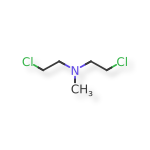
SUBSTANCE RECORD