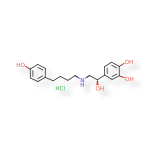
Details
| Stereochemistry | ABSOLUTE |
| Molecular Formula | C18H23NO4.ClH |
| Molecular Weight | 353.84 |
| Optical Activity | UNSPECIFIED |
| Defined Stereocenters | 1 / 1 |
| E/Z Centers | 0 |
| Charge | 0 |
SHOW SMILES / InChI
SMILES
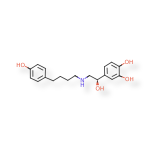
Cl.O[C@@H](CNCCCCC1=CC=C(O)C=C1)C2=CC(O)=C(O)C=C2
InChI
InChIKey=ATBUNPBAFFCFKY-FERBBOLQSA-N
InChI=1S/C18H23NO4.ClH/c20-15-7-4-13(5-8-15)3-1-2-10-19-12-18(23)14-6-9-16(21)17(22)11-14;/h4-9,11,18-23H,1-3,10,12H2;1H/t18-;/m0./s1
Arbutamine was indicated to elicit acute cardiovascular responses in order to aid in diagnosing the presence or absence of coronary artery disease in patients who cannot exercise adequately. Arbutamine is a synthetic catecholamine with positive chronotropic and inotropic properties. The chronotropic (increase in heart rate [HR]) and inotropic (increase in force of contraction) effects of arbutamine serve to mimic exercise by increasing cardiac work (producing stress) and provoke myocardial ischemia in patients with compromised coronary arteries. In functional assays, arbutamine is more selective for beta-adrenergic receptors than for alpha-adrenergic receptors. The beta-agonist activity of arbutamine provides cardiac stress by increasing HR, cardiac contractility, and systolic blood pressure.
Approval Year
T1/2
| Value | Dose | Co-administered | Analyte | Population |
|---|---|---|---|---|
5 min |
10 μg/kg single, intravenous dose: 10 μg/kg route of administration: Intravenous experiment type: SINGLE co-administered: |
ARBUTAMINE plasma | Homo sapiens population: HEALTHY age: ADULT sex: MALE food status: UNKNOWN |
Funbound
| Value | Dose | Co-administered | Analyte | Population |
|---|---|---|---|---|
42% |
10 μg/kg single, intravenous dose: 10 μg/kg route of administration: Intravenous experiment type: SINGLE co-administered: |
ARBUTAMINE plasma | Homo sapiens population: HEALTHY age: ADULT sex: MALE food status: UNKNOWN |
Doses
| Dose | Population | Adverse events |
|---|---|---|
4.62 mg/kg single, oral Recommended Dose: 4.62 mg/kg Route: oral Route: single Dose: 4.62 mg/kg Sources: |
healthy, 20-70 |
Disc. AE: Arrhythmia, Hypotension... Other AEs: Arrhythmia... AEs leading to discontinuation/dose reduction: Arrhythmia (2%) Other AEs:Hypotension (9%) Arrhythmia (29 patients) Sources: |
3.58 mg/kg single, oral Recommended Dose: 3.58 mg/kg Route: oral Route: single Dose: 3.58 mg/kg Sources: |
healthy, 37 - 79 years Health Status: healthy Age Group: 37 - 79 years Sex: M+F Sources: |
Disc. AE: Angina, Arrhythmia... Other AEs: Arrhythmia... AEs leading to discontinuation/dose reduction: Angina (21%) Other AEs:Arrhythmia (4%) Hypotension (4%) Dyspnea (4%) Arrhythmia (103 patients) Sources: |
AEs
| AE | Significance | Dose | Population |
|---|---|---|---|
| Arrhythmia | 2% Disc. AE |
4.62 mg/kg single, oral Recommended Dose: 4.62 mg/kg Route: oral Route: single Dose: 4.62 mg/kg Sources: |
healthy, 20-70 |
| Arrhythmia | 29 patients | 4.62 mg/kg single, oral Recommended Dose: 4.62 mg/kg Route: oral Route: single Dose: 4.62 mg/kg Sources: |
healthy, 20-70 |
| Hypotension | 9% Disc. AE |
4.62 mg/kg single, oral Recommended Dose: 4.62 mg/kg Route: oral Route: single Dose: 4.62 mg/kg Sources: |
healthy, 20-70 |
| Arrhythmia | 103 patients | 3.58 mg/kg single, oral Recommended Dose: 3.58 mg/kg Route: oral Route: single Dose: 3.58 mg/kg Sources: |
healthy, 37 - 79 years Health Status: healthy Age Group: 37 - 79 years Sex: M+F Sources: |
| Angina | 21% Disc. AE |
3.58 mg/kg single, oral Recommended Dose: 3.58 mg/kg Route: oral Route: single Dose: 3.58 mg/kg Sources: |
healthy, 37 - 79 years Health Status: healthy Age Group: 37 - 79 years Sex: M+F Sources: |
| Arrhythmia | 4% Disc. AE |
3.58 mg/kg single, oral Recommended Dose: 3.58 mg/kg Route: oral Route: single Dose: 3.58 mg/kg Sources: |
healthy, 37 - 79 years Health Status: healthy Age Group: 37 - 79 years Sex: M+F Sources: |
| Dyspnea | 4% Disc. AE |
3.58 mg/kg single, oral Recommended Dose: 3.58 mg/kg Route: oral Route: single Dose: 3.58 mg/kg Sources: |
healthy, 37 - 79 years Health Status: healthy Age Group: 37 - 79 years Sex: M+F Sources: |
| Hypotension | 4% Disc. AE |
3.58 mg/kg single, oral Recommended Dose: 3.58 mg/kg Route: oral Route: single Dose: 3.58 mg/kg Sources: |
healthy, 37 - 79 years Health Status: healthy Age Group: 37 - 79 years Sex: M+F Sources: |
PubMed
| Title | Date | PubMed |
|---|---|---|
| Feasibility, safety and tolerability of accelerated dobutamine stress echocardiography. | 2007-11-21 |
|
| Asymmetric hydrogenation of alpha-primary and secondary amino ketones: efficient asymmetric syntheses of (-)-arbutamine and (-)-denopamine. | 2007 |
|
| Dobutamine stress echocardiography in healthy adult male rats. | 2005-10-26 |
|
| Sonovue improves endocardial border detection and variability in assessing wall motion score and ejection fraction during stress echocardiography. | 2005-03-01 |
|
| [Comparison of usefulness of dobutamine-atropine and dobutamine-adenosine stress echocardiography in detection of coronary artery disease]. | 2004-04 |
|
| Myocardial perfusion scintigraphy: the evidence. | 2004-02 |
|
| Use of pharmaceuticals in noninvasive cardiovascular diagnosis. | 2002-09-28 |
|
| Effect of ligand structure on the zinc-catalyzed Henry reaction. Asymmetric syntheses of (-)-denopamine and (-)-arbutamine. | 2002-08-08 |
|
| Pharmacologic interventions in nuclear radiology: indications, imaging protocols, and clinical results. | 2002-05-15 |
|
| Arbutamine stress perfusion imaging in dogs with critical coronary artery stenoses: (99m)Tc-sestamibi versus (201)Tl. | 2002-05 |
|
| Identification of viable myocardium early after acute myocardial infarction using closed-loop arbutamine echocardiography: comparison with positron emission tomography. | 2001-12 |
|
| Pharmacological stress agents for evaluation of ischemic heart disease. | 2001-12 |
|
| Assessment of adenosine, arbutamine and dobutamine as pharmacological stress agents during (99m)Tc-tetrofosmin SPECT imaging: a randomized study. | 2001-12 |
|
| Incremental prognostic value of RNA ejection fraction measurements during pharmacologic stress testing: a comparison with clinical and perfusion variables. | 2001-06 |
|
| Arbutamine stimulation detects viable myocardium 4 weeks after coronary occlusion. | 2001-02 |
|
| [Methodological aspects of performing exercise tests used in combination with perfusion scintigraphy of the myocardium]. | 2001 |
|
| Characterization of the adrenergic activity of arbutamine, a novel agent for pharmacological stress testing. | 1996-03 |
Sample Use Guides
Intravenous infusion, up to a maximum of 10 mcg per kg of body weight as administered by the drug delivery device
Route of Administration:
Intravenous
It was characterized the interactions of arbutamine with different adrenergic receptor subtypes in vitro. In the electrically stimulated left atria of rats, arbutamine increased contractile force. The pD2 values (- log of the dose that produces 50% of the maximal responses) for arbutamine and isoproterenol were 8.45 +/- 0.15 and 8.55 +/- 0.02, respectively. Both arbutamine and isoproterenol increased the rate of spontaneously beating rat right atria with pD2 values of 9.0 +/- 0.19 and 8.82 +/- 0.18, respectively. The affinity constants (KA) of arbutamine and isoproterenol for cardiac beta1-adrenergic receptors, as determined by competition binding assays, were found to be 7.32 and 6.04, respectively. In guinea pig trachea, arbutamine and isoproterenol produced a concentration-dependent relaxation that was blocked by propranolol. Their pD2 values were 7.9 +/- 0.1 and 8.2 +/- 0.1, respectively. Arbutamine contracted isolated rat aortic rings with a maximal increase of 38.1 +/- 6.7% that of 10 microM of norepinephrine. In rat white adipocytes, arbutamine, isoproterenol, and BRL-37344 stimulated glycerol release, with the order of potency being BRL-37344 > arbutamine > isoproterenol. In hamster brown adipocytes, the order was arbutamine > isoproterenol > BRL-37344. Moreover, arbutamine stimulated beta3-adrenergic receptors in guinea pig ileum. Arbutamine does not stimulate alpha-adrenergic receptors at concentrations that were high enough to maximally activate the beta-adrenergic receptors.
| Name | Type | Language | ||
|---|---|---|---|---|
|
Preferred Name | English | ||
|
Official Name | English | ||
|
Common Name | English | ||
|
Code | English | ||
|
Common Name | English | ||
|
Common Name | English | ||
|
Common Name | English | ||
|
Common Name | English | ||
|
Common Name | English | ||
|
Common Name | English | ||
|
Common Name | English | ||
|
Common Name | English |
| Classification Tree | Code System | Code | ||
|---|---|---|---|---|
|
NCI_THESAURUS |
C48149
Created by
admin on Mon Mar 31 18:03:28 GMT 2025 , Edited by admin on Mon Mar 31 18:03:28 GMT 2025
|
| Code System | Code | Type | Description | ||
|---|---|---|---|---|---|
|
125251-66-3
Created by
admin on Mon Mar 31 18:03:28 GMT 2025 , Edited by admin on Mon Mar 31 18:03:28 GMT 2025
|
PRIMARY | |||
|
DBSALT001445
Created by
admin on Mon Mar 31 18:03:28 GMT 2025 , Edited by admin on Mon Mar 31 18:03:28 GMT 2025
|
PRIMARY | |||
|
K0NF2CPJ7F
Created by
admin on Mon Mar 31 18:03:28 GMT 2025 , Edited by admin on Mon Mar 31 18:03:28 GMT 2025
|
PRIMARY | |||
|
166551
Created by
admin on Mon Mar 31 18:03:28 GMT 2025 , Edited by admin on Mon Mar 31 18:03:28 GMT 2025
|
PRIMARY | |||
|
EE-20
Created by
admin on Mon Mar 31 18:03:28 GMT 2025 , Edited by admin on Mon Mar 31 18:03:28 GMT 2025
|
PRIMARY | |||
|
m2032
Created by
admin on Mon Mar 31 18:03:28 GMT 2025 , Edited by admin on Mon Mar 31 18:03:28 GMT 2025
|
PRIMARY | Merck Index | ||
|
DTXSID40154718
Created by
admin on Mon Mar 31 18:03:28 GMT 2025 , Edited by admin on Mon Mar 31 18:03:28 GMT 2025
|
PRIMARY | |||
|
236829
Created by
admin on Mon Mar 31 18:03:28 GMT 2025 , Edited by admin on Mon Mar 31 18:03:28 GMT 2025
|
PRIMARY | RxNorm | ||
|
100000085186
Created by
admin on Mon Mar 31 18:03:28 GMT 2025 , Edited by admin on Mon Mar 31 18:03:28 GMT 2025
|
PRIMARY | |||
|
CHEMBL1201251
Created by
admin on Mon Mar 31 18:03:28 GMT 2025 , Edited by admin on Mon Mar 31 18:03:28 GMT 2025
|
PRIMARY | |||
|
SUB00570MIG
Created by
admin on Mon Mar 31 18:03:28 GMT 2025 , Edited by admin on Mon Mar 31 18:03:28 GMT 2025
|
PRIMARY | |||
|
C65239
Created by
admin on Mon Mar 31 18:03:28 GMT 2025 , Edited by admin on Mon Mar 31 18:03:28 GMT 2025
|
PRIMARY |
ACTIVE MOIETY
SUBSTANCE RECORD