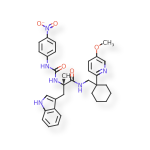
Details
| Stereochemistry | ABSOLUTE |
| Molecular Formula | C32H36N6O5 |
| Molecular Weight | 584.6654 |
| Optical Activity | UNSPECIFIED |
| Defined Stereocenters | 1 / 1 |
| E/Z Centers | 0 |
| Charge | 0 |
SHOW SMILES / InChI
SMILES
COC1=CN=C(C=C1)C5(CNC(=O)[C@](C)(CC2=CNC3=C2C=CC=C3)NC(=O)NC4=CC=C(C=C4)[N+]([O-])=O)CCCCC5
InChI
InChIKey=NNFUWNLENRUDHR-HKBQPEDESA-N
InChI=1S/C32H36N6O5/c1-31(18-22-19-33-27-9-5-4-8-26(22)27,37-30(40)36-23-10-12-24(13-11-23)38(41)42)29(39)35-21-32(16-6-3-7-17-32)28-15-14-25(43-2)20-34-28/h4-5,8-15,19-20,33H,3,6-7,16-18,21H2,1-2H3,(H,35,39)(H2,36,37,40)/t31-/m0/s1
DescriptionCurator's Comment: description was created based on several sources, including
https://www.ncbi.nlm.nih.gov/pubmed/12909192 |
https://www.ncbi.nlm.nih.gov/pubmed/17035523
Curator's Comment: description was created based on several sources, including
https://www.ncbi.nlm.nih.gov/pubmed/12909192 |
https://www.ncbi.nlm.nih.gov/pubmed/17035523
PD 176252 is a competitive antagonist of neuromedin-B preferring (BB1) and gastrin-releasing peptide preferring (BB2) receptors. PD176252 inhibited tumor growtn in preclinical model of lung cancer, and exhibited synergy with EGFR inhibitor in the model of head and neck cancer. PD176252 demonstrated anxiolytic properties in preclinical models.
CNS Activity
Originator
Approval Year
Sample Use Guides
Female athymic Balb/c nude mice (Taconic Farms), 4–5 weeks old, were housed in a pathogen-free temperature controlled isolation room, with a diet consisting of autoclaved rodent chow and autoclaved water given ad libitum. NCI-H1299 cells (1*10^7) were injected into the right flank of each mouse by subcutaneous injection. Palpable tumors were observed in approximately 90% of the mice after 1 week. Polyethylene glycol (PEG, 100 Al) or PD176252 (10 or 1 ug in 100 ul of PEG 400) were injected daily by gavage. In anxiety model, PD176252 was administered to rats intraperitoneally at doses 3.75-7.5 mg/kg or intracerebloventicularly, 100-200 ng/rat.
Route of Administration:
Other
Growth studies in vitro were conducted using the MTT colorimetic assays. NCI-H1299 cells (104/well) were placed in SIT medium and various concentrations of PD176252 added. After 4 days, MTT (Sigma) was added. After 4 h, 150 Al of dimethylsulfoxide was added. After 16 h, the optical density at 570 nm was determined. The IC50 for PD176252 was 5 and 7 AM using NCI-H1299 and H345 cells, respectively.
| Name | Type | Language | ||
|---|---|---|---|---|
|
Preferred Name | English | ||
|
Common Name | English | ||
|
Systematic Name | English |
| Code System | Code | Type | Description | ||
|---|---|---|---|---|---|
|
204067-01-6
Created by
admin on Mon Mar 31 22:41:38 GMT 2025 , Edited by admin on Mon Mar 31 22:41:38 GMT 2025
|
PRIMARY | |||
|
JT21Y57650
Created by
admin on Mon Mar 31 22:41:38 GMT 2025 , Edited by admin on Mon Mar 31 22:41:38 GMT 2025
|
PRIMARY | |||
|
9829828
Created by
admin on Mon Mar 31 22:41:38 GMT 2025 , Edited by admin on Mon Mar 31 22:41:38 GMT 2025
|
PRIMARY | |||
|
DTXSID90431389
Created by
admin on Mon Mar 31 22:41:38 GMT 2025 , Edited by admin on Mon Mar 31 22:41:38 GMT 2025
|
PRIMARY |
ACTIVE MOIETY