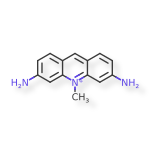
Details
| Stereochemistry | ACHIRAL |
| Molecular Formula | C14H14N3 |
| Molecular Weight | 224.2811 |
| Optical Activity | NONE |
| Defined Stereocenters | 0 / 0 |
| E/Z Centers | 0 |
| Charge | 1 |
SHOW SMILES / InChI
SMILES
C[N+]1=C2C=C(N)C=CC2=CC3=CC=C(N)C=C13
InChI
InChIKey=XSIOKTWDEOJMGG-UHFFFAOYSA-O
InChI=1S/C14H13N3/c1-17-13-7-11(15)4-2-9(13)6-10-3-5-12(16)8-14(10)17/h2-8H,1H3,(H3,15,16)/p+1
DescriptionCurator's Comment: description was created based on several sources, including
http://www.ncbi.nlm.nih.gov/pubmed/19805192
https://en.wikipedia.org/wiki/Acriflavinium_chloride
Curator's Comment: description was created based on several sources, including
http://www.ncbi.nlm.nih.gov/pubmed/19805192
https://en.wikipedia.org/wiki/Acriflavinium_chloride
Acriflavine (ACF) is a topical antiseptic. The hydrochloride form is more irritating than the neutral form. It is derived from acridine. Commercial preparations are often mixtures with proflavine. Acriflavine was developed in 1912 by Paul Ehrlich, a German medical researcher, and was used during the First World War against sleeping sickness. ACF has known trypanocidal, antibacterial, and antiviral activities. Effects of ACF on cancer cells were first reported 50 years ago. By present time was demonstrated that ACF a drug, that binds directly to HIF-1 alpha and HIF-2 alpha and inhibits HIF-1 dimerization and transcriptional activity and thus has potent inhibitory effects on tumor growth and vascularization. Also Acriflavine in combination with 3,6-diaminoacridine (proflavine) could prove to be a potential antimalarial drug and its pharmacological action can be due to inhibition of gyrase activity. This is achieved through interaction of the ACF with the DNA substrate. This interaction may lead to conformation change in DNA unsuitable for binding of gyrase with DNA.
Approval Year
Targets
| Primary Target | Pharmacology | Condition | Potency |
|---|---|---|---|
Target ID: CHEMBL612883 Sources: Acta Protozoologica (1974), 13, (11-20), 225-32. |
|||
Target ID: CHEMBL4261 |
|||
Target ID: CHEMBL1744522 |
|||
Target ID: CHEMBL2364041 |
Conditions
| Condition | Modality | Targets | Highest Phase | Product |
|---|---|---|---|---|
| Primary | Unknown Approved UseUnknown |
|||
| Curative | Unknown Approved UseUnknown |
| Name | Type | Language | ||
|---|---|---|---|---|
|
Systematic Name | English | ||
|
Preferred Name | English | ||
|
Systematic Name | English | ||
|
Systematic Name | English |
| Code System | Code | Type | Description | ||
|---|---|---|---|---|---|
|
2016
Created by
admin on Wed Apr 02 05:49:08 GMT 2025 , Edited by admin on Wed Apr 02 05:49:08 GMT 2025
|
PRIMARY | |||
|
J276XBF77Z
Created by
admin on Wed Apr 02 05:49:08 GMT 2025 , Edited by admin on Wed Apr 02 05:49:08 GMT 2025
|
PRIMARY | |||
|
837-73-0
Created by
admin on Wed Apr 02 05:49:08 GMT 2025 , Edited by admin on Wed Apr 02 05:49:08 GMT 2025
|
PRIMARY | |||
|
DTXSID30232534
Created by
admin on Wed Apr 02 05:49:08 GMT 2025 , Edited by admin on Wed Apr 02 05:49:08 GMT 2025
|
PRIMARY |
SALT/SOLVATE (PARENT)
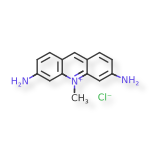
SUBSTANCE RECORD