Details
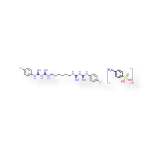
| Stereochemistry | ACHIRAL |
| Molecular Formula | C22H30Cl2N10.2C6H8NO3P |
| Molecular Weight | 851.659 |
| Optical Activity | NONE |
| Defined Stereocenters | 0 / 0 |
| E/Z Centers | 0 |
| Charge | 0 |
SHOW SMILES / InChI
SMILES
NC1=CC=C(C=C1)P(O)(O)=O.NC2=CC=C(C=C2)P(O)(O)=O.ClC3=CC=C(NC(=N)NC(=N)NCCCCCCNC(=N)NC(=N)NC4=CC=C(Cl)C=C4)C=C3
InChI
InChIKey=NSCOCGOFKMUTMW-UHFFFAOYSA-N
InChI=1S/C22H30Cl2N10.2C6H8NO3P/c23-15-5-9-17(10-6-15)31-21(27)33-19(25)29-13-3-1-2-4-14-30-20(26)34-22(28)32-18-11-7-16(24)8-12-18;2*7-5-1-3-6(4-2-5)11(8,9)10/h5-12H,1-4,13-14H2,(H5,25,27,29,31,33)(H5,26,28,30,32,34);2*1-4H,7H2,(H2,8,9,10)
DescriptionCurator's Comment: Description was created based on several sources, including:
http://www.accessdata.fda.gov/drugsatfda_docs/label/2013/019028s022lbl.pdf
http://www.drugbank.ca/drugs/DB00878
http://www.wikidoc.org/index.php/Chlorhexidine_gluconate
Curator's Comment: Description was created based on several sources, including:
http://www.accessdata.fda.gov/drugsatfda_docs/label/2013/019028s022lbl.pdf
http://www.drugbank.ca/drugs/DB00878
http://www.wikidoc.org/index.php/Chlorhexidine_gluconate
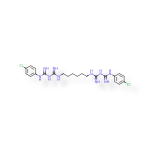
Chlorhexidine is a broad-spectrum biocide effective against Gram-positive bacteria, Gram-negative bacteria and fungi. It is used primarily as its salts (e.g., the dihydrochloride, diacetate, and digluconate). Chlorhexidine inactivates microorganisms with a broader spectrum than other antimicrobials (e.g. antibiotics) and has a quicker kill rate than other antimicrobials (e.g. povidone-iodine). It has both bacteriostatic (inhibits bacterial growth) and bactericidal (kills bacteria) mechanisms of action, depending on its concentration. Chlorhexidine kills by disrupting the cell membrane. The most common side effects associated with chlorhexidine gluconate oral rinses are: 1) an increase in staining of teeth and other oral surfaces; 2) an increase in calculus formation; and 3) an alteration in taste perception; 4) toothache; 5) upper respiratory tract infection; and 6) headache.
Approval Year
Targets
| Primary Target | Pharmacology | Condition | Potency |
|---|---|---|---|
Target ID: bacterial cell wall |
Conditions
| Condition | Modality | Targets | Highest Phase | Product |
|---|---|---|---|---|
| Curative | HIBICLENS Approved UseUse for the preparation of the patient's skin prior to surgery. Helps to reduce bacteria that potentially can cause skin infection. Launch Date1976 |
Cmax
| Value | Dose | Co-administered | Analyte | Population |
|---|---|---|---|---|
2007 μg/mL EXPERIMENT https://pubmed.ncbi.nlm.nih.gov/9869352 |
2.5 mg single, dental dose: 2.5 mg route of administration: Dental experiment type: SINGLE co-administered: |
CHLORHEXIDINE inflammatory exudate | Homo sapiens population: UNHEALTHY age: ADULT sex: FEMALE / MALE food status: UNKNOWN |
|
0.206 μg/g |
300 mg single, oral dose: 300 mg route of administration: Oral experiment type: SINGLE co-administered: |
CHLORHEXIDINE plasma | Homo sapiens population: UNKNOWN age: ADULT sex: UNKNOWN food status: UNKNOWN |
AUC
| Value | Dose | Co-administered | Analyte | Population |
|---|---|---|---|---|
148287.6 ng × h/mL EXPERIMENT https://pubmed.ncbi.nlm.nih.gov/26271869 |
20 mg single, oral dose: 20 mg route of administration: Oral experiment type: SINGLE co-administered: |
CHLORHEXIDINE saliva | Homo sapiens population: UNHEALTHY age: ADULT sex: FEMALE / MALE food status: UNKNOWN |
|
180892.9 ng × h/mL EXPERIMENT https://pubmed.ncbi.nlm.nih.gov/26271869 |
20 mg 1 times / day multiple, oral dose: 20 mg route of administration: Oral experiment type: MULTIPLE co-administered: |
CHLORHEXIDINE saliva | Homo sapiens population: UNHEALTHY age: ADULT sex: FEMALE / MALE food status: UNKNOWN |
|
187083.4 μg × h/mL EXPERIMENT https://pubmed.ncbi.nlm.nih.gov/9869352 |
2.5 mg single, dental dose: 2.5 mg route of administration: Dental experiment type: SINGLE co-administered: |
CHLORHEXIDINE inflammatory exudate | Homo sapiens population: UNHEALTHY age: ADULT sex: FEMALE / MALE food status: UNKNOWN |
Funbound
| Value | Dose | Co-administered | Analyte | Population |
|---|---|---|---|---|
17% EXPERIMENT https://pubmed.ncbi.nlm.nih.gov/4269593 |
CHLORHEXIDINE serum | Homo sapiens population: UNKNOWN age: UNKNOWN sex: UNKNOWN food status: UNKNOWN |
||
73% EXPERIMENT https://pubmed.ncbi.nlm.nih.gov/4269593/ |
CHLORHEXIDINE saliva | Homo sapiens population: UNKNOWN age: UNKNOWN sex: UNKNOWN food status: UNKNOWN |
Doses
| Dose | Population | Adverse events |
|---|---|---|
2 % 1 times / day single, topical Recommended Dose: 2 %, 1 times / day Route: topical Route: single Dose: 2 %, 1 times / day Sources: |
healthy, 18-64 years Health Status: healthy Age Group: 18-64 years Sex: M+F Sources: |
Other AEs: Redness... Other AEs: Redness (grade 2) Sources: |
3 % 1 times / day multiple, topical Recommended Dose: 3 %, 1 times / day Route: topical Route: multiple Dose: 3 %, 1 times / day Sources: |
healthy, 18-79 years Health Status: healthy Age Group: 18-79 years Sex: M+F Sources: |
Disc. AE: Papule, Erythema... AEs leading to discontinuation/dose reduction: Papule Sources: Erythema (grade 2) Edema (grade 1) |
3 % 1 times / day multiple, topical Recommended Dose: 3 %, 1 times / day Route: topical Route: multiple Dose: 3 %, 1 times / day Sources: |
healthy, 22-60 years Health Status: healthy Age Group: 22-60 years Sex: M+F Sources: |
Disc. AE: Burning sensation, Petechial rash... AEs leading to discontinuation/dose reduction: Burning sensation (grade 1) Sources: Petechial rash (grade 1) Scab |
1.5 oz 1 times / day single, oral Studied dose Dose: 1.5 oz, 1 times / day Route: oral Route: single Dose: 1.5 oz, 1 times / day Sources: |
healthy, child Health Status: healthy Age Group: child Sources: |
Other AEs: Distress epigastric, Nausea... Other AEs: Distress epigastric Sources: Nausea Alcohol intoxication |
2.5 mg 3 times / month multiple, subgingival Recommended Dose: 2.5 mg, 3 times / month Route: subgingival Route: multiple Dose: 2.5 mg, 3 times / month Sources: |
unhealthy, mean age 47 years Health Status: unhealthy Age Group: mean age 47 years Sex: M+F Sources: |
Other AEs: Toothache, Upper respiratory tract infection... Other AEs: Toothache (50.7%) Sources: Upper respiratory tract infection (28.4%) Headache (27.1%) Sinusitis (13.8%) Influenza-like symptoms (7.6%) Back pain (6.7%) Tooth disorder (6.2%) Bronchitis (6.2%) Abscess (5.8%) Pain (4.9%) Allergy (4%) Myalgia (4%) Gum hyperplasia (3.6%) Pharyngitis (3.6%) Arthralgia (3.1%) Dysmenorrhea (3.1%) Dyspepsia (3.1%) Rhinitis (2.7%) Coughing (2.7%) Arthrosis (2.7%) Hypertension (2.2%) Stomatitis ulcerative (2.2%) Tendinitis (2.2%) |
AEs
| AE | Significance | Dose | Population |
|---|---|---|---|
| Redness | grade 2 | 2 % 1 times / day single, topical Recommended Dose: 2 %, 1 times / day Route: topical Route: single Dose: 2 %, 1 times / day Sources: |
healthy, 18-64 years Health Status: healthy Age Group: 18-64 years Sex: M+F Sources: |
| Papule | Disc. AE | 3 % 1 times / day multiple, topical Recommended Dose: 3 %, 1 times / day Route: topical Route: multiple Dose: 3 %, 1 times / day Sources: |
healthy, 18-79 years Health Status: healthy Age Group: 18-79 years Sex: M+F Sources: |
| Edema | grade 1 Disc. AE |
3 % 1 times / day multiple, topical Recommended Dose: 3 %, 1 times / day Route: topical Route: multiple Dose: 3 %, 1 times / day Sources: |
healthy, 18-79 years Health Status: healthy Age Group: 18-79 years Sex: M+F Sources: |
| Erythema | grade 2 Disc. AE |
3 % 1 times / day multiple, topical Recommended Dose: 3 %, 1 times / day Route: topical Route: multiple Dose: 3 %, 1 times / day Sources: |
healthy, 18-79 years Health Status: healthy Age Group: 18-79 years Sex: M+F Sources: |
| Scab | Disc. AE | 3 % 1 times / day multiple, topical Recommended Dose: 3 %, 1 times / day Route: topical Route: multiple Dose: 3 %, 1 times / day Sources: |
healthy, 22-60 years Health Status: healthy Age Group: 22-60 years Sex: M+F Sources: |
| Burning sensation | grade 1 Disc. AE |
3 % 1 times / day multiple, topical Recommended Dose: 3 %, 1 times / day Route: topical Route: multiple Dose: 3 %, 1 times / day Sources: |
healthy, 22-60 years Health Status: healthy Age Group: 22-60 years Sex: M+F Sources: |
| Petechial rash | grade 1 Disc. AE |
3 % 1 times / day multiple, topical Recommended Dose: 3 %, 1 times / day Route: topical Route: multiple Dose: 3 %, 1 times / day Sources: |
healthy, 22-60 years Health Status: healthy Age Group: 22-60 years Sex: M+F Sources: |
| Alcohol intoxication | 1.5 oz 1 times / day single, oral Studied dose Dose: 1.5 oz, 1 times / day Route: oral Route: single Dose: 1.5 oz, 1 times / day Sources: |
healthy, child Health Status: healthy Age Group: child Sources: |
|
| Distress epigastric | 1.5 oz 1 times / day single, oral Studied dose Dose: 1.5 oz, 1 times / day Route: oral Route: single Dose: 1.5 oz, 1 times / day Sources: |
healthy, child Health Status: healthy Age Group: child Sources: |
|
| Nausea | 1.5 oz 1 times / day single, oral Studied dose Dose: 1.5 oz, 1 times / day Route: oral Route: single Dose: 1.5 oz, 1 times / day Sources: |
healthy, child Health Status: healthy Age Group: child Sources: |
|
| Sinusitis | 13.8% | 2.5 mg 3 times / month multiple, subgingival Recommended Dose: 2.5 mg, 3 times / month Route: subgingival Route: multiple Dose: 2.5 mg, 3 times / month Sources: |
unhealthy, mean age 47 years Health Status: unhealthy Age Group: mean age 47 years Sex: M+F Sources: |
| Hypertension | 2.2% | 2.5 mg 3 times / month multiple, subgingival Recommended Dose: 2.5 mg, 3 times / month Route: subgingival Route: multiple Dose: 2.5 mg, 3 times / month Sources: |
unhealthy, mean age 47 years Health Status: unhealthy Age Group: mean age 47 years Sex: M+F Sources: |
| Stomatitis ulcerative | 2.2% | 2.5 mg 3 times / month multiple, subgingival Recommended Dose: 2.5 mg, 3 times / month Route: subgingival Route: multiple Dose: 2.5 mg, 3 times / month Sources: |
unhealthy, mean age 47 years Health Status: unhealthy Age Group: mean age 47 years Sex: M+F Sources: |
| Tendinitis | 2.2% | 2.5 mg 3 times / month multiple, subgingival Recommended Dose: 2.5 mg, 3 times / month Route: subgingival Route: multiple Dose: 2.5 mg, 3 times / month Sources: |
unhealthy, mean age 47 years Health Status: unhealthy Age Group: mean age 47 years Sex: M+F Sources: |
| Arthrosis | 2.7% | 2.5 mg 3 times / month multiple, subgingival Recommended Dose: 2.5 mg, 3 times / month Route: subgingival Route: multiple Dose: 2.5 mg, 3 times / month Sources: |
unhealthy, mean age 47 years Health Status: unhealthy Age Group: mean age 47 years Sex: M+F Sources: |
| Coughing | 2.7% | 2.5 mg 3 times / month multiple, subgingival Recommended Dose: 2.5 mg, 3 times / month Route: subgingival Route: multiple Dose: 2.5 mg, 3 times / month Sources: |
unhealthy, mean age 47 years Health Status: unhealthy Age Group: mean age 47 years Sex: M+F Sources: |
| Rhinitis | 2.7% | 2.5 mg 3 times / month multiple, subgingival Recommended Dose: 2.5 mg, 3 times / month Route: subgingival Route: multiple Dose: 2.5 mg, 3 times / month Sources: |
unhealthy, mean age 47 years Health Status: unhealthy Age Group: mean age 47 years Sex: M+F Sources: |
| Headache | 27.1% | 2.5 mg 3 times / month multiple, subgingival Recommended Dose: 2.5 mg, 3 times / month Route: subgingival Route: multiple Dose: 2.5 mg, 3 times / month Sources: |
unhealthy, mean age 47 years Health Status: unhealthy Age Group: mean age 47 years Sex: M+F Sources: |
| Upper respiratory tract infection | 28.4% | 2.5 mg 3 times / month multiple, subgingival Recommended Dose: 2.5 mg, 3 times / month Route: subgingival Route: multiple Dose: 2.5 mg, 3 times / month Sources: |
unhealthy, mean age 47 years Health Status: unhealthy Age Group: mean age 47 years Sex: M+F Sources: |
| Arthralgia | 3.1% | 2.5 mg 3 times / month multiple, subgingival Recommended Dose: 2.5 mg, 3 times / month Route: subgingival Route: multiple Dose: 2.5 mg, 3 times / month Sources: |
unhealthy, mean age 47 years Health Status: unhealthy Age Group: mean age 47 years Sex: M+F Sources: |
| Dysmenorrhea | 3.1% | 2.5 mg 3 times / month multiple, subgingival Recommended Dose: 2.5 mg, 3 times / month Route: subgingival Route: multiple Dose: 2.5 mg, 3 times / month Sources: |
unhealthy, mean age 47 years Health Status: unhealthy Age Group: mean age 47 years Sex: M+F Sources: |
| Dyspepsia | 3.1% | 2.5 mg 3 times / month multiple, subgingival Recommended Dose: 2.5 mg, 3 times / month Route: subgingival Route: multiple Dose: 2.5 mg, 3 times / month Sources: |
unhealthy, mean age 47 years Health Status: unhealthy Age Group: mean age 47 years Sex: M+F Sources: |
| Gum hyperplasia | 3.6% | 2.5 mg 3 times / month multiple, subgingival Recommended Dose: 2.5 mg, 3 times / month Route: subgingival Route: multiple Dose: 2.5 mg, 3 times / month Sources: |
unhealthy, mean age 47 years Health Status: unhealthy Age Group: mean age 47 years Sex: M+F Sources: |
| Pharyngitis | 3.6% | 2.5 mg 3 times / month multiple, subgingival Recommended Dose: 2.5 mg, 3 times / month Route: subgingival Route: multiple Dose: 2.5 mg, 3 times / month Sources: |
unhealthy, mean age 47 years Health Status: unhealthy Age Group: mean age 47 years Sex: M+F Sources: |
| Allergy | 4% | 2.5 mg 3 times / month multiple, subgingival Recommended Dose: 2.5 mg, 3 times / month Route: subgingival Route: multiple Dose: 2.5 mg, 3 times / month Sources: |
unhealthy, mean age 47 years Health Status: unhealthy Age Group: mean age 47 years Sex: M+F Sources: |
| Myalgia | 4% | 2.5 mg 3 times / month multiple, subgingival Recommended Dose: 2.5 mg, 3 times / month Route: subgingival Route: multiple Dose: 2.5 mg, 3 times / month Sources: |
unhealthy, mean age 47 years Health Status: unhealthy Age Group: mean age 47 years Sex: M+F Sources: |
| Pain | 4.9% | 2.5 mg 3 times / month multiple, subgingival Recommended Dose: 2.5 mg, 3 times / month Route: subgingival Route: multiple Dose: 2.5 mg, 3 times / month Sources: |
unhealthy, mean age 47 years Health Status: unhealthy Age Group: mean age 47 years Sex: M+F Sources: |
| Abscess | 5.8% | 2.5 mg 3 times / month multiple, subgingival Recommended Dose: 2.5 mg, 3 times / month Route: subgingival Route: multiple Dose: 2.5 mg, 3 times / month Sources: |
unhealthy, mean age 47 years Health Status: unhealthy Age Group: mean age 47 years Sex: M+F Sources: |
| Toothache | 50.7% | 2.5 mg 3 times / month multiple, subgingival Recommended Dose: 2.5 mg, 3 times / month Route: subgingival Route: multiple Dose: 2.5 mg, 3 times / month Sources: |
unhealthy, mean age 47 years Health Status: unhealthy Age Group: mean age 47 years Sex: M+F Sources: |
| Bronchitis | 6.2% | 2.5 mg 3 times / month multiple, subgingival Recommended Dose: 2.5 mg, 3 times / month Route: subgingival Route: multiple Dose: 2.5 mg, 3 times / month Sources: |
unhealthy, mean age 47 years Health Status: unhealthy Age Group: mean age 47 years Sex: M+F Sources: |
| Tooth disorder | 6.2% | 2.5 mg 3 times / month multiple, subgingival Recommended Dose: 2.5 mg, 3 times / month Route: subgingival Route: multiple Dose: 2.5 mg, 3 times / month Sources: |
unhealthy, mean age 47 years Health Status: unhealthy Age Group: mean age 47 years Sex: M+F Sources: |
| Back pain | 6.7% | 2.5 mg 3 times / month multiple, subgingival Recommended Dose: 2.5 mg, 3 times / month Route: subgingival Route: multiple Dose: 2.5 mg, 3 times / month Sources: |
unhealthy, mean age 47 years Health Status: unhealthy Age Group: mean age 47 years Sex: M+F Sources: |
| Influenza-like symptoms | 7.6% | 2.5 mg 3 times / month multiple, subgingival Recommended Dose: 2.5 mg, 3 times / month Route: subgingival Route: multiple Dose: 2.5 mg, 3 times / month Sources: |
unhealthy, mean age 47 years Health Status: unhealthy Age Group: mean age 47 years Sex: M+F Sources: |
PubMed
| Title | Date | PubMed |
|---|---|---|
| Cytotoxicity and genotoxicity of chlorhexidine on macrophages in vitro. | 2014-04 |
|
| Food components with anticaries activity. | 2012-04 |
|
| Identification and characterization of inhibitors of the aminoglycoside resistance acetyltransferase Eis from Mycobacterium tuberculosis. | 2012-01-02 |
|
| Profiling of a prescription drug library for potential renal drug-drug interactions mediated by the organic cation transporter 2. | 2011-07-14 |
|
| Chlorhexidine-induced apoptosis or necrosis in L929 fibroblasts: A role for endoplasmic reticulum stress. | 2009-01-15 |
|
| [Ultrastructure study of pathogen of acanthamoeba keratitis]. | 2008-11 |
|
| Adverse events associated with chlorhexidine use: results from the Department of Veterans Affairs Dental Diabetes Study. | 2008-02 |
|
| Cysticidal effect on acanthamoeba and toxicity on human keratocytes by polyhexamethylene biguanide and chlorhexidine. | 2007-07 |
|
| Chemoenzymatic synthesis and antimicrobial and haemolytic activities of amphiphilic bis(phenylacetylarginine) derivatives. | 2006-10 |
|
| Chlorhexidine in urethral gel: does it cause pain at flexible cystoscopy? | 2006-04 |
|
| Short-term side effects of 0.2% alcohol-free chlorhexidine mouthrinse used as an adjunct to non-surgical periodontal treatment: a double-blind clinical study. | 2006-03 |
|
| Remineralisation of carious enamel lesions after application of a CHX/F-mouthrinse compared with sole CHX- and placebo-application. | 2006 |
|
| Chlorhexidine induces DNA damage in rat peripheral leukocytes and oral mucosal cells. | 2004-10 |
|
| [Contact sensitization to pharmaceutic aids in dermatologic cosmetic and external use preparations]. | 2004-05 |
|
| Effects of a chlorhexidine gluconate-containing mouthwash on the vitality and antimicrobial susceptibility of in vitro oral bacterial ecosystems. | 2003-08 |
|
| Probing depth changes following 2 years of periodontal maintenance therapy including adjunctive controlled release of chlorhexidine. | 2003-04 |
|
| Developing a dynamic pharmacophore model for HIV-1 integrase. | 2000-06-01 |
|
| Chlorhexidine and taste. Influence of mouthwashes concentration and of rinsing time. | 2000-05 |
|
| Severe anaphylaxis after a chlorhexidine bath. | 1999-05 |
|
| 6-month use of 0.2% delmopinol hydrochloride in comparison with 0.2% chlorhexidine digluconate and placebo. (I). Effect on plaque formation and gingivitis. | 1998-09 |
|
| The effectiveness and side effects of 0.1% and 0.2% chlorhexidine mouthrinses: a clinical study. | 1998-07 |
|
| Clinical and pathological changes in the knee after accidental chlorhexidine irrigation during arthroscopy. Case reports and review of the literature. | 1998-05 |
|
| The activity of candidate virucidal agents, low pH and genital secretions against HIV-1 in vitro. | 1995-07-01 |
|
| Spermicides: anti-HIV activity and cytotoxicity in vitro. | 1993-02 |
|
| Effects of chlorhexidine diacetate on Candida albicans, C. glabrata and Saccharomyces cerevisiae. | 1992-04 |
|
| [Anaphylactic shock with ventricular fibrillation induced by chlorhexidine]. | 1992-03 |
|
| Combined effects of Zn(2+)-chlorhexidine and Zn(2+)-cetylpyridinium chloride on caries incidence in partially desalivated rats. | 1991-08 |
|
| Bradycardia associated with chlorhexidine spray. | 1989-06 |
|
| Some toxic effects of lead, other metals and antibacterial agents on the nervous system--animal experiment models. | 1984 |
|
| [Disturbances of taste from oral disinfectants (author's transl)]. | 1978-10 |
|
| Nephrotoxic and hepatotoxic effects of triclosan and chlorhexidine in rats. | 1977-10 |
|
| Further studies on effects of irrigation solutions on rat bladders. | 1976-12 |
|
| The effect of chlorhexidine irrigation of the bladder in the rat. | 1975-10 |
Patents
Sample Use Guides
Recommended use is twice daily oral rinsing for 30 seconds, morning and evening after tooth brushing. Usual dosage is 15 ml (1 tablespoon) of undiluted Chlorhexidine gluconate oral rinse. Prophylaxis intervals - no longer than six months.
Route of Administration:
Topical
In Vitro Use Guide
Curator's Comment: Chlorhexidine caused significant decreases in both total anaerobe and total aerobe/facultative anaerobe counts (P < 0.05), together with lesser decreases in gram-negative anaerobes.
Minimum bactericidal concentrations are different for different bacterial strains (3.9-83.3 mg/l).
| Name | Type | Language | ||
|---|---|---|---|---|
|
Preferred Name | English | ||
|
Official Name | English | ||
|
Code | English | ||
|
Common Name | English | ||
|
Common Name | English | ||
|
Common Name | English | ||
|
Common Name | English |
| Code System | Code | Type | Description | ||
|---|---|---|---|---|---|
|
C048279
Created by
admin on Mon Mar 31 19:05:28 GMT 2025 , Edited by admin on Mon Mar 31 19:05:28 GMT 2025
|
PRIMARY | |||
|
AA-20
Created by
admin on Mon Mar 31 19:05:28 GMT 2025 , Edited by admin on Mon Mar 31 19:05:28 GMT 2025
|
PRIMARY | |||
|
77146-42-0
Created by
admin on Mon Mar 31 19:05:28 GMT 2025 , Edited by admin on Mon Mar 31 19:05:28 GMT 2025
|
PRIMARY | |||
|
9919060
Created by
admin on Mon Mar 31 19:05:28 GMT 2025 , Edited by admin on Mon Mar 31 19:05:28 GMT 2025
|
PRIMARY | |||
|
300000055327
Created by
admin on Mon Mar 31 19:05:28 GMT 2025 , Edited by admin on Mon Mar 31 19:05:28 GMT 2025
|
PRIMARY | |||
|
I20F29W4EO
Created by
admin on Mon Mar 31 19:05:28 GMT 2025 , Edited by admin on Mon Mar 31 19:05:28 GMT 2025
|
PRIMARY | |||
|
C169844
Created by
admin on Mon Mar 31 19:05:28 GMT 2025 , Edited by admin on Mon Mar 31 19:05:28 GMT 2025
|
PRIMARY | |||
|
CHEMBL790
Created by
admin on Mon Mar 31 19:05:28 GMT 2025 , Edited by admin on Mon Mar 31 19:05:28 GMT 2025
|
PRIMARY | |||
|
DTXSID70998405
Created by
admin on Mon Mar 31 19:05:28 GMT 2025 , Edited by admin on Mon Mar 31 19:05:28 GMT 2025
|
PRIMARY |
ACTIVE MOIETY
SUBSTANCE RECORD