Details
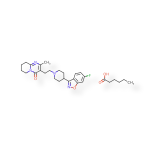
| Stereochemistry | ACHIRAL |
| Molecular Formula | C23H27FN4O2.C6H12O2 |
| Molecular Weight | 526.6428 |
| Optical Activity | NONE |
| Defined Stereocenters | 0 / 0 |
| E/Z Centers | 0 |
| Charge | 0 |
SHOW SMILES / InChI
SMILES
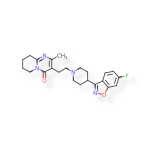
CCCCCC(O)=O.CC1=C(CCN2CCC(CC2)C3=NOC4=C3C=CC(F)=C4)C(=O)N5CCCCC5=N1
InChI
InChIKey=KBFKXAXGRPWQON-UHFFFAOYSA-N
InChI=1S/C23H27FN4O2.C6H12O2/c1-15-18(23(29)28-10-3-2-4-21(28)25-15)9-13-27-11-7-16(8-12-27)22-19-6-5-17(24)14-20(19)30-26-22;1-2-3-4-5-6(7)8/h5-6,14,16H,2-4,7-13H2,1H3;2-5H2,1H3,(H,7,8)
DescriptionCurator's Comment: description was created based on several sources, including:
https://www.drugs.com/risperidone.html
http://www.wikidoc.org/index.php/Risperidone_(oral)
http://www.rxlist.com/risperdal-drug.htm
Curator's Comment: description was created based on several sources, including:
https://www.drugs.com/risperidone.html
http://www.wikidoc.org/index.php/Risperidone_(oral)
http://www.rxlist.com/risperdal-drug.htm
Risperidone, a benzisoxazole derivative, is an atypical antipsychotic drug with high affinity for 5-hydrotryptamine (5-HT) and dopamine D2 receptors. It is FDA approved for the treatment of schizophrenia, bipolar mania, irritability associated with autistic disorder. Carbamazepine and other enzyme inducers decrease plasma concentrations of risperidone. Vice versa, Fluoxetine, paroxetine, and other CYP 2D6 enzyme inhibitors increase plasma concentrations of risperidone. Common adverse reactions include increased mortality in elderly patients with dementia-related psychosis, cerebrovascular adverse events, including stroke, in elderly patients with dementia-related psychosis, neuroleptic malignant syndrome, tardive dyskinesia , metabolic Changes (hyperglycemia and diabetes mellitus, dyslipidemia, weight gain), hyperprolactinemia, orthostatic hypotension, leukopenia, neutropenia, agranulocytosis, potential for cognitive and motor impairment, seizures, dysphagia, priapism, disruption of body temperature regulation.
Approval Year
Targets
| Primary Target | Pharmacology | Condition | Potency |
|---|---|---|---|
Target ID: CHEMBL2094251 |
2.7 nM [Kd] | ||
Target ID: CHEMBL217 |
3.8 nM [Kd] | ||
Target ID: CHEMBL1983 |
3.9 nM [Kd] | ||
| 0.15 nM [Kd] |
Conditions
| Condition | Modality | Targets | Highest Phase | Product |
|---|---|---|---|---|
| Primary | RISPERDAL Approved UseINDICATIONS & USAGE Risperidone tablets are indicated for the acute and maintenance treatment of schizophrenia [see Clinical Studies (14.1) Launch Date1993 |
|||
| Primary | RISPERDAL Approved UseINDICATIONS & USAGE Risperidone tablets are indicated for the acute and maintenance treatment of schizophrenia [see Clinical Studies (14.1) Launch Date1993 |
|||
| Primary | RISPERDAL Approved UseINDICATIONS & USAGE Risperidone tablets are indicated for the acute and maintenance treatment of schizophrenia [see Clinical Studies (14.1) Launch Date1993 |
Cmax
| Value | Dose | Co-administered | Analyte | Population |
|---|---|---|---|---|
17 ng/mL EXPERIMENT https://pubmed.ncbi.nlm.nih.gov/11985287/ |
2 mg 2 times / day steady-state, oral dose: 2 mg route of administration: Oral experiment type: STEADY-STATE co-administered: |
RISPERIDONE plasma | Homo sapiens population: UNHEALTHY age: ADULT sex: FEMALE / MALE food status: FASTED |
|
7.77 ng/mL EXPERIMENT https://pubmed.ncbi.nlm.nih.gov/25042870/ |
1 mg single, oral dose: 1 mg route of administration: Oral experiment type: SINGLE co-administered: |
RISPERIDONE plasma | Homo sapiens population: HEALTHY age: ADULT sex: FEMALE / MALE food status: FASTED |
AUC
| Value | Dose | Co-administered | Analyte | Population |
|---|---|---|---|---|
83.1 ng × h/mL EXPERIMENT https://pubmed.ncbi.nlm.nih.gov/11985287/ |
2 mg 2 times / day steady-state, oral dose: 2 mg route of administration: Oral experiment type: STEADY-STATE co-administered: |
RISPERIDONE plasma | Homo sapiens population: UNHEALTHY age: ADULT sex: FEMALE / MALE food status: FASTED |
|
53.86 ng × h/mL EXPERIMENT https://pubmed.ncbi.nlm.nih.gov/25042870/ |
1 mg single, oral dose: 1 mg route of administration: Oral experiment type: SINGLE co-administered: |
RISPERIDONE plasma | Homo sapiens population: HEALTHY age: ADULT sex: FEMALE / MALE food status: FASTED |
T1/2
| Value | Dose | Co-administered | Analyte | Population |
|---|---|---|---|---|
4.88 h EXPERIMENT https://pubmed.ncbi.nlm.nih.gov/25042870/ |
1 mg single, oral dose: 1 mg route of administration: Oral experiment type: SINGLE co-administered: |
RISPERIDONE plasma | Homo sapiens population: HEALTHY age: ADULT sex: FEMALE / MALE food status: FASTED |
|
20 h |
1 mg single, oral dose: 1 mg route of administration: Oral experiment type: SINGLE co-administered: |
RISPERIDONE plasma | Homo sapiens population: HEALTHY age: ADULT sex: MALE food status: UNKNOWN |
Funbound
| Value | Dose | Co-administered | Analyte | Population |
|---|---|---|---|---|
10% |
1 mg single, oral dose: 1 mg route of administration: Oral experiment type: SINGLE co-administered: |
RISPERIDONE plasma | Homo sapiens population: HEALTHY age: ADULT sex: MALE food status: UNKNOWN |
Overview
| CYP3A4 | CYP2C9 | CYP2D6 | hERG |
|---|---|---|---|
OverviewOther
| Other Inhibitor | Other Substrate | Other Inducer |
|---|---|---|
Drug as perpetrator
| Target | Modality | Activity | Metabolite | Clinical evidence |
|---|---|---|---|---|
Page: 1.0 |
moderate [IC50 38.1 uM] | |||
| weak | no (co-administration study) Comment: RISPERDAL did not significantly affect the pharmacokinetics of donepezil and galantamine, which are metabolized by CYP2D6 Page: 37.0 |
|||
| yes [IC50 15.78 uM] |
Drug as victim
| Target | Modality | Activity | Metabolite | Clinical evidence |
|---|---|---|---|---|
| major | yes (co-administration study) Comment: Fluoxetine and paroxetine (CYP 2D6 inhibitors) have been shown to increase the plasma concentration of risperidone 2.5-2.8 fold and 3-9 fold, respectively Page: 36.0 |
|||
Page: 3.0 |
minor | |||
Page: 4.0 |
minor | yes (co-administration study) Comment: Carbamazepine co-administration with oral RISPERDAL decreased the steady-state plasma concentrations of risperidone by about 50%; Page: 4.0 |
||
| no | ||||
Page: 3.0 |
no | |||
Page: 3.0 |
no | |||
Page: 3.0 |
no | |||
Page: 3.0 |
no | |||
Page: 3.0 |
no | |||
| no | ||||
Page: 1.0 |
yes |
Tox targets
| Target | Modality | Activity | Metabolite | Clinical evidence |
|---|---|---|---|---|
PubMed
| Title | Date | PubMed |
|---|---|---|
| Effects of dopamine antagonists with different receptor blockade profiles on morphine-induced place preference in male mice. | 2001-06 |
|
| [Viewpoint of schizophrenic patients: a European survey]. | 2001-04-11 |
|
| Short-term inpatient pharmacotherapy of schizophrenia. | 2001-04-05 |
|
| Effective treatment of aggression and impulsivity in antisocial personality disorder with risperidone. | 2001-04 |
|
| Risperidone-induced retrograde ejaculation. | 2001-04 |
|
| An MRI study of basal ganglia volumes in first-episode schizophrenia patients treated with risperidone. | 2001-04 |
|
| Novel treatments for bipolar disorder. | 2001-04 |
|
| Dynamic dopamine-antagonist interactions at recombinant human dopamine D(2short) receptor: dopamine-bound versus antagonist-bound receptor states. | 2001-04 |
|
| Protein thiol oxidation by haloperidol results in inhibition of mitochondrial complex I in brain regions: comparison with atypical antipsychotics. | 2001-04 |
|
| Estrogen - a potential treatment for schizophrenia. | 2001-03-01 |
|
| Effects of olanzapine and other antipsychotics on cognitive function in chronic schizophrenia: a longitudinal study. | 2001-03-01 |
|
| Effectiveness of ECT combined with risperidone against aggression in schizophrenia. | 2001-03 |
|
| Suspected induction of a pyoderma gangrenosum-like eruption due to sulpiride treatment. | 2001-03 |
|
| The evaluation of multiple surrogate endpoints. | 2001-03 |
|
| 5-HT(2A) and D(2) receptor blockade increases cortical DA release via 5-HT(1A) receptor activation: a possible mechanism of atypical antipsychotic-induced cortical dopamine release. | 2001-03 |
|
| Fixed-dosed risperidone in mania: an open experimental trial. | 2001-03 |
|
| Does fast dissociation from the dopamine d(2) receptor explain the action of atypical antipsychotics?: A new hypothesis. | 2001-03 |
|
| Pharmacological characterization of locomotor sensitization induced by chronic phencyclidine administration. | 2001-03 |
|
| Hyperthermia and chronic pancerebellar syndrome after cocaine abuse. | 2001-02-26 |
|
| Health care utilization in patients with schizophrenia maintained on atypical versus conventional antipsychotics. | 2001-02 |
|
| Dose relationship of limbic-cortical D2-dopamine receptor occupancy with risperidone. | 2001-02 |
|
| Treatment of psychogenic polydipsia: comparison of risperidone and olanzapine, and the effects of an adjunctive angiotensin-II receptor blocking drug (irbesartan). | 2001-02 |
|
| Addition of risperidone to clozapine therapy in chronically psychotic inpatients. | 2001-02 |
|
| Priapism associated with polypharmacy. | 2001-02 |
|
| Weight gain with risperidone among patients with mental retardation: effect of calorie restriction. | 2001-02 |
|
| Long-term treatment of chronic schizophrenia with risperidone: a study with plasma levels. | 2001-02 |
|
| Drug induced akathisia, suicidal ideation and its treatment in the elderly. | 2001-02 |
|
| Tolerability and effectiveness of atypical antipsychotics in male geriatric inpatients. | 2001-02 |
|
| Combination risperidone and quetiapine therapy in refractory schizophrenia. | 2001-02 |
|
| A case of risperidone-induced stuttering. | 2001-02 |
|
| Atypical antipsychotics and cardiovascular risk in schizophrenic patients. | 2001-02 |
|
| Adverse drug interaction between risperidone and carbamazepine in a patient with chronic schizophrenia and deficient CYP2D6 activity. | 2001-02 |
|
| Antipsychotic drugs classified by their effects on the release of dopamine and noradrenaline in the prefrontal cortex and striatum. | 2001-01-26 |
|
| Dopamine transporter density in young patients with schizophrenia assessed with [123]FP-CIT SPECT. | 2001-01-15 |
|
| Relationship between plasma risperidone and 9-hydroxyrisperidone concentrations and clinical response in patients with schizophrenia. | 2001-01-01 |
|
| Consistency of atypical antipsychotic superiority to placebo in recent clinical trials. | 2001-01-01 |
|
| Receptor-mediated regulation of serotonin output in the rat dorsal raphe nucleus: effects of risperidone. | 2001-01 |
|
| Risperidone versus pimozide in Tourette's disorder: a comparative double-blind parallel-group study. | 2001-01 |
|
| Acute and long-term treatment of catatonia with risperidone. | 2001-01 |
|
| Bodyweight gain with atypical antipsychotics. A comparative review. | 2001-01 |
|
| Risperidone-induced cholestatic hepatitis. | 2001-01 |
|
| Does risperidone have a place in the treatment of nonschizophrenic patients? | 2001-01 |
|
| Weight change and atypical antipsychotic treatment in patients with schizophrenia. | 2001 |
|
| Evidence for the effectiveness of olanzapine among patients nonresponsive and/or intolerant to risperidone. | 2001 |
|
| Antipsychotic medications and the elderly: effects on cognition and implications for use. | 2001 |
|
| Olanzapine: an updated review of its use in the management of schizophrenia. | 2001 |
|
| Risperidone addition and psychotic exacerbation. | 2001 |
|
| Full remission of panic attacks in a schizophrenic patient after switching from haloperidol to risperidone. | 2001 |
|
| Atypical antipsychotics: new directions and new challenges in the treatment of schizophrenia. | 2001 |
|
| Use of the dopamine agonists bromocriptine and cabergoline in the management of risperidone-induced hyperprolactinemia in patients with psychotic disorders. | 2000-12 |
Sample Use Guides
Initial dosing is generally 2 mg/day. Dose increases should then occur at intervals not less than 24 hours, in increments of 1–2 mg/day, as tolerated, to a recommended dose of 4–8 mg/day. Effective dose range - 0.5-16 mg (disease dependent).
Route of Administration:
Other
| Name | Type | Language | ||
|---|---|---|---|---|
|
Preferred Name | English | ||
|
Common Name | English |
| Code System | Code | Type | Description | ||
|---|---|---|---|---|---|
|
FQ117R8W8H
Created by
admin on Wed Apr 02 07:05:17 GMT 2025 , Edited by admin on Wed Apr 02 07:05:17 GMT 2025
|
PRIMARY | |||
|
1587586-95-5
Created by
admin on Wed Apr 02 07:05:17 GMT 2025 , Edited by admin on Wed Apr 02 07:05:17 GMT 2025
|
NON-SPECIFIC STOICHIOMETRY | |||
|
70675271
Created by
admin on Wed Apr 02 07:05:17 GMT 2025 , Edited by admin on Wed Apr 02 07:05:17 GMT 2025
|
PRIMARY |
ACTIVE MOIETY
SUBSTANCE RECORD