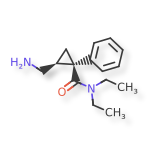
Details
| Stereochemistry | ABSOLUTE |
| Molecular Formula | C15H22N2O |
| Molecular Weight | 246.348 |
| Optical Activity | UNSPECIFIED |
| Defined Stereocenters | 2 / 2 |
| E/Z Centers | 0 |
| Charge | 0 |
SHOW SMILES / InChI
SMILES
CCN(CC)C(=O)[C@@]1(C[C@@H]1CN)C2=CC=CC=C2
InChI
InChIKey=GJJFMKBJSRMPLA-HIFRSBDPSA-N
InChI=1S/C15H22N2O/c1-3-17(4-2)14(18)15(10-13(15)11-16)12-8-6-5-7-9-12/h5-9,13H,3-4,10-11,16H2,1-2H3/t13-,15+/m1/s1
DescriptionCurator's Comment: https://www.tga.gov.au/sites/default/files/auspar-milnacipran-hydrochloride-120124.pdf
Curator's Comment: https://www.tga.gov.au/sites/default/files/auspar-milnacipran-hydrochloride-120124.pdf
Dextromilnacipran (1R, 2S/F2696) is an enantiomer of milnacipran, a serotonin/norepinephrine (5-HT/NE) reuptake inhibitor. Dextromilnacipran is pharmacologically less active as compared with racemic mixture and levomilnacipran (1S, 2R/F2695).
Approval Year
Targets
| Primary Target | Pharmacology | Condition | Potency |
|---|---|---|---|
Target ID: CHEMBL228 |
290.0 nM [Ki] | ||
Target ID: CHEMBL228 |
16.9 nM [Ki] | ||
Target ID: CHEMBL222 |
139.0 nM [Ki] |
Conditions
| Condition | Modality | Targets | Highest Phase | Product |
|---|---|---|---|---|
| Primary | SAVELLA Approved UseSavella is indicated for the management of fibromyalgia. Savella is not approved for use in pediatric patients [see Use in Specific Populations (8.4) Launch Date2009 |
|||
Cmax
| Value | Dose | Co-administered | Analyte | Population |
|---|---|---|---|---|
132 ng/mL EXPERIMENT https://pubmed.ncbi.nlm.nih.gov/26663198/ |
50 mg single, oral dose: 50 mg route of administration: Oral experiment type: SINGLE co-administered: |
MILNACIPRAN plasma | Homo sapiens population: HEALTHY age: ADULT sex: FEMALE / MALE food status: UNKNOWN |
|
150 ng/mL EXPERIMENT https://pubmed.ncbi.nlm.nih.gov/8923123/ |
50 mg single, oral dose: 50 mg route of administration: Oral experiment type: SINGLE co-administered: |
MILNACIPRAN plasma | Homo sapiens population: HEALTHY age: ADULT sex: MALE food status: UNKNOWN |
AUC
| Value | Dose | Co-administered | Analyte | Population |
|---|---|---|---|---|
1316.9 ng × h/mL EXPERIMENT https://pubmed.ncbi.nlm.nih.gov/26663198/ |
50 mg single, oral dose: 50 mg route of administration: Oral experiment type: SINGLE co-administered: |
MILNACIPRAN plasma | Homo sapiens population: HEALTHY age: ADULT sex: FEMALE / MALE food status: UNKNOWN |
T1/2
| Value | Dose | Co-administered | Analyte | Population |
|---|---|---|---|---|
7 h EXPERIMENT https://pubmed.ncbi.nlm.nih.gov/26663198/ |
50 mg single, oral dose: 50 mg route of administration: Oral experiment type: SINGLE co-administered: |
MILNACIPRAN plasma | Homo sapiens population: HEALTHY age: ADULT sex: FEMALE / MALE food status: UNKNOWN |
|
8 h EXPERIMENT https://pubmed.ncbi.nlm.nih.gov/8923123/ |
50 mg single, oral dose: 50 mg route of administration: Oral experiment type: SINGLE co-administered: |
MILNACIPRAN plasma | Homo sapiens population: HEALTHY age: ADULT sex: MALE food status: UNKNOWN |
|
6 h |
50 mg single, oral dose: 50 mg route of administration: Oral experiment type: SINGLE co-administered: |
MILNACIPRAN plasma | Homo sapiens population: UNKNOWN age: UNKNOWN sex: UNKNOWN food status: UNKNOWN |
Funbound
| Value | Dose | Co-administered | Analyte | Population |
|---|---|---|---|---|
87% EXPERIMENT https://pubmed.ncbi.nlm.nih.gov/8923123/ |
50 mg single, oral dose: 50 mg route of administration: Oral experiment type: SINGLE co-administered: |
MILNACIPRAN plasma | Homo sapiens population: HEALTHY age: ADULT sex: MALE food status: UNKNOWN |
|
87% |
50 mg single, oral dose: 50 mg route of administration: Oral experiment type: SINGLE co-administered: |
MILNACIPRAN plasma | Homo sapiens population: UNKNOWN age: UNKNOWN sex: UNKNOWN food status: UNKNOWN |
Overview
| CYP3A4 | CYP2C9 | CYP2D6 | hERG |
|---|---|---|---|
OverviewOther
| Other Inhibitor | Other Substrate | Other Inducer |
|---|---|---|
Drug as perpetrator
| Target | Modality | Activity | Metabolite | Clinical evidence |
|---|---|---|---|---|
| no | ||||
| no | ||||
| no | ||||
| no | ||||
| no | ||||
| no | ||||
| no | ||||
| no | ||||
| no | ||||
| no | ||||
| no | ||||
| no | ||||
| no |
Drug as victim
| Target | Modality | Activity | Metabolite | Clinical evidence |
|---|---|---|---|---|
| no | ||||
| no | no (co-administration study) Comment: no changes in PK of warfarin or milnacipran were observed Sources: https://www.accessdata.fda.gov/drugsatfda_docs/nda/2009/022256s000_ClinPharmR_P1.pdf#page=55 Page: 55.0 |
|||
| no | unlikely (co-administration study) Comment: when coadministered with carbamazepine, exposure (Cmax and AUC) to milnacipran decreased by 18% and 19%, respectively; Sources: https://www.accessdata.fda.gov/drugsatfda_docs/nda/2009/022256s000_ClinPharmR_P1.pdf#page=55 Page: 55.0 |
|||
| no | unlikely (co-administration study) Comment: At steady state, Cmax and AUC for milnacipran increased by only 10% and 20% when coadministered with levomepromazine; no changes in PK of warfarin or milnacipran were observed Sources: https://www.accessdata.fda.gov/drugsatfda_docs/nda/2009/022256s000_ClinPharmR_P1.pdf#page=55 Page: 55.0 |
|||
| no | unlikely (co-administration study) Comment: when coadministered with carbamazepine, exposure (Cmax and AUC) to milnacipran decreased by 18% and 19%, respectively; Sources: https://www.accessdata.fda.gov/drugsatfda_docs/nda/2009/022256s000_ClinPharmR_P1.pdf#page=55 Page: 55.0 |
Tox targets
| Target | Modality | Activity | Metabolite | Clinical evidence |
|---|---|---|---|---|
PubMed
| Title | Date | PubMed |
|---|---|---|
| Anxiolytic-like effect of milnacipran in the four-plate test in mice: mechanism of action. | 2005-07 |
|
| The monoamine-mediated antiallodynic effects of intrathecally administered milnacipran, a serotonin noradrenaline reuptake inhibitor, in a rat model of neuropathic pain. | 2005-05 |
|
| Chronic treatment with milnacipran reverses the impairment of synaptic plasticity induced by conditioned fear stress. | 2005-05 |
|
| Remarkable effect of milnacipran, a serotonin-noradrenalin reuptake inhibitor (SNRI), on depressive symptoms in patients with Parkinson's disease who have insufficient response to selective serotonin reuptake inhibitors (SSRIs): two case reports. | 2005-02 |
|
| Lithium augmentation in milnacipran-refractory depression for the prevention of relapse following electroconvulsive therapy. | 2005-01-22 |
|
| [Effects of milnacipran on neuronal excitability and synaptic transmission in neurons of the rat locus coeruleus]. | 2005-01 |
|
| Peripheral circulatory disturbance induced by milnacipran. | 2005 |
|
| Effectiveness of milnacipran for the treatment of chronic pain: a case series. | 2004-12-17 |
|
| The effect of milnacipran (serotonin noradrenaline reuptake inhibitor) on memory in Korsakoff's syndrome after encephalitis. | 2004-12-13 |
|
| [Review of antidepressants from the TCAs to the third generation drugs]. | 2004-12 |
|
| Acute effect of milnacipran on the relationship between the locus coeruleus noradrenergic and dorsal raphe serotonergic neuronal transmitters. | 2004-12 |
|
| Post-treatment emergent adverse events in depressed patients following treatment with milnacipran and paroxetine. | 2004-12 |
|
| A comparative study of milnacipran and paroxetine in outpatients with major depression. | 2004-12 |
|
| Characterization of the anxiolytic-like effects of fluvoxamine, milnacipran and risperidone in mice using the conditioned fear stress paradigm. | 2004-11-03 |
|
| Differential effects of milnacipran, fluvoxamine and paroxetine for inhibited and agitated depression. | 2004-11 |
|
| Controlled comparison of two different doses of milnacipran in major depressive outpatients. | 2004-11 |
|
| Efficacy of duloxetine, a potent and balanced serotonin-norepinephrine reuptake inhibitor in persistent pain models in rats. | 2004-11 |
|
| Nociceptin/orphanin FQ, hedonic state and the response to abused drugs. | 2004-10 |
|
| The effectiveness of lithium augmentation of milnacipran: preliminary data using the modified Japanese Psychopharmacology Algorithm. | 2004-10 |
|
| Serotonin and noradrenaline reuptake inhibitors in animal models of pain. | 2004-10 |
|
| Clinical experience with dual action antidepressants in different chronic pain syndromes. | 2004-10 |
|
| A double-blind placebo-controlled trial of milnacipran in the treatment of fibromyalgia. | 2004-10 |
|
| Opioid and monoamine systems mediate the discriminative stimulus of tramadol in rats. | 2004-09-13 |
|
| Prediction of antidepressant response to milnacipran by norepinephrine transporter gene polymorphisms. | 2004-09 |
|
| In vitro inhibition of recombinant ligand-gated ion channels by high concentrations of milnacipran. | 2004-09 |
|
| Milnacipran treatment of a terminally ill cancer patient with major depressive disorder. | 2004-08 |
|
| Differential effects of fluvoxamine, paroxetine and milnacipran for depression, especially with regard to age. | 2004-08 |
|
| Prevalence of induced mania in patients treated with milnacipran: a comparison with paroxetine. | 2004-08 |
|
| Determination of milnacipran, a serotonin and noradrenaline reuptake inhibitor, in human plasma using liquid chromatography with spectrofluorimetric detection. | 2004-07-05 |
|
| A case of temporo-mandibular disorder with fibromyalgia treated with the antidepressant, milnacipran. | 2004-07 |
|
| Subjective and polysomnographic effects of milnacipran on sleep in depressed patients. | 2004-07 |
|
| A comparative study of milnacipran and imipramine in the treatment of major depressive disorder. | 2004-06 |
|
| The monoamine reuptake inhibitor milnacipran does not affect nociception to acute visceral distension in rats. | 2004-05 |
|
| Efficacy of milnacipran for depressive symptoms in schizophrenia spectrum disorders. | 2004-04 |
|
| Milnacipran, a serotonin and noradrenaline reuptake inhibitor, suppresses long-term potentiation in the rat hippocampal CA1 field via 5-HT1A receptors and alpha 1-adrenoceptors. | 2004-03-04 |
|
| Milnacipran: a dual norepinephrine and serotonin reuptake pump inhibitor. | 2004-03 |
|
| Peripheral nerve injury sensitizes the response to visceral distension but not its inhibition by the antidepressant milnacipran. | 2004-03 |
|
| Augmentation of milnacipran by risperidone in treatment for major depression. | 2004-03 |
|
| Milnacipran: a comparative analysis of human monoamine uptake and transporter binding affinity. | 2004-02-01 |
|
| [Acute hepatitis associated with milnacipran treatment]. | 2004-02 |
|
| Associations between baseline plasma MHPG (3-methoxy-4-hydroxyphenylglycol) levels and clinical responses with respect to milnacipran versus paroxetine treatment. | 2004-02 |
|
| Reboxetine: a norepinephrine selective reuptake pump inhibitor. | 2004-01 |
|
| Double-blind comparative study of the action of repeated administration of milnacipran versus placebo on cognitive functions in healthy volunteers. | 2004-01 |
|
| Effects of milnacipran on the inhibitory postsynaptic potential in neurons of the rat locus coeruleus. | 2004 |
|
| Ejaculation after defecation without orgasm induced by milnacipran. | 2004 |
|
| A method for designing conformationally restricted analogues based on allylic strain: synthesis of a novel class of noncompetitive NMDA receptor antagonists having the acrylamide structure. | 2003-12-04 |
|
| Milnacipran and pindolol: a randomized trial of reduction of antidepressant latency. | 2003-12 |
|
| Differential effects of milnacipran, fluvoxamine and paroxetine for depression, especially in gender. | 2003-12 |
|
| [Psychotropic drugs used in a psychiatric hospital (pharmaco-epidemiologic aspects)]. | 2003 |
|
| [Experience with ixel (milnacipran hydrochloride) use in the treatment of patients with post-stroke depression]. | 2003 |
Sample Use Guides
The recommended dose of Savella (Milnacipran) is 100 mg/day (50 mg twice daily).
Based on efficacy and tolerability dosing may be titrated according to the following schedule:
Day 1: 12.5 mg once
Days 2-3: 25 mg/day (12.5 mg twice daily)
Days 4-7: 50 mg/day (25 mg twice daily)
After Day 7: 100 mg/day (50 mg twice daily)
Based on individual patient response, the dose may be increased to 200 mg/day (100 mg twice daily).
Doses above 200 mg/day have not been studied.
Route of Administration:
Oral
| Name | Type | Language | ||
|---|---|---|---|---|
|
Preferred Name | English | ||
|
Common Name | English | ||
|
Code | English | ||
|
Common Name | English | ||
|
Systematic Name | English | ||
|
Systematic Name | English |
| Code System | Code | Type | Description | ||
|---|---|---|---|---|---|
|
ES1O38J3C4
Created by
admin on Mon Mar 31 22:46:19 GMT 2025 , Edited by admin on Mon Mar 31 22:46:19 GMT 2025
|
PRIMARY | |||
|
DB08918
Created by
admin on Mon Mar 31 22:46:19 GMT 2025 , Edited by admin on Mon Mar 31 22:46:19 GMT 2025
|
PRIMARY | |||
|
96847-55-1
Created by
admin on Mon Mar 31 22:46:19 GMT 2025 , Edited by admin on Mon Mar 31 22:46:19 GMT 2025
|
PRIMARY | |||
|
DTXSID601025164
Created by
admin on Mon Mar 31 22:46:19 GMT 2025 , Edited by admin on Mon Mar 31 22:46:19 GMT 2025
|
PRIMARY | |||
|
65833
Created by
admin on Mon Mar 31 22:46:19 GMT 2025 , Edited by admin on Mon Mar 31 22:46:19 GMT 2025
|
PRIMARY |
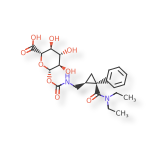
METABOLITE (PARENT)
SUBSTANCE RECORD