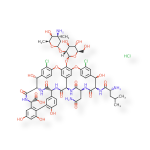
Details
| Stereochemistry | ABSOLUTE |
| Molecular Formula | C65H73Cl2N9O24 |
| Molecular Weight | 1435.227 |
| Optical Activity | UNSPECIFIED |
| Defined Stereocenters | 18 / 18 |
| E/Z Centers | 0 |
| Charge | 0 |
SHOW SMILES / InChI
SMILES
CC(C)C[C@@H](N)C(=O)N[C@@H]1[C@H](O)C2=CC=C(OC3=C(O[C@@H]4O[C@H](CO)[C@@H](O)[C@H](O)[C@H]4O[C@H]5C[C@](C)(N)[C@H](O)[C@H](C)O5)C6=CC(=C3)[C@@H](NC(=O)[C@H](CC(N)=O)NC1=O)C(=O)N[C@@H]7C8=CC=C(O)C(=C8)C9=C(O)C=C(O)C=C9[C@H](NC(=O)[C@@H](NC7=O)[C@H](O)C%10=CC(Cl)=C(O6)C=C%10)C(O)=O)C(Cl)=C2
InChI
InChIKey=NUAQIRUAZSJTAI-YRPZDAAMSA-N
InChI=1S/C65H73Cl2N9O24/c1-22(2)11-33(68)57(87)75-48-50(82)25-6-9-37(31(66)13-25)96-39-15-27-16-40(54(39)100-64-55(53(85)52(84)41(21-77)98-64)99-43-20-65(4,70)56(86)23(3)95-43)97-38-10-7-26(14-32(38)67)51(83)49-62(92)74-47(63(93)94)30-17-28(78)18-36(80)44(30)29-12-24(5-8-35(29)79)45(59(89)76-49)73-60(90)46(27)72-58(88)34(19-42(69)81)71-61(48)91/h5-10,12-18,22-23,33-34,41,43,45-53,55-56,64,77-80,82-86H,11,19-21,68,70H2,1-4H3,(H2,69,81)(H,71,91)(H,72,88)(H,73,90)(H,74,92)(H,75,87)(H,76,89)(H,93,94)/t23-,33+,34-,41+,43-,45+,46+,47-,48+,49-,50+,51+,52+,53-,55+,56+,64-,65-/m0/s1
Norvancomycin is an analog of glycopeptide antibiotic vancomycin. It was first found to be produced by a soil microorganisms such Nocardia orientalis and Amycolatopsis orientalis and recently was found in actinomycete Amycolatopsis orientalis CPCC200066. Norvancomycin can be derived by demethylation at N-terminus of vancomycin. It has significant inhibitory activity against Gram-positive cocci and bacilli. The mode of action of norvancomycin is based on its ability to bind to the cell-wall peptidoglycan of Gram-positive bacteria terminating tripeptide -L-Lys-D-Ala-D-Ala. Similar to vancomycin in terms of antibacterial activity, spectrum and clinical efficacy norvancomycin has more potent antibiotic activity against Staphylococcus aureus and higher affinity for bacteria cell wall analogue DALAA than vancomycin. Norvancomycin has been widely used in China to treat endocarditis, osteomyelitis and other severe infections caused by Staphylococcus aureus (including methicillin-resistant strains). The adverse drug reactions of norvancomycin are like vancomycin, such as nephrotoxicity, ototoxicity, rash and itching. Norvancomycin is not available therapeutically outside of China.
CNS Activity
Originator
Curator's Comment: Norvancomycin was first isolated from Van-23, a strain of Amycolatopsis orientalis from soil sample collected in Guizhou Province, China, in 1959 and has been clinically used in China since 1967. In the early 1980s it was found to be produced by a soil isolate collected in Yucatan, Mexico and its structure was determined by scientists at Eli Lilly.
Approval Year
PubMed
| Title | Date | PubMed |
|---|---|---|
| Drug concentrations in the serum and cerebrospinal fluid of patients treated with norvancomycin after craniotomy. | 2017-02 |
|
| Draft Genome Sequence of Norvancomycin-Producing Strain Amycolatopsis orientalis CPCC200066. | 2015-05-14 |
|
| Population pharmacokinetic and pharmacodynamic modeling of norvancomycin. | 2008-04 |
|
| Ototoxicity of a new glycopeptide, norvancomycin with multiple intravenous administrations in guinea pigs. | 2004-01 |
|
| Antibiotic activities and affinities for bacterial cell wall analogue of N-demethylvancomycin and its derivatives. | 1998-08 |
|
| [In vitro antibacterial activity and clinical significance of domestic fluoroquinolones combinations with other antimicrobial agents]. | 1993-03 |
Patents
Sample Use Guides
Patients after craniotomy with an indwelling catheter in the operational area/ventricle were administered norvancomycin by two approaches: (1) The conventional group consisted of 14 cases that were infused with 0.8 g norvancomycin for 1 h, every 12 h; (2) The continuous administration group consisted of 14 cases that were infused with 0.8 g norvancomycin for 1 h, and then another 0.4 g for 11 h with extended infusion, followed by continuous infusion of 0.4 g norvancomycin for 12 h.
Route of Administration:
Intravenous
| Name | Type | Language | ||
|---|---|---|---|---|
|
Preferred Name | English | ||
|
Common Name | English | ||
|
Code | English | ||
|
Code | English | ||
|
Common Name | English | ||
|
Common Name | English | ||
|
Common Name | English | ||
|
Common Name | English |
| Code System | Code | Type | Description | ||
|---|---|---|---|---|---|
|
10419027
Created by
admin on Mon Mar 31 23:06:19 GMT 2025 , Edited by admin on Mon Mar 31 23:06:19 GMT 2025
|
PRIMARY | |||
|
BP129IOC93
Created by
admin on Mon Mar 31 23:06:19 GMT 2025 , Edited by admin on Mon Mar 31 23:06:19 GMT 2025
|
PRIMARY | |||
|
100000124400
Created by
admin on Mon Mar 31 23:06:19 GMT 2025 , Edited by admin on Mon Mar 31 23:06:19 GMT 2025
|
PRIMARY | |||
|
SUB32246
Created by
admin on Mon Mar 31 23:06:19 GMT 2025 , Edited by admin on Mon Mar 31 23:06:19 GMT 2025
|
PRIMARY | |||
|
DTXSID301016186
Created by
admin on Mon Mar 31 23:06:19 GMT 2025 , Edited by admin on Mon Mar 31 23:06:19 GMT 2025
|
PRIMARY | |||
|
91700-98-0
Created by
admin on Mon Mar 31 23:06:19 GMT 2025 , Edited by admin on Mon Mar 31 23:06:19 GMT 2025
|
PRIMARY |
ACTIVE MOIETY
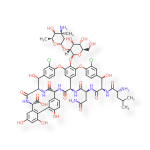
SALT/SOLVATE (PARENT)