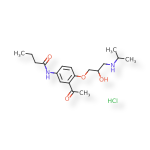
Details
| Stereochemistry | RACEMIC |
| Molecular Formula | C18H28N2O4.ClH |
| Molecular Weight | 372.887 |
| Optical Activity | ( + / - ) |
| Defined Stereocenters | 0 / 1 |
| E/Z Centers | 0 |
| Charge | 0 |
SHOW SMILES / InChI
SMILES
Cl.CCCC(=O)NC1=CC=C(OCC(O)CNC(C)C)C(=C1)C(C)=O
InChI
InChIKey=KTUFKADDDORSSI-UHFFFAOYSA-N
InChI=1S/C18H28N2O4.ClH/c1-5-6-18(23)20-14-7-8-17(16(9-14)13(4)21)24-11-15(22)10-19-12(2)3;/h7-9,12,15,19,22H,5-6,10-11H2,1-4H3,(H,20,23);1H
Acebutolol is a cardioselective, beta-adrenoreceptor blocking agent, which possesses mild intrinsic sympathomimetic activity (ISA) in its therapeutically effective dose range. Acebutolol is marketed under the trade names Sectral, Prent. Acebutolol is indicated for the management of hypertension in adults. It may be used alone or in combination with other antihypertensive agents, especially thiazide-type diuretics. Acebutolol is also indicated in the management of ventricular premature beats; it reduces the total number of premature beats, as well as the number of paired and multiform ventricular ectopic beats, and R-on-T beats. Acebutolol is a selective β1-receptor antagonist. Activation of β1-receptors by epinephrine increases the heart rate and the blood pressure, and the heart consumes more oxygen. Acebutolol blocks these receptors, lowering the heart rate and blood pressure. This drug then has the reverse effect of epinephrine. In addition, beta blockers prevent the release of renin, which is a hormone produced by the kidneys which leads to constriction of blood vessels.
Approval Year
Targets
| Primary Target | Pharmacology | Condition | Potency |
|---|---|---|---|
| 741.0 nM [Ki] |
Conditions
| Condition | Modality | Targets | Highest Phase | Product |
|---|---|---|---|---|
| Primary | SECTRAL Approved UseINDICATIONS & USAGE HYPERTENSION: Acebutolol hydrochloride capsules are indicated for the management of hypertension in adults. It may be used alone or in combination with other antihypertensive agents, especially thiazide-type diuretics. VENTRICULAR ARRHYTHMIAS: Acebutolol hydrochloride capsules are indicated in the management of ventricular premature beats; it reduces the total number of premature beats, as well as the number of paired and multiform ventricular ectopic beats, and R-on-T beats. Launch Date1984 |
|||
| Primary | SECTRAL Approved UseINDICATIONS & USAGE HYPERTENSION: Acebutolol hydrochloride capsules are indicated for the management of hypertension in adults. It may be used alone or in combination with other antihypertensive agents, especially thiazide-type diuretics. VENTRICULAR ARRHYTHMIAS: Acebutolol hydrochloride capsules are indicated in the management of ventricular premature beats; it reduces the total number of premature beats, as well as the number of paired and multiform ventricular ectopic beats, and R-on-T beats. Launch Date1984 |
Cmax
| Value | Dose | Co-administered | Analyte | Population |
|---|---|---|---|---|
92 ng/mL EXPERIMENT https://pubmed.ncbi.nlm.nih.gov/6884417/ |
400 mg single, oral dose: 400 mg route of administration: Oral experiment type: SINGLE co-administered: |
ACEBUTOLOL plasma | Homo sapiens population: HEALTHY age: ADULT sex: MALE food status: FASTED |
AUC
| Value | Dose | Co-administered | Analyte | Population |
|---|---|---|---|---|
4492 ng × h/mL EXPERIMENT https://pubmed.ncbi.nlm.nih.gov/6884417/ |
400 mg single, oral dose: 400 mg route of administration: Oral experiment type: SINGLE co-administered: |
ACEBUTOLOL plasma | Homo sapiens population: HEALTHY age: ADULT sex: MALE food status: FASTED |
T1/2
| Value | Dose | Co-administered | Analyte | Population |
|---|---|---|---|---|
4 h |
unknown, oral |
ACEBUTOLOL plasma | Homo sapiens population: UNKNOWN age: UNKNOWN sex: UNKNOWN food status: UNKNOWN |
Funbound
| Value | Dose | Co-administered | Analyte | Population |
|---|---|---|---|---|
74% |
unknown, oral |
ACEBUTOLOL plasma | Homo sapiens population: UNKNOWN age: UNKNOWN sex: UNKNOWN food status: UNKNOWN |
Doses
| Dose | Population | Adverse events |
|---|---|---|
6 g 1 times / day single, oral Overdose Dose: 6 g, 1 times / day Route: oral Route: single Dose: 6 g, 1 times / day Sources: |
healthy, 16 |
Other AEs: Breathing shallow, Nausea... Other AEs: Breathing shallow Sources: Nausea Pulse thready Tachycardia Bradycardia Asystole Death (grade 5) Blood pressure low |
9.2 g 1 times / day single, oral Overdose Dose: 9.2 g, 1 times / day Route: oral Route: single Dose: 9.2 g, 1 times / day Sources: |
healthy, 24 |
Other AEs: Blood pressure low, Heart rate low... Other AEs: Blood pressure low Sources: Heart rate low Necrosis bowel Muscle tone flaccid |
0.8 g 2 times / day multiple, oral Highest studied dose Dose: 0.8 g, 2 times / day Route: oral Route: multiple Dose: 0.8 g, 2 times / day Sources: |
unhealthy, 31-63 |
Disc. AE: Antinuclear antibody... AEs leading to discontinuation/dose reduction: Antinuclear antibody (3 patients) Sources: |
4 g 1 times / day single, oral Overdose Dose: 4 g, 1 times / day Route: oral Route: single Dose: 4 g, 1 times / day Sources: |
healthy, 43 |
Other AEs: Blood pressure low, Ventricular tachycardia... Other AEs: Blood pressure low Sources: Ventricular tachycardia Death (grade 5) |
AEs
| AE | Significance | Dose | Population |
|---|---|---|---|
| Asystole | 6 g 1 times / day single, oral Overdose Dose: 6 g, 1 times / day Route: oral Route: single Dose: 6 g, 1 times / day Sources: |
healthy, 16 |
|
| Blood pressure low | 6 g 1 times / day single, oral Overdose Dose: 6 g, 1 times / day Route: oral Route: single Dose: 6 g, 1 times / day Sources: |
healthy, 16 |
|
| Bradycardia | 6 g 1 times / day single, oral Overdose Dose: 6 g, 1 times / day Route: oral Route: single Dose: 6 g, 1 times / day Sources: |
healthy, 16 |
|
| Breathing shallow | 6 g 1 times / day single, oral Overdose Dose: 6 g, 1 times / day Route: oral Route: single Dose: 6 g, 1 times / day Sources: |
healthy, 16 |
|
| Nausea | 6 g 1 times / day single, oral Overdose Dose: 6 g, 1 times / day Route: oral Route: single Dose: 6 g, 1 times / day Sources: |
healthy, 16 |
|
| Pulse thready | 6 g 1 times / day single, oral Overdose Dose: 6 g, 1 times / day Route: oral Route: single Dose: 6 g, 1 times / day Sources: |
healthy, 16 |
|
| Tachycardia | 6 g 1 times / day single, oral Overdose Dose: 6 g, 1 times / day Route: oral Route: single Dose: 6 g, 1 times / day Sources: |
healthy, 16 |
|
| Death | grade 5 | 6 g 1 times / day single, oral Overdose Dose: 6 g, 1 times / day Route: oral Route: single Dose: 6 g, 1 times / day Sources: |
healthy, 16 |
| Blood pressure low | 9.2 g 1 times / day single, oral Overdose Dose: 9.2 g, 1 times / day Route: oral Route: single Dose: 9.2 g, 1 times / day Sources: |
healthy, 24 |
|
| Heart rate low | 9.2 g 1 times / day single, oral Overdose Dose: 9.2 g, 1 times / day Route: oral Route: single Dose: 9.2 g, 1 times / day Sources: |
healthy, 24 |
|
| Muscle tone flaccid | 9.2 g 1 times / day single, oral Overdose Dose: 9.2 g, 1 times / day Route: oral Route: single Dose: 9.2 g, 1 times / day Sources: |
healthy, 24 |
|
| Necrosis bowel | 9.2 g 1 times / day single, oral Overdose Dose: 9.2 g, 1 times / day Route: oral Route: single Dose: 9.2 g, 1 times / day Sources: |
healthy, 24 |
|
| Antinuclear antibody | 3 patients Disc. AE |
0.8 g 2 times / day multiple, oral Highest studied dose Dose: 0.8 g, 2 times / day Route: oral Route: multiple Dose: 0.8 g, 2 times / day Sources: |
unhealthy, 31-63 |
| Blood pressure low | 4 g 1 times / day single, oral Overdose Dose: 4 g, 1 times / day Route: oral Route: single Dose: 4 g, 1 times / day Sources: |
healthy, 43 |
|
| Ventricular tachycardia | 4 g 1 times / day single, oral Overdose Dose: 4 g, 1 times / day Route: oral Route: single Dose: 4 g, 1 times / day Sources: |
healthy, 43 |
|
| Death | grade 5 | 4 g 1 times / day single, oral Overdose Dose: 4 g, 1 times / day Route: oral Route: single Dose: 4 g, 1 times / day Sources: |
healthy, 43 |
PubMed
| Title | Date | PubMed |
|---|---|---|
| Potential for biodegradation and sorption of acetaminophen, caffeine, propranolol and acebutolol in lab-scale aqueous environments. | 2010-11-15 |
|
| Occurrence and removal of estrogens and beta blockers by various processes in wastewater treatment plants. | 2010-09-01 |
|
| Management of infantile subglottic hemangioma: acebutolol or propranolol? | 2010-08 |
|
| Principal component analysis of HPLC retention data and molecular modeling structural parameters of cardiovascular system drugs in view of their pharmacological activity. | 2010-07-09 |
|
| Seasonal variations in the occurrence and fate of basic and neutral pharmaceuticals in a Swedish river-lake system. | 2010-06 |
|
| Correlation effect of EGFR and CXCR4 and CCR7 chemokine receptors in predicting breast cancer metastasis and prognosis. | 2010-02-24 |
|
| Fate of beta blockers in aquatic-sediment systems: sorption and biotransformation. | 2010-02-01 |
|
| Medicinal chemistry of drugs used in diabetic cardiomyopathy. | 2010 |
|
| Comparison of the analysis of beta-blockers by different techniques. | 2009-12-01 |
|
| Drugs associated with more suicidal ideations are also associated with more suicide attempts. | 2009-10-02 |
|
| [Beta blockers in migraine prophylaxis]. | 2009-10 |
|
| The role of transporters in the pharmacokinetics of orally administered drugs. | 2009-09 |
|
| Involvement of influx and efflux transport systems in gastrointestinal absorption of celiprolol. | 2009-07 |
|
| Application of ionic liquids in high performance reversed-phase chromatography. | 2009-06-04 |
|
| Beta-blocking agent for treatment of infantile hemangioma. | 2009-06 |
|
| First record of Prorocentrum lima (Dinophyceae) inside harbor areas and along the Abruzzo region coast, W Adriatic. | 2009-04 |
|
| In-vitro relationship between protein-binding and free drug concentrations of a water-soluble selective beta-adrenoreceptor antagonist (atenolol) and its interaction with arsenic. | 2009-02 |
|
| Using supported liquid extraction together with cellobiohydrolase chiral stationary phases-based liquid chromatography with tandem mass spectrometry for enantioselective determination of acebutolol and its active metabolite diacetolol in spiked human plasma. | 2009-01-15 |
|
| Pharmaceutical cleaning validation using non-proximate large-area desorption electrospray ionization mass spectrometry. | 2009-01 |
|
| Determination of selected beta-receptor antagonists in biological samples by solid-phase extraction with cholesterolic phase and LC/MS. | 2009-01 |
|
| Simultaneous determination of beta-blockers in human plasma using liquid chromatography-tandem mass spectrometry. | 2008-07 |
|
| Ozonation of reverse osmosis concentrate: kinetics and efficiency of beta blocker oxidation. | 2008-06 |
|
| Stability of chosen beta-adrenolytic drugs of different polarity in basic environment. | 2008-05-15 |
|
| A unique mechanism of beta-blocker action: carvedilol stimulates beta-arrestin signaling. | 2007-10-16 |
|
| Evaluation of the impact on entomocoenosis of active agents allowed in organic olive farming against Bactrocera oleae (Gmelin, 1790). | 2007-09-01 |
|
| Cutaneous vasculitis induced by carvedilol. | 2007-08 |
|
| Biopharmaceutics classification of selected beta-blockers: solubility and permeability class membership. | 2007-07-20 |
|
| Amoxicillin-Induced Eosinophilic Pneumonia with Granulomatous Reaction: Discrepancy between Drug-Induced Lymphocyte Stimulation Test Findings and the Provocation Drug Test. | 2007-06-15 |
|
| Determination of beta-blockers and beta2-agonists in sewage by solid-phase extraction and liquid chromatography-tandem mass spectrometry. | 2007-05-04 |
|
| Antihypertensive and antioxidant action of amlodipine and vitamin C in patients of essential hypertension. | 2007-03 |
|
| Elimination of pharmaceuticals in sewage treatment plants in Finland. | 2007-03 |
|
| A population-based analysis of the class effect of beta-blockers after myocardial infarction. | 2007-02 |
|
| Evaluation of chromatographic descriptors for the prediction of gastro-intestinal absorption of drugs. | 2007-01-05 |
|
| Spectrophotometric and spectrofluorimetric methods for analysis of acyclovir and acebutolol hydrochloride. | 2007-01 |
|
| Abstracts of papers presented at the 2007 pittsburgh conference. | 2007 |
|
| Beta-blockers use in patients with chronic obstructive pulmonary disease and concomitant cardiovascular conditions. | 2007 |
|
| [Interrelationship between changes of rate and variability of cardiac rhythm under influence of beta-adrenoblockers]. | 2007 |
|
| Clinical review: aggressive management and extracorporeal support for drug-induced cardiotoxicity. | 2007 |
|
| Spectrophotometric and spectrofluorimetric methods for analysis of tramadol, acebutolol and dothiepin in pharmaceutical preparations. | 2006-12 |
|
| Analysis of neutral and basic pharmaceuticals in sewage treatment plants and in recipient rivers using solid phase extraction and liquid chromatography-tandem mass spectrometry detection. | 2006-11-17 |
|
| Spectrophotometric and spectrofluorimetric methods for analysis of acyclovir and acebutolol hydrochloride. | 2006-11 |
|
| Arrhythmogenic right ventricular dysplasia in pregnancy: a case report. | 2006-09 |
|
| Smith-Magenis syndrome: a case report of improved sleep after treatment with beta1-adrenergic antagonists and melatonin. | 2006-09 |
|
| Spectrofluorimetric determination of drugs containing active methylene group using N1-methyl nicotinamide chloride as a fluorigenic agent. | 2006-07 |
|
| Transdermal delivery of beta-blockers. | 2006-05 |
|
| Transport of acebutolol through rabbit corneal epithelium. | 2006-04 |
|
| [Cholinergic urticaria revealed by beta-blockers: case report and therapeutic management]. | 2006-03-25 |
|
| UPLC/MS for the identification of beta-blockers. | 2006-02-24 |
|
| Stability of atenolol, acebutolol and propranolol in acidic environment depending on its diversified polarity. | 2006 |
|
| Treatment of high blood pressure and gain in event-free life expectancy. | 2005 |
Sample Use Guides
Hypertension
The initial dosage of acebutolol in uncomplicated mild-to-moderate hypertension is 400 mg. This can be given as a single daily dose, but in occasional patients twice daily dosing may be required for adequate 24-hour blood-pressure control. An optimal response is usually achieved with dosages of 400 to 800 mg per day, although some patients have been maintained on as little as 200 mg per day. Patients with more severe hypertension or who have demonstrated inadequate control may respond to a total of 1200 mg daily (administered b.i.d.), or to the addition of a second antihypertensive agent. Beta-1 selectivity diminishes as dosage is increased.
Ventricular Arrhythmia
The usual initial dose of acebutolol is 400 mg daily given as 200 mg b.i.d. Dosage should be increased gradually until an optimal clinical response is obtained, generally at 600 to 1200 mg per day. If treatment is to be discontinued, the dosage should be reduced gradually over a period of about two weeks.
Use in Older Patients
Older patients have an approximately 2-fold increase in bioavailability and may require lower maintenance doses. Doses above 800 mg/day should be avoided in the elderly.
Route of Administration:
Oral
Two adrenergic receptor antagonists, acebutolol and propranolol, were observed to depress rabbit heart contractile force and adrenaline-stimulated adenylate cyclase activity at 1 X 10-(5) to 1 X 10-(3) M and 1 X 10-(6) to 1 X 10-(3) M concentrations, respectively. Acebutolol depressed sarcoplasmic reticular and mitochondrial calcium uptake at 5 X 10-(3) to 10-(2) M concentrations.
| Name | Type | Language | ||
|---|---|---|---|---|
|
Preferred Name | English | ||
|
Common Name | English | ||
|
Common Name | English | ||
|
Common Name | English | ||
|
Common Name | English | ||
|
Code | English | ||
|
Code | English | ||
|
Common Name | English | ||
|
Code | English | ||
|
Common Name | English | ||
|
Code | English | ||
|
Common Name | English | ||
|
Common Name | English | ||
|
Code | English | ||
|
Brand Name | English | ||
|
Systematic Name | English | ||
|
Common Name | English | ||
|
Common Name | English | ||
|
Common Name | English | ||
|
Common Name | English | ||
|
Brand Name | English | ||
|
Code | English | ||
|
Code | English | ||
|
Common Name | English | ||
|
Common Name | English | ||
|
Common Name | English | ||
|
Common Name | English | ||
|
Brand Name | English |
| Classification Tree | Code System | Code | ||
|---|---|---|---|---|
|
NCI_THESAURUS |
C29576
Created by
admin on Mon Mar 31 18:03:13 GMT 2025 , Edited by admin on Mon Mar 31 18:03:13 GMT 2025
|
||
|
EU-Orphan Drug |
EU/3/16/1742
Created by
admin on Mon Mar 31 18:03:13 GMT 2025 , Edited by admin on Mon Mar 31 18:03:13 GMT 2025
|
| Code System | Code | Type | Description | ||
|---|---|---|---|---|---|
|
251-980-3
Created by
admin on Mon Mar 31 18:03:13 GMT 2025 , Edited by admin on Mon Mar 31 18:03:13 GMT 2025
|
PRIMARY | |||
|
36816
Created by
admin on Mon Mar 31 18:03:13 GMT 2025 , Edited by admin on Mon Mar 31 18:03:13 GMT 2025
|
PRIMARY | |||
|
100000091380
Created by
admin on Mon Mar 31 18:03:13 GMT 2025 , Edited by admin on Mon Mar 31 18:03:13 GMT 2025
|
PRIMARY | |||
|
DTXSID5045461
Created by
admin on Mon Mar 31 18:03:13 GMT 2025 , Edited by admin on Mon Mar 31 18:03:13 GMT 2025
|
PRIMARY | |||
|
CHEMBL642
Created by
admin on Mon Mar 31 18:03:13 GMT 2025 , Edited by admin on Mon Mar 31 18:03:13 GMT 2025
|
PRIMARY | |||
|
142130
Created by
admin on Mon Mar 31 18:03:13 GMT 2025 , Edited by admin on Mon Mar 31 18:03:13 GMT 2025
|
PRIMARY | RxNorm | ||
|
C28806
Created by
admin on Mon Mar 31 18:03:13 GMT 2025 , Edited by admin on Mon Mar 31 18:03:13 GMT 2025
|
PRIMARY | |||
|
6524
Created by
admin on Mon Mar 31 18:03:13 GMT 2025 , Edited by admin on Mon Mar 31 18:03:13 GMT 2025
|
PRIMARY | |||
|
2380
Created by
admin on Mon Mar 31 18:03:13 GMT 2025 , Edited by admin on Mon Mar 31 18:03:13 GMT 2025
|
PRIMARY | |||
|
B025Y34C54
Created by
admin on Mon Mar 31 18:03:13 GMT 2025 , Edited by admin on Mon Mar 31 18:03:13 GMT 2025
|
PRIMARY | |||
|
DBSALT000192
Created by
admin on Mon Mar 31 18:03:13 GMT 2025 , Edited by admin on Mon Mar 31 18:03:13 GMT 2025
|
PRIMARY | |||
|
1000601
Created by
admin on Mon Mar 31 18:03:13 GMT 2025 , Edited by admin on Mon Mar 31 18:03:13 GMT 2025
|
PRIMARY | |||
|
34381-68-5
Created by
admin on Mon Mar 31 18:03:13 GMT 2025 , Edited by admin on Mon Mar 31 18:03:13 GMT 2025
|
PRIMARY | |||
|
757412
Created by
admin on Mon Mar 31 18:03:13 GMT 2025 , Edited by admin on Mon Mar 31 18:03:13 GMT 2025
|
PRIMARY | |||
|
B025Y34C54
Created by
admin on Mon Mar 31 18:03:13 GMT 2025 , Edited by admin on Mon Mar 31 18:03:13 GMT 2025
|
PRIMARY | |||
|
SUB00240MIG
Created by
admin on Mon Mar 31 18:03:13 GMT 2025 , Edited by admin on Mon Mar 31 18:03:13 GMT 2025
|
PRIMARY | |||
|
m1290
Created by
admin on Mon Mar 31 18:03:13 GMT 2025 , Edited by admin on Mon Mar 31 18:03:13 GMT 2025
|
PRIMARY | Merck Index |
ACTIVE MOIETY
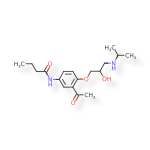
SUBSTANCE RECORD