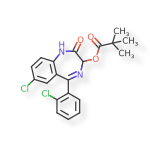
Details
| Stereochemistry | RACEMIC |
| Molecular Formula | C20H18Cl2N2O3 |
| Molecular Weight | 405.275 |
| Optical Activity | ( + / - ) |
| Defined Stereocenters | 0 / 1 |
| E/Z Centers | 0 |
| Charge | 0 |
SHOW SMILES / InChI
SMILES
CC(C)(C)C(=O)OC1N=C(C2=CC=CC=C2Cl)C3=CC(Cl)=CC=C3NC1=O
InChI
InChIKey=JFOCMCPAFDDCKV-UHFFFAOYSA-N
InChI=1S/C20H18Cl2N2O3/c1-20(2,3)19(26)27-18-17(25)23-15-9-8-11(21)10-13(15)16(24-18)12-6-4-5-7-14(12)22/h4-10,18H,1-3H3,(H,23,25)
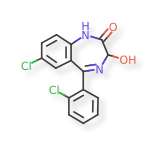
Lorazepam (brand name Ativan) is indicated for the management of anxiety disorders or for the short-term relief of the symptoms of anxiety or anxiety associated with depressive symptoms. Anxiety or tension associated with the stress of everyday life usually does not require treatment with an anxiolytic. Lorazepam binds to an allosteric site on GABA-A receptors, which are pentameric ionotropic receptors in the CNS. Binding potentiates the effects of the inhibitory neurotransmitter GABA, which upon binding opens the chloride channel in the receptor, allowing chloride influx and causing hyperpolarization of the neuron. Studies in healthy volunteers show that in single high doses Ativan (lorazepam) has a tranquilizing action on the central nervous system with no appreciable effect on the respiratory or cardiovascular systems. Ativan (lorazepam) is readily absorbed with an absolute bioavailability of 90 percent. The mean half-life of unconjugated lorazepam in human plasma is about 12 hours and for its major metabolite, lorazepam glucuronide, about 18 hours. At clinically relevant concentrations, lorazepam is approximately 85% bound to plasma proteins. Lorazepam is rapidly conjugated at its 3-hydroxy group into lorazepam glucuronide which is then excreted in the urine. Lorazepam glucuronide has no demonstrable CNS activity in animal. Most adverse reactions to benzodiazepines, including CNS effects and respiratory depression, are dose dependent, with more severe effects occurring with high doses. Paradoxical reactions, including anxiety, excitation, agitation, hostility, aggression, rage, sleep disturbances/insomnia, sexual arousal, and hallucinations may occur. Small decreases in blood pressure and hypotension may occur but are usually not clinically significant, probably being related to the relief of anxiety produced by lorazepam.
Approval Year
Targets
| Primary Target | Pharmacology | Condition | Potency |
|---|---|---|---|
Target ID: CHEMBL2093872 |
Conditions
| Condition | Modality | Targets | Highest Phase | Product |
|---|---|---|---|---|
| Primary | ATIVAN Approved UseLorazepam is indicated for the management of anxiety disorders or for the short-term relief of the symptoms of anxiety or anxiety associated with depressive symptoms. Anxiety or tension associated with the stress of everyday life usually does not require treatment with an anxiolytic. The effectiveness of lorazepam in long-term use, that is, more than 4 months, has not been assessed by systematic clinical studies. The physician should periodically reassess the usefulness of the drug for the individual patient. Launch Date1977 |
Cmax
| Value | Dose | Co-administered | Analyte | Population |
|---|---|---|---|---|
20 ng/mL |
2 mg single, oral dose: 2 mg route of administration: Oral experiment type: SINGLE co-administered: |
LORAZEPAM plasma | Homo sapiens population: HEALTHY age: ADULT sex: UNKNOWN food status: UNKNOWN |
AUC
| Value | Dose | Co-administered | Analyte | Population |
|---|---|---|---|---|
563.1 ng × h/mL EXPERIMENT https://pubmed.ncbi.nlm.nih.gov/31453/ |
2 mg single, intravenous dose: 2 mg route of administration: Intravenous experiment type: SINGLE co-administered: |
LORAZEPAM plasma | Homo sapiens population: HEALTHY age: ADULT sex: FEMALE / MALE food status: FASTED |
T1/2
| Value | Dose | Co-administered | Analyte | Population |
|---|---|---|---|---|
14.3 h EXPERIMENT https://pubmed.ncbi.nlm.nih.gov/31453/ |
2 mg single, intravenous dose: 2 mg route of administration: Intravenous experiment type: SINGLE co-administered: |
LORAZEPAM plasma | Homo sapiens population: HEALTHY age: ADULT sex: FEMALE / MALE food status: FASTED |
|
12 h |
2 mg single, oral dose: 2 mg route of administration: Oral experiment type: SINGLE co-administered: |
LORAZEPAM plasma | Homo sapiens population: HEALTHY age: ADULT sex: UNKNOWN food status: UNKNOWN |
Funbound
| Value | Dose | Co-administered | Analyte | Population |
|---|---|---|---|---|
15% |
2 mg single, oral dose: 2 mg route of administration: Oral experiment type: SINGLE co-administered: |
LORAZEPAM plasma | Homo sapiens population: HEALTHY age: ADULT sex: UNKNOWN food status: UNKNOWN |
Overview
| CYP3A4 | CYP2C9 | CYP2D6 | hERG |
|---|---|---|---|
OverviewOther
| Other Inhibitor | Other Substrate | Other Inducer |
|---|---|---|
Drug as victim
| Target | Modality | Activity | Metabolite | Clinical evidence |
|---|---|---|---|---|
| yes | yes (pharmacogenomic study) Comment: The mean systemic clearance of lorazepam decreased by 20% in the inhibited state and increased by 140% in the induced state; UGT2B15*2 polymorphism is a major determinant of interindividual variability with respect to the pharmacokinetics and pharmacodynamics of lorazepam |
PubMed
| Title | Date | PubMed |
|---|---|---|
| Simultaneous determination of fifteen low-dosed benzodiazepines in human urine by solid-phase extraction and gas chromatography-mass spectrometry. | 2001-12-25 |
|
| Adjunctive antipsychotic treatment of adolescents with bipolar psychosis. | 2001-12 |
|
| Pharmacokinetics of sufentanil in patients undergoing coronary artery bypass graft surgery. | 2001-12 |
|
| Pentobarbital for severe gamma-butyrolactone withdrawal. | 2001-12 |
|
| Treatment of insomnia in hospitalized patients. | 2001-11 |
|
| Sertraline-induced hypoglycemia. | 2001-11 |
|
| Bioavailability and pharmacokinetics of lorazepam after intranasal, intravenous, and intramuscular administration. | 2001-11 |
|
| [Benzodiazepine consumption: survey of community pharmacies in Aquitaine]. | 2001-10-27 |
|
| Determination of partial solubility parameters of five benzodiazepines in individual solvents. | 2001-10-09 |
|
| Evaluation of in vitro percutaneous absorption of lorazepam and clonazepam from hydro-alcoholic gel formulations. | 2001-10-09 |
|
| New agents for sedation in the intensive care unit. | 2001-10 |
|
| Benzodiazepines in the intensive care unit. | 2001-10 |
|
| Predisposing factors for delirium in the surgical intensive care unit. | 2001-10 |
|
| Sedation in critically ill patients: a review. | 2001-10 |
|
| Medication administration errors in adult patients in the ICU. | 2001-10 |
|
| Seizures may be safely treated en route to hospital. | 2001-09-01 |
|
| Pharmacological modulation of behavioral and neuronal correlates of repetition priming. | 2001-09-01 |
|
| De novo absence status of late onset following withdrawal of lorazepam: a case report. | 2001-09 |
|
| Catatonia: an open prospective series with carbamazepine. | 2001-09 |
|
| Lorazepam: an adjuvant therapy in patients with seizure and heliotaxis. | 2001-09 |
|
| Amphotericin B-induced seizures in a patient with AIDS. | 2001-09 |
|
| Short-term lorazepam infusion and concern for propylene glycol toxicity: case report and review. | 2001-09 |
|
| Clinical research on out-of-hospital emergency care. | 2001-08-30 |
|
| A comparison of lorazepam, diazepam, and placebo for the treatment of out-of-hospital status epilepticus. | 2001-08-30 |
|
| Sudden cardiac death with clozapine and sertraline combination. | 2001-08-04 |
|
| Failed challenge with quetiapine after neuroleptic malignant syndrome with conventional antipsychotics. | 2001-08 |
|
| Bacterial meningitis in children: critical care needs. | 2001-08 |
|
| Airway pressure release ventilation increases cardiac performance in patients with acute lung injury/adult respiratory distress syndrome. | 2001-08 |
|
| A double-blind, randomized comparison of i.v. lorazepam versus midazolam for sedation of ICU patients via a pharmacologic model. | 2001-08 |
|
| Pharmacokinetic-pharmacodynamic modeling and ICU sedation: unexplored territories. | 2001-08 |
|
| Maternal exposure to lorazepam and anal atresia in newborns: results from a hypothesis-generating study of benzodiazepines and malformations. | 2001-08 |
|
| Haloperidol blood levels in acute mania with psychosis. | 2001-08 |
|
| A double-blind, randomized comparison of the efficacy and safety of intramuscular injections of olanzapine, lorazepam, or placebo in treating acutely agitated patients diagnosed with bipolar mania. | 2001-08 |
|
| Sedation and analgesia in MR imaging. | 2001-08 |
|
| Different effects of lorazepam and diazepam on perceptual integration. | 2001-08 |
|
| Comparison of monomeric and polymeric amino acid based surfactants for chiral separations. | 2001-07-13 |
|
| A fluorescent receptor assay for benzodiazepines using coumarin-labeled desethylflumazenil as ligand. | 2001-07-01 |
|
| Comparison of ondansetron-dexamethasone-lorazepam versus metoclopramide-dexamethasone-lorazepam in the control of cisplatin induced emesis. | 2001-07 |
|
| Successful management of claustrophobia and depression during allogeneic SCT. | 2001-07 |
|
| Dexamethasone, paclitaxel, etoposide, cyclophosphamide (d-TEC) and G-CSF for stem cell mobilisation in multiple myeloma. | 2001-07 |
|
| Psychotropic drug use in Italy, 1984-99: the impact of a change in reimbursement status. | 2001-07 |
|
| Settlement plan approved for lorazepam, clorazepate overcharges. | 2001-06-15 |
|
| A double blind parallel group placebo controlled comparison of sedative and mnesic effects of etifoxine and lorazepam in healthy subjects [corrected]. | 2001-06 |
|
| The differential effects of chlorpromazine and haloperidol on latent inhibition in healthy volunteers. | 2001-06 |
|
| Role of central histaminergic system in lorazepam withdrawal syndrome in rats. | 2001-04 |
|
| Antiepileptogenesis and seizure prevention trials with antiepileptic drugs: meta-analysis of controlled trials. | 2001-04 |
|
| Fast-track cardiac anaesthesia in the elderly: effect of two different anaesthetic techniques on mental recovery. | 2001-01 |
|
| Smoking in patients receiving psychotropic medications: a pharmacokinetic perspective. | 2001 |
|
| Clinical pharmacokinetics of mizolastine. | 2001 |
|
| Treatment of status epilepticus in children. | 2001 |
Sample Use Guides
For optimal results, dose, frequency of administration, and duration of therapy should be individualized according to patient response. To facilitate this, 0.5 mg, 1 mg, and 2 mg tablets are available. The usual range is 2 to 6 mg/day given in divided doses, the largest dose being taken before bedtime, but the daily dosage may vary from 1 to 10 mg/day. For anxiety, most patients require an initial dose of 2 to 3 mg/day given b.i.d. or t.i.d.
For insomnia due to anxiety or transient situational stress, a single daily dose of 2 to 4 mg may be given, usually at bedtime. For elderly or debilitated patients, an initial dosage of 1 to 2 mg/day in divided doses is recommended, to be adjusted as needed and tolerated.
Route of Administration:
Oral
In Vitro Use Guide
Curator's Comment: Various ligands for the peripheral benzodiazepine receptors (PBR) displaced [3H]Ro5-4864 binding with the following rank order of potencies: PK11195 = Ro5-4864 > FGIN-1-27 > triazolam = diazepam > beta-pro-pyl-beta-carboline-3-carboxylate = clonazepam > lorazepam = flurazepam >> chlordiazepoxide = clorazepate
Unknown
| Name | Type | Language | ||
|---|---|---|---|---|
|
Common Name | English | ||
|
Preferred Name | English | ||
|
Common Name | English | ||
|
Systematic Name | English |
| Code System | Code | Type | Description | ||
|---|---|---|---|---|---|
|
AHT66H7SCO
Created by
admin on Mon Mar 31 21:19:58 GMT 2025 , Edited by admin on Mon Mar 31 21:19:58 GMT 2025
|
PRIMARY | |||
|
DTXSID90973355
Created by
admin on Mon Mar 31 21:19:58 GMT 2025 , Edited by admin on Mon Mar 31 21:19:58 GMT 2025
|
PRIMARY | |||
|
SUB37220
Created by
admin on Mon Mar 31 21:19:58 GMT 2025 , Edited by admin on Mon Mar 31 21:19:58 GMT 2025
|
PRIMARY | |||
|
93795
Created by
admin on Mon Mar 31 21:19:58 GMT 2025 , Edited by admin on Mon Mar 31 21:19:58 GMT 2025
|
PRIMARY | |||
|
Lorazepam pivalate
Created by
admin on Mon Mar 31 21:19:58 GMT 2025 , Edited by admin on Mon Mar 31 21:19:58 GMT 2025
|
PRIMARY | |||
|
260-940-4
Created by
admin on Mon Mar 31 21:19:58 GMT 2025 , Edited by admin on Mon Mar 31 21:19:58 GMT 2025
|
PRIMARY | |||
|
100000129131
Created by
admin on Mon Mar 31 21:19:58 GMT 2025 , Edited by admin on Mon Mar 31 21:19:58 GMT 2025
|
PRIMARY | |||
|
57773-81-6
Created by
admin on Mon Mar 31 21:19:58 GMT 2025 , Edited by admin on Mon Mar 31 21:19:58 GMT 2025
|
PRIMARY |
ACTIVE MOIETY
SUBSTANCE RECORD