Details
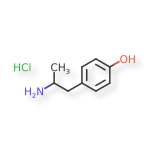
| Stereochemistry | RACEMIC |
| Molecular Formula | C9H13NO.ClH |
| Molecular Weight | 187.667 |
| Optical Activity | ( + / - ) |
| Defined Stereocenters | 0 / 1 |
| E/Z Centers | 0 |
| Charge | 0 |
SHOW SMILES / InChI
SMILES
Cl.CC(N)CC1=CC=C(O)C=C1
InChI
InChIKey=MYTMYIPUXIMVQW-UHFFFAOYSA-N
InChI=1S/C9H13NO.ClH/c1-7(10)6-8-2-4-9(11)5-3-8;/h2-5,7,11H,6,10H2,1H3;1H
Hydroxyamphetamine is a derivative of amphetamines. Hydroxyamphetamine is intended mainly as local eye drops for diagnostic purposes. It is indirect sympathomimetic agent which cause dilation of the eye pupil before diagnostic test. Among the minor side effects from its use are: change in color vision, difficulty seeing at night, dry mouth, headache, increased sensitivity of eyes to sunlight, muscle stiffness or tightness and temporary stinging in the eyes. The main use of hydroxyamphetamines as eye drops is the diagnosis of Horner's syndrome which is characterized by nerve lesions. Hydroxyamphetamine hydrobromide is a component of FDA approved brand drug - Paremyd sterile ophthalmic solution (Hydroxyamphetamine hydrobromide, USP 1.0%, Tropicamide, USP 0.25%). Hydroxyamphetamine is an indirect-acting sympathomimetic, while tropicamide acts as a parasympatholytic.
Approval Year
Targets
| Primary Target | Pharmacology | Condition | Potency |
|---|---|---|---|
Conditions
| Condition | Modality | Targets | Highest Phase | Product |
|---|---|---|---|---|
| Diagnostic | Paremyd Approved UsePAREMYD Solution is indicated for mydriasis in routine diagnostic procedures and in conditions
where short-term pupil dilation is desired. PAREMYD provides clinically significant mydriasis with
partial cycloplegia. Launch Date1992 |
Cmax
| Value | Dose | Co-administered | Analyte | Population |
|---|---|---|---|---|
1.8 μg/mL EXPERIMENT https://pubmed.ncbi.nlm.nih.gov/13143480/ |
10 mg/kg bw single, intravenous dose: 10 mg/kg bw route of administration: Intravenous experiment type: SINGLE co-administered: |
HYDROXYAMPHETAMINE plasma | Canis lupus population: HEALTHY age: ADULT sex: UNKNOWN food status: UNKNOWN |
AUC
| Value | Dose | Co-administered | Analyte | Population |
|---|---|---|---|---|
4 μg × h/mL EXPERIMENT https://pubmed.ncbi.nlm.nih.gov/13143480/ |
10 mg/kg bw single, intravenous dose: 10 mg/kg bw route of administration: Intravenous experiment type: SINGLE co-administered: |
HYDROXYAMPHETAMINE plasma | Canis lupus population: HEALTHY age: ADULT sex: UNKNOWN food status: UNKNOWN |
T1/2
| Value | Dose | Co-administered | Analyte | Population |
|---|---|---|---|---|
3 h EXPERIMENT https://pubmed.ncbi.nlm.nih.gov/13143480/ |
10 mg/kg bw single, intravenous dose: 10 mg/kg bw route of administration: Intravenous experiment type: SINGLE co-administered: |
HYDROXYAMPHETAMINE plasma | Canis lupus population: HEALTHY age: ADULT sex: UNKNOWN food status: UNKNOWN |
PubMed
| Title | Date | PubMed |
|---|---|---|
| p-Hydroxyamphetamine causes prepulse inhibition disruptions in mice: contribution of dopamine neurotransmission. | 2010-12-25 |
|
| New meconium biomarkers of prenatal methamphetamine exposure increase identification of affected neonates. | 2010-05 |
|
| Central administration of p-hydroxyamphetamine produces a behavioral stimulant effect in rodents: evidence for the involvement of dopaminergic systems. | 2010-02 |
|
| Current pharmacologic testing for Horner syndrome. | 2009-09 |
|
| Novel biomarkers of prenatal methamphetamine exposure in human meconium. | 2009-02 |
|
| Trace amine-associated receptor 1 displays species-dependent stereoselectivity for isomers of methamphetamine, amphetamine, and para-hydroxyamphetamine. | 2007-04 |
|
| Determination of amphetamine, methamphetamine, and hydroxyamphetamine derivatives in urine by gas chromatography-mass spectrometry and its relation to CYP2D6 phenotype of drug users. | 2007-03-29 |
|
| Cation-selective exhaustive injection and sweeping MEKC for direct analysis of methamphetamine and its metabolites in urine. | 2006-12 |
|
| A study of the metabolism of methamphetamine and 4-bromo-2,5-dimethoxyphenethylamine (2C-B) in isolated rat hepatocytes. | 2005-03-10 |
|
| Prolactinoma presenting as painful postganglionic Horner syndrome. | 2004-04-27 |
|
| The correlation of phenylephrine 1% with hydroxyamphetamine 1% in Horner's syndrome. | 2004-04 |
|
| Simultaneous determination of amphetamine derivatives in human urine after SPE extraction and HPLC-UV analysis. | 2004-03 |
|
| Monoamine oxidase and head-twitch response in mice. Mechanisms of alpha-methylated substrate derivatives. | 2004-01 |
|
| Horner syndrome. | 2003-12 |
|
| Screening for and validated quantification of amphetamines and of amphetamine- and piperazine-derived designer drugs in human blood plasma by gas chromatography/mass spectrometry. | 2003-06 |
|
| False negative hydroxyamphetamine test in horner syndrome caused by acute internal carotid artery dissection. | 2003-03 |
|
| The contribution of the metabolite p-hydroxyamphetamine to the central actions of p-methoxyamphetamine. | 2002-03 |
|
| Determination of amphetamine and its metabolite p-hydroxyamphetamine in rat urine by reversed-phase high-performance liquid chromatography after dabsyl derivatization. | 2001-11 |
|
| Hydroxyamphetamine drops for Horner's syndrome. | 2001-08 |
|
| Hydroxyamphetamine increases intraocular pressure in rabbits. | 2001-02 |
Patents
Sample Use Guides
Mydriasis: Ophthalmic: Instill 1 to 2 drops into conjunctival sac(s)
Route of Administration:
Topical
SH-SY5Y neurons were incubated with Hydroxyamphetamine (concentration range 0-10mM) for 24 or 48h, and the viability was determined by 3-(4,5-dimethylthiazol-2-yl)-2,5-diphenyl tetrazolium bromide (MTT) and lactate dehydrogenase (LDH) leakage assays.. For Hydroxyamphetamine the TC50 was not reached in the tested concentration range. Hydroxyamphetamine at 8.00mM originated few late apoptotic cells
| Name | Type | Language | ||
|---|---|---|---|---|
|
Common Name | English | ||
|
Preferred Name | English | ||
|
Systematic Name | English | ||
|
Common Name | English | ||
|
Systematic Name | English | ||
|
Common Name | English | ||
|
Systematic Name | English | ||
|
Common Name | English | ||
|
Common Name | English | ||
|
Common Name | English |
| Code System | Code | Type | Description | ||
|---|---|---|---|---|---|
|
6078-07-5
Created by
admin on Mon Mar 31 23:04:59 GMT 2025 , Edited by admin on Mon Mar 31 23:04:59 GMT 2025
|
SUPERSEDED | |||
|
876-26-6
Created by
admin on Mon Mar 31 23:04:59 GMT 2025 , Edited by admin on Mon Mar 31 23:04:59 GMT 2025
|
PRIMARY | |||
|
9C9E3TQW4U
Created by
admin on Mon Mar 31 23:04:59 GMT 2025 , Edited by admin on Mon Mar 31 23:04:59 GMT 2025
|
PRIMARY | |||
|
51345-30-3
Created by
admin on Mon Mar 31 23:04:59 GMT 2025 , Edited by admin on Mon Mar 31 23:04:59 GMT 2025
|
SUPERSEDED | |||
|
DTXSID60976252
Created by
admin on Mon Mar 31 23:04:59 GMT 2025 , Edited by admin on Mon Mar 31 23:04:59 GMT 2025
|
PRIMARY | |||
|
160807
Created by
admin on Mon Mar 31 23:04:59 GMT 2025 , Edited by admin on Mon Mar 31 23:04:59 GMT 2025
|
PRIMARY |
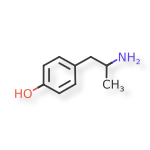
ACTIVE MOIETY
SUBSTANCE RECORD