Details
| Stereochemistry | RACEMIC |
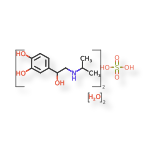
| Molecular Formula | 2C11H17NO3.2H2O.H2O4S |
| Molecular Weight | 556.624 |
| Optical Activity | ( + / - ) |
| Defined Stereocenters | 0 / 2 |
| E/Z Centers | 0 |
| Charge | 0 |
SHOW SMILES / InChI
SMILES
O.O.OS(O)(=O)=O.CC(C)NCC(O)C1=CC(O)=C(O)C=C1.CC(C)NCC(O)C2=CC(O)=C(O)C=C2
InChI
InChIKey=CUQPTVCVZLUXJB-UHFFFAOYSA-N
InChI=1S/2C11H17NO3.H2O4S.2H2O/c2*1-7(2)12-6-11(15)8-3-4-9(13)10(14)5-8;1-5(2,3)4;;/h2*3-5,7,11-15H,6H2,1-2H3;(H2,1,2,3,4);2*1H2
DescriptionCurator's Comment: description was created based on several sources, including
https://www.drugs.com/cdi/isoproterenol.html | https://www.ncbi.nlm.nih.gov/pubmed/209581 | https://www.ncbi.nlm.nih.gov/pubmed/22073124 | https://www.ncbi.nlm.nih.gov/pubmed/11723224
Curator's Comment: description was created based on several sources, including
https://www.drugs.com/cdi/isoproterenol.html | https://www.ncbi.nlm.nih.gov/pubmed/209581 | https://www.ncbi.nlm.nih.gov/pubmed/22073124 | https://www.ncbi.nlm.nih.gov/pubmed/11723224
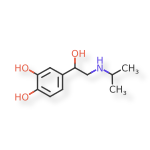
Isoproterenol (trade names Medihaler-Iso and Isuprel) is a medication used for the treatment of bradycardia (slow heart rate), heart block, and rarely for asthma. Isoproterenol is a non-selective β adrenoreceptor agonist and TAAR1 agonist that is the isopropylaminomethyl analog of epinephrine. Isoprenaline's effects on the cardiovascular system (non-selective) relate to its actions on cardiac β1 receptors and β2 receptors on smooth muscle within the tunica media of arterioles. Isoprenaline has positive inotropic and chronotropic effects on the heart. β2 adrenoceptor stimulation in arteriolar smooth muscle induces vasodilation. Its inotropic and chronotropic effects elevate systolic blood pressure, while its vasodilatory effects tend to lower diastolic blood pressure. The overall effect is to decrease mean arterial pressure due to the β2 receptors' vasodilation. The adverse effects of isoprenaline are also related to the drug's cardiovascular effects. Isoprenaline can produce tachycardia (an elevated heart rate), which predisposes patients to cardiac arrhythmias.
CNS Activity
Approval Year
Targets
| Primary Target | Pharmacology | Condition | Potency |
|---|---|---|---|
Target ID: CHEMBL5857 |
|||
Target ID: CHEMBL210 |
240.0 nM [EC50] | ||
Target ID: CHEMBL246 |
86.0 nM [IC50] | ||
Target ID: CHEMBL213 |
12.0 nM [EC50] |
Conditions
| Condition | Modality | Targets | Highest Phase | Product |
|---|---|---|---|---|
| Primary | ISOPROTERENOL HYDROCHLORIDE Approved UseIsoproterenol hydrochloride injection is indicated: For mild or transient episodes of heart block that do not require electric shock or pacemaker therapy. For serious episodes of heart block and Adams-Stokes attacks (except when caused by ventricular tachycardia or fibrillation). (See CONTRAINDICATIONS.) For use in cardiac arrest until electric shock or pacemaker therapy, the treatments of choice, is available. (See CONTRAINDICATIONS.) For bronchospasm occurring during anesthesia. As an adjunct to fluid and electrolyte replacement therapy and the use of other drugs and procedures in the treatment of hypovolemic and septic shock, low cardiac output (hypoperfusion) states, congestive heart failure, and cardiogenic shock. (See WARNINGS.) Launch Date1956 |
|||
| Primary | ISOPROTERENOL HYDROCHLORIDE Approved UseIsoproterenol hydrochloride injection is indicated: For mild or transient episodes of heart block that do not require electric shock or pacemaker therapy. For serious episodes of heart block and Adams-Stokes attacks (except when caused by ventricular tachycardia or fibrillation). (See CONTRAINDICATIONS.) For use in cardiac arrest until electric shock or pacemaker therapy, the treatments of choice, is available. (See CONTRAINDICATIONS.) For bronchospasm occurring during anesthesia. As an adjunct to fluid and electrolyte replacement therapy and the use of other drugs and procedures in the treatment of hypovolemic and septic shock, low cardiac output (hypoperfusion) states, congestive heart failure, and cardiogenic shock. (See WARNINGS.) Launch Date1956 |
|||
| Primary | ISOPROTERENOL HYDROCHLORIDE Approved UseIsoproterenol hydrochloride injection is indicated: For mild or transient episodes of heart block that do not require electric shock or pacemaker therapy. For serious episodes of heart block and Adams-Stokes attacks (except when caused by ventricular tachycardia or fibrillation). (See CONTRAINDICATIONS.) For use in cardiac arrest until electric shock or pacemaker therapy, the treatments of choice, is available. (See CONTRAINDICATIONS.) For bronchospasm occurring during anesthesia. As an adjunct to fluid and electrolyte replacement therapy and the use of other drugs and procedures in the treatment of hypovolemic and septic shock, low cardiac output (hypoperfusion) states, congestive heart failure, and cardiogenic shock. (See WARNINGS.) Launch Date1956 |
|||
| Primary | ISOPROTERENOL HYDROCHLORIDE Approved UseIsoproterenol hydrochloride injection is indicated: For mild or transient episodes of heart block that do not require electric shock or pacemaker therapy. For serious episodes of heart block and Adams-Stokes attacks (except when caused by ventricular tachycardia or fibrillation). (See CONTRAINDICATIONS.) For use in cardiac arrest until electric shock or pacemaker therapy, the treatments of choice, is available. (See CONTRAINDICATIONS.) For bronchospasm occurring during anesthesia. As an adjunct to fluid and electrolyte replacement therapy and the use of other drugs and procedures in the treatment of hypovolemic and septic shock, low cardiac output (hypoperfusion) states, congestive heart failure, and cardiogenic shock. (See WARNINGS.) Launch Date1956 |
Cmax
| Value | Dose | Co-administered | Analyte | Population |
|---|---|---|---|---|
42 ng/mL EXPERIMENT https://www.ncbi.nlm.nih.gov/pubmed/7422709 |
0.3 mg/kg single, subcutaneous dose: 0.3 mg/kg route of administration: Subcutaneous experiment type: SINGLE co-administered: |
ISOPROTERENOL plasma | Rattus norvegicus population: HEALTHY age: ADULT sex: MALE food status: UNKNOWN |
Doses
| Dose | Population | Adverse events |
|---|---|---|
15 mg 1 times / day multiple, respiratory Studied dose Dose: 15 mg, 1 times / day Route: respiratory Route: multiple Dose: 15 mg, 1 times / day Sources: |
unhealthy, 27 - 67 |
Other AEs: Tachycardia, Premature ventricular contractions... Other AEs: Tachycardia (66.7%) Sources: Premature ventricular contractions (8.3%) |
0.2 mg multiple, intravenous Recommended Dose: 0.2 mg Route: intravenous Route: multiple Dose: 0.2 mg Sources: |
unhealthy Health Status: unhealthy Sources: |
Disc. AE: Block heart, Adams-Stokes syndrome... AEs leading to discontinuation/dose reduction: Block heart Sources: Adams-Stokes syndrome |
1 mg multiple, intramuscular Recommended Dose: 1 mg Route: intramuscular Route: multiple Dose: 1 mg Sources: |
unhealthy Health Status: unhealthy Sources: |
Disc. AE: Block heart, Adams-Stokes syndrome... AEs leading to discontinuation/dose reduction: Block heart Sources: Adams-Stokes syndrome |
AEs
| AE | Significance | Dose | Population |
|---|---|---|---|
| Tachycardia | 66.7% | 15 mg 1 times / day multiple, respiratory Studied dose Dose: 15 mg, 1 times / day Route: respiratory Route: multiple Dose: 15 mg, 1 times / day Sources: |
unhealthy, 27 - 67 |
| Premature ventricular contractions | 8.3% | 15 mg 1 times / day multiple, respiratory Studied dose Dose: 15 mg, 1 times / day Route: respiratory Route: multiple Dose: 15 mg, 1 times / day Sources: |
unhealthy, 27 - 67 |
| Adams-Stokes syndrome | Disc. AE | 0.2 mg multiple, intravenous Recommended Dose: 0.2 mg Route: intravenous Route: multiple Dose: 0.2 mg Sources: |
unhealthy Health Status: unhealthy Sources: |
| Block heart | Disc. AE | 0.2 mg multiple, intravenous Recommended Dose: 0.2 mg Route: intravenous Route: multiple Dose: 0.2 mg Sources: |
unhealthy Health Status: unhealthy Sources: |
| Adams-Stokes syndrome | Disc. AE | 1 mg multiple, intramuscular Recommended Dose: 1 mg Route: intramuscular Route: multiple Dose: 1 mg Sources: |
unhealthy Health Status: unhealthy Sources: |
| Block heart | Disc. AE | 1 mg multiple, intramuscular Recommended Dose: 1 mg Route: intramuscular Route: multiple Dose: 1 mg Sources: |
unhealthy Health Status: unhealthy Sources: |
PubMed
| Title | Date | PubMed |
|---|---|---|
| Glucose uptake via SGLT-1 is stimulated by beta(2)-adrenoceptors in the ruminal epithelium of sheep. | 2002-06 |
|
| Vanillylamide-based propanolamine derivative displays alpha/beta-adrenoceptor blocking and vasodilating properties. | 2002-06 |
|
| Impaired intracellular signal transduction via cyclic AMP contributes to cerebral vasospasm in rats with subarachnoid hemorrhage. | 2002-04 |
|
| 99mTc-glucarate for detection of isoproterenol-induced myocardial infarction in rats. | 2002-02-21 |
|
| Expression of human angiotensinogen-renin in rat: effects on transcription and heart function. | 2002-02 |
|
| The regulation of human vascular smooth muscle extracellular matrix protein production by alpha- and beta-adrenoceptor stimulation. | 2002-02 |
|
| Effect of an orally active Na+/H+ exchange inhibitor, SMP-300, on experimental angina and myocardial infarction models in rats. | 2002-02 |
|
| Bone marrow-derived regenerated cardiomyocytes (CMG Cells) express functional adrenergic and muscarinic receptors. | 2002-01-22 |
|
| Decreased SOD activity and increased nitrates level in rat heart with left ventricular hypertrophy induced by isoproterenol. | 2002-01-19 |
|
| Synergistic effect of nicorandil and amlodipine on mitochondrial function during isoproterenol-induced myocardial infarction in rats. | 2002-01 |
|
| Allosteric modulation of beta2-adrenergic receptor by Zn(2+). | 2002-01 |
|
| Effects of alpha- and beta-adrenergic stimulation on free magnesium concentrations in platelets from healthy and obese individuals. | 2001-12 |
|
| Differential effects of atropine and isoproterenol on inducibility of atrioventricular nodal reentrant tachycardia. | 2001-12 |
|
| Isoproterenol-induced cardiac hypertrophy: role of circulatory versus cardiac renin-angiotensin system. | 2001-12 |
|
| In vitro activity of polyhydroxycarboxylates against herpesviruses and HIV. | 2001-11 |
|
| Spironolactone and captopril attenuates isoproterenol-induced cardiac remodelling in rats. | 2001-10 |
|
| Activation of mitochondrial oxidative phosphorylation during (+/-)-isoproterenol-induced cell injury of myocardium. | 2001-09-22 |
|
| Calcineurin-GATA4 pathway is involved in beta-adrenergic agonist-responsive endothelin-1 transcription in cardiac myocytes. | 2001-09-14 |
|
| Report of a life-threatening arrhythmia after hospital discharge in a liver transplant recipient with previously unknown congenital long QT syndrome. | 2001-09-01 |
|
| A comparison of effects measured with isotonic and isometric recording: II. Concentration-effect curves for physiological antagonists. | 2001-08 |
|
| [Functional characterization of myocardial hypertrophy induced by isoproterenol and its regression]. | 2001-07 |
|
| Different mechanisms of isoproterenol-induced and nitroglycerin-induced syncope during head-up tilt in patients with unexplained syncope: important role of epinephrine in nitroglycerin-induced syncope. | 2001-07 |
|
| A new aspect of view in synthesizing new type beta-adrenoceptor blockers with ancillary antioxidant activities. | 2001-07 |
|
| Catecholamines stimulate interleukin-6 synthesis in rat cardiac fibroblasts. | 2001-07 |
|
| Alterative and plastic insufficiency of cardiomyocytes: isoproterenol-induced damage to myocardium during anthracycline cardiomyopathy. | 2001-06 |
|
| beta-Adrenergic and endothelin receptor interaction in dilated human cardiomyopathic myocardium. | 2001-06 |
|
| Cardioprotective effects of Picrorrhiza kurroa against isoproterenol-induced myocardial stress in rats. | 2001-05 |
|
| PKC-beta is not necessary for cardiac hypertrophy. | 2001-05 |
|
| Evidence that ranolazine behaves as a weak beta1- and beta2-adrenoceptor antagonist in the rat [correction of cat] cardiovascular system. | 2001-04 |
|
| Elevated parasympathetic nerve tone in isoproterenol-induced neurally mediated syncope during head-up tilt testing. | 2001-04 |
|
| Targeted inhibition of calcineurin attenuates cardiac hypertrophy in vivo. | 2001-03-13 |
|
| Neurohormonal regulation of secretion from isolated rat stomach ECL cells: a critical reappraisal. | 2001-03-02 |
|
| In vivo regulation of Na/Ca exchanger expression by adrenergic effectors. | 2001-03 |
|
| Interaction of calcitonin gene-related peptide (CGRP), substance P (SP) and conventional autonomic agonists in rat submandibular salivary peroxidase release in vitro. | 2001-01-14 |
|
| Paroxysmal tachycardia in children and teenagers with normal sinus rhythm and without heart disease. | 2001-01 |
|
| Lipopolysaccharide-induced tumor necrosis factor-alpha release is controlled by the central nervous system. | 2001 |
|
| Recurrent asystoles associated with vasovagal reaction during venipuncture. | 2000-12 |
|
| [Effects of isoprenaline on apoptosis related gene expression in rat myocardium cells]. | 2000-11 |
|
| Pharmacological effects of an aldehyde type alpha/beta-adrenoceptor blocking agent with vasodilating properties. | 2000-06 |
|
| [Pharmacology of acebutolol in animals]. | 1975-12-31 |
|
| Serum prolactin levels in rats following isoproterenol-induced myocardial infarction. | 1975-12 |
|
| [Prevention of isoproterenol-induced lesions in the rat myocardium by prenylamine]. | 1975-09-01 |
|
| Effects of prindolol on isoproterenol-induced subendocardial ischaemia in dogs with multiple chronic coronary artery occlusion. | 1975-07 |
|
| Metabolic responses following isoproterenol-induced myocardial infarction in arteriosclerotic breeder vs. non-arteriosclerotic virgin and ovariectomized female rats. | 1975-05-01 |
|
| The use of practolol in supraventricular arrhythmias associated with acute illnesses. | 1975-05 |
|
| Metabolic response after isoproterenol-induced myocardial infarction in arteriosclerotic breeder vs nonarteriosclerotic virgin intact and gonadectomized male rats. | 1975-04 |
|
| Prolyl hydroxylase and collagen metabolism after experimental mycardial infarction. | 1975-01 |
|
| [Myocardial DNA and cell count following isoproterenol-induced myocardial necrosis in the rat]. | 1975 |
|
| Method for the production of severe ventricular dysrhythmias in small laboratory animals. | 1975 |
|
| Membrane phospholipid metabolism in the isoproterenol-induced cardiomyopathy of the rat. | 1975 |
Patents
Sample Use Guides
Bolus intravenous injection: 0.02 mg to 0.06 mg; Intravenous infusion: 5 mcg/min; Intramuscular 0.2 mg; Subcutaneous 0.2 mg; Intracardiac 0.02 mg;
Route of Administration:
Other
Human embryonic kidney cells (HEK293) were cultured in Minimum Essential Medium (MEM) Earle’s (Biochrom AG) supplemented with 10% FBS (PAA Laboratories GmbH), 100 U/ml penicillin, and 100 mg/ml streptomycin (Biochrom AG) and 2 mM L-glutamine (Invitrogen) at 37C with 5% CO2. 48 well plates were coated with Poly-L-Lysine (Biochrom) and HEK293 cells were seeded with 37,500 cells per well. Transient transfection in triplicates with 84 ng DNA/well using metafectene according to manufactures instructions (Biontex, Munich, Germany) was performed 28 hours later. 40 hours after transfection cells were pre-incubated for 5 minutes with stimulation buffer containing of MEM Earle’s media and 1 mM 3-isobutyl-1-methylxanthine (IBMX, Sigma). This stimulation buffer was used for all further steps. For ligand competition experiments cells were incubated with tyramine, 2-phenylethylamine or octopamine ranging from 6.7 nM to 6700 nM, diluted in stimulation buffer for 15 minutes followed by a stimulation with isoprenaline in concentrations ranging from 1 nM to 10000 nM for 30 minutes. All reactions were performed at 37C with 5% CO2 saturated air and stopped by aspirating medium.
| Name | Type | Language | ||
|---|---|---|---|---|
|
Common Name | English | ||
|
Preferred Name | English | ||
|
Common Name | English | ||
|
Common Name | English | ||
|
Common Name | English | ||
|
Brand Name | English | ||
|
Common Name | English | ||
|
Common Name | English | ||
|
Common Name | English | ||
|
Common Name | English | ||
|
Brand Name | English | ||
|
Common Name | English | ||
|
Common Name | English | ||
|
Common Name | English | ||
|
Common Name | English | ||
|
Common Name | English | ||
|
Common Name | English | ||
|
Common Name | English | ||
|
Common Name | English | ||
|
Brand Name | English | ||
|
Brand Name | English | ||
|
Common Name | English | ||
|
Common Name | English | ||
|
Brand Name | English | ||
|
Common Name | English |
| Classification Tree | Code System | Code | ||
|---|---|---|---|---|
|
NCI_THESAURUS |
C319
Created by
admin on Mon Mar 31 18:27:53 GMT 2025 , Edited by admin on Mon Mar 31 18:27:53 GMT 2025
|
||
|
NCI_THESAURUS |
C48149
Created by
admin on Mon Mar 31 18:27:53 GMT 2025 , Edited by admin on Mon Mar 31 18:27:53 GMT 2025
|
| Code System | Code | Type | Description | ||
|---|---|---|---|---|---|
|
CHEMBL434
Created by
admin on Mon Mar 31 18:27:53 GMT 2025 , Edited by admin on Mon Mar 31 18:27:53 GMT 2025
|
PRIMARY | |||
|
6700-39-6
Created by
admin on Mon Mar 31 18:27:53 GMT 2025 , Edited by admin on Mon Mar 31 18:27:53 GMT 2025
|
SUPERSEDED | |||
|
SUB02795MIG
Created by
admin on Mon Mar 31 18:27:53 GMT 2025 , Edited by admin on Mon Mar 31 18:27:53 GMT 2025
|
PRIMARY | |||
|
DTXSID80976254
Created by
admin on Mon Mar 31 18:27:53 GMT 2025 , Edited by admin on Mon Mar 31 18:27:53 GMT 2025
|
PRIMARY | |||
|
ISOPROTERENOL SULFATE
Created by
admin on Mon Mar 31 18:27:53 GMT 2025 , Edited by admin on Mon Mar 31 18:27:53 GMT 2025
|
PRIMARY | Description: A white or almost white, crystalline powder; odourless. Solubility: Freely soluble in water; very slightly soluble in ethanol (~750 g/l) TS; practically insoluble in ether R. Category: Bronchodilator. Storage: Isoprenaline sulfate should be kept in a tightly closed container, protected from light. Additional information: Isoprenaline sulfate gradually darkens in colour on exposure to air and light. Even in the absence of light, Isoprenaline sulfate is gradually degraded on exposure to a humid atmosphere, the decomposition being faster at higher temperatures. Definition: Isoprenaline sulfate contains not less than 98.0% and not more than 101.0% of (C11H17NO3)2,H2SO4, calculated with reference to the anhydrous substance. | ||
|
656677
Created by
admin on Mon Mar 31 18:27:53 GMT 2025 , Edited by admin on Mon Mar 31 18:27:53 GMT 2025
|
PRIMARY | |||
|
6078-56-4
Created by
admin on Mon Mar 31 18:27:53 GMT 2025 , Edited by admin on Mon Mar 31 18:27:53 GMT 2025
|
PRIMARY | |||
|
m6533
Created by
admin on Mon Mar 31 18:27:53 GMT 2025 , Edited by admin on Mon Mar 31 18:27:53 GMT 2025
|
PRIMARY | Merck Index | ||
|
82031
Created by
admin on Mon Mar 31 18:27:53 GMT 2025 , Edited by admin on Mon Mar 31 18:27:53 GMT 2025
|
PRIMARY | RxNorm | ||
|
DBSALT001403
Created by
admin on Mon Mar 31 18:27:53 GMT 2025 , Edited by admin on Mon Mar 31 18:27:53 GMT 2025
|
PRIMARY | |||
|
925FX3X776
Created by
admin on Mon Mar 31 18:27:53 GMT 2025 , Edited by admin on Mon Mar 31 18:27:53 GMT 2025
|
PRIMARY | |||
|
C65983
Created by
admin on Mon Mar 31 18:27:53 GMT 2025 , Edited by admin on Mon Mar 31 18:27:53 GMT 2025
|
PRIMARY |
ACTIVE MOIETY
SUBSTANCE RECORD