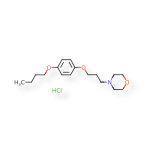
Details
| Stereochemistry | ACHIRAL |
| Molecular Formula | C17H27NO3.ClH |
| Molecular Weight | 329.862 |
| Optical Activity | NONE |
| Defined Stereocenters | 0 / 0 |
| E/Z Centers | 0 |
| Charge | 0 |
SHOW SMILES / InChI
SMILES
Cl.CCCCOC1=CC=C(OCCCN2CCOCC2)C=C1
InChI
InChIKey=SYCBXBCPLUFJID-UHFFFAOYSA-N
InChI=1S/C17H27NO3.ClH/c1-2-3-12-20-16-5-7-17(8-6-16)21-13-4-9-18-10-14-19-15-11-18;/h5-8H,2-4,9-15H2,1H3;1H
Pramoxine (also known as pramocaine or pramoxine HCI) is a topical anesthetic and antipruritic. Pramoxine is used to temporarily relieve itching and pain caused by minor skin irritation such as minor burns/cuts/scrapes, sunburn, eczema, insect bites, cold sores, or rashes from poison ivy, poison oak, or poison sumac. Some products containing pramoxine are also used to temporarily relieve the itching and discomfort from hemorrhoids and certain other problems of the genital/anal area (such as anal fissures, itching around the vagina/rectum). Pramocaine is available by itself and in combination with other medications in various topical preparations. It works by preventing ionic fluctuations needed for neuron membrane depolarization and action potential propagation. Pramoxine reversibly binds and inhibits voltage gated sodium channels on neurons decreasing sodium permeability into the cell. This stabilizes the membrane and prevents ionic fluctuations needed for depolarization stopping any action potential propagation.
Approval Year
Targets
| Primary Target | Pharmacology | Condition | Potency |
|---|---|---|---|
Target ID: CHEMBL2331043 |
Conditions
| Condition | Modality | Targets | Highest Phase | Product |
|---|---|---|---|---|
| Palliative | PRAMOSONE Approved UseUse for the temporary relief of pain and itching associated with minor lip or skin irritations (e.g., dermatoses, insect bites, minor burns or sunburns, minor cuts or scrapes, cold sores, hives, rashes due to poison ivy, poison oak, or poison sumac) Launch Date1976 |
PubMed
| Title | Date | PubMed |
|---|---|---|
| Psychological interventions in the management of common skin conditions. | 2010 |
|
| Prediction of pharmacological and xenobiotic responses to drugs based on time course gene expression profiles. | 2009-12-02 |
|
| Management of side effects associated with sunitinib therapy for patients with renal cell carcinoma. | 2009-02-18 |
|
| A pramoxine-based anti-itch lotion is more effective than a control lotion for the treatment of uremic pruritus in adult hemodialysis patients. | 2009 |
|
| Perioral dermatitis. | 2008 |
|
| Acquiring tetanus after hemorrhoid banding and other gastrointestinal procedures. | 2007-04 |
|
| Contact dermatitis from prilocaine with cross-sensitivity to pramocaine and bupivacaine. | 2007-02 |
|
| Treating itch in psoriasis. | 2006-06 |
|
| Evaluation of pramoxine ingestion as reported to poison centers. | 2006-05 |
|
| OTC product: Monistat Soothing Care for vaginial discomfort. | 2005-12-31 |
|
| Decreased efficacy of topical anesthetic creams in presence of benzoyl peroxide. | 2005-11 |
|
| Uncovering tinea incognito. Topical corticosteroids can mask typical features of ringworm. | 2004-07 |
|
| Childhood shingles. Herpes zoster can occur in healthy children too. | 2004-04 |
|
| An evaluation of the moisturizing and anti-itch effects of a lactic acid and pramoxine hydrochloride cream. | 2004-02 |
|
| Anorectal drug products for over-the-counter human use. Final rule. | 2003-08-26 |
|
| Evidence-based veterinary dermatology: a systematic review of the pharmacotherapy of canine atopic dermatitis. | 2003-06 |
|
| Lack of burning and stinging from a novel first-aid formulation applied to experimental wounds. | 2003-05-20 |
|
| Contact irritant dermatitis and anti-pruritic agents: the need to address the itch. | 2003-04 |
|
| Screening topical antipruritics: a histamine-induced itch human model. | 2002-09-10 |
Patents
Sample Use Guides
Adults
Dermatologic Conditions
Topical
As self-medication: Apply gel, lotion, ointment, or solution to the affected area up to 3 or 4 times daily.
Fixed combination with hydrocortisone: Apply cream, lotion, or ointment to the affected area as a thin film 3 or 4 times daily.
Route of Administration:
Topical
| Name | Type | Language | ||
|---|---|---|---|---|
|
Common Name | English | ||
|
Preferred Name | English | ||
|
Brand Name | English | ||
|
Common Name | English | ||
|
Common Name | English | ||
|
Common Name | English | ||
|
Common Name | English | ||
|
Common Name | English | ||
|
Common Name | English | ||
|
Common Name | English | ||
|
Common Name | English | ||
|
Common Name | English | ||
|
Common Name | English | ||
|
Common Name | English | ||
|
Systematic Name | English | ||
|
Code | English | ||
|
Common Name | English |
| Classification Tree | Code System | Code | ||
|---|---|---|---|---|
|
CFR |
21 CFR 346.10
Created by
admin on Mon Mar 31 18:01:59 GMT 2025 , Edited by admin on Mon Mar 31 18:01:59 GMT 2025
|
||
|
NCI_THESAURUS |
C245
Created by
admin on Mon Mar 31 18:01:59 GMT 2025 , Edited by admin on Mon Mar 31 18:01:59 GMT 2025
|
||
|
CFR |
21 CFR 310.201
Created by
admin on Mon Mar 31 18:01:59 GMT 2025 , Edited by admin on Mon Mar 31 18:01:59 GMT 2025
|
| Code System | Code | Type | Description | ||
|---|---|---|---|---|---|
|
88AYB867L5
Created by
admin on Mon Mar 31 18:01:59 GMT 2025 , Edited by admin on Mon Mar 31 18:01:59 GMT 2025
|
PRIMARY | |||
|
DBSALT001353
Created by
admin on Mon Mar 31 18:01:59 GMT 2025 , Edited by admin on Mon Mar 31 18:01:59 GMT 2025
|
PRIMARY | |||
|
m9099
Created by
admin on Mon Mar 31 18:01:59 GMT 2025 , Edited by admin on Mon Mar 31 18:01:59 GMT 2025
|
PRIMARY | Merck Index | ||
|
100000078849
Created by
admin on Mon Mar 31 18:01:59 GMT 2025 , Edited by admin on Mon Mar 31 18:01:59 GMT 2025
|
PRIMARY | |||
|
DTXSID2047777
Created by
admin on Mon Mar 31 18:01:59 GMT 2025 , Edited by admin on Mon Mar 31 18:01:59 GMT 2025
|
PRIMARY | |||
|
211-293-1
Created by
admin on Mon Mar 31 18:01:59 GMT 2025 , Edited by admin on Mon Mar 31 18:01:59 GMT 2025
|
PRIMARY | |||
|
57555
Created by
admin on Mon Mar 31 18:01:59 GMT 2025 , Edited by admin on Mon Mar 31 18:01:59 GMT 2025
|
PRIMARY | RxNorm | ||
|
25573
Created by
admin on Mon Mar 31 18:01:59 GMT 2025 , Edited by admin on Mon Mar 31 18:01:59 GMT 2025
|
PRIMARY | |||
|
SUB15004MIG
Created by
admin on Mon Mar 31 18:01:59 GMT 2025 , Edited by admin on Mon Mar 31 18:01:59 GMT 2025
|
PRIMARY | |||
|
1554002
Created by
admin on Mon Mar 31 18:01:59 GMT 2025 , Edited by admin on Mon Mar 31 18:01:59 GMT 2025
|
PRIMARY | |||
|
C47682
Created by
admin on Mon Mar 31 18:01:59 GMT 2025 , Edited by admin on Mon Mar 31 18:01:59 GMT 2025
|
PRIMARY | |||
|
73957
Created by
admin on Mon Mar 31 18:01:59 GMT 2025 , Edited by admin on Mon Mar 31 18:01:59 GMT 2025
|
PRIMARY | |||
|
88AYB867L5
Created by
admin on Mon Mar 31 18:01:59 GMT 2025 , Edited by admin on Mon Mar 31 18:01:59 GMT 2025
|
PRIMARY | |||
|
CHEMBL1198
Created by
admin on Mon Mar 31 18:01:59 GMT 2025 , Edited by admin on Mon Mar 31 18:01:59 GMT 2025
|
PRIMARY | |||
|
7220
Created by
admin on Mon Mar 31 18:01:59 GMT 2025 , Edited by admin on Mon Mar 31 18:01:59 GMT 2025
|
PRIMARY | |||
|
637-58-1
Created by
admin on Mon Mar 31 18:01:59 GMT 2025 , Edited by admin on Mon Mar 31 18:01:59 GMT 2025
|
PRIMARY |
ACTIVE MOIETY
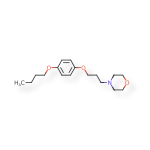
SUBSTANCE RECORD