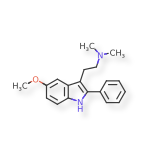
Details
| Stereochemistry | ACHIRAL |
| Molecular Formula | C19H22N2O |
| Molecular Weight | 294.3908 |
| Optical Activity | NONE |
| Defined Stereocenters | 0 / 0 |
| E/Z Centers | 0 |
| Charge | 0 |
SHOW SMILES / InChI
SMILES
COC1=CC2=C(NC(=C2CCN(C)C)C3=CC=CC=C3)C=C1
InChI
InChIKey=VSGPGYWZVPDDSK-UHFFFAOYSA-N
InChI=1S/C19H22N2O/c1-21(2)12-11-16-17-13-15(22-3)9-10-18(17)20-19(16)14-7-5-4-6-8-14/h4-10,13,20H,11-12H2,1-3H3
DescriptionCurator's Comment: description was created based on several sources, including
https://www.ncbi.nlm.nih.gov/pubmed/16298400
Curator's Comment: description was created based on several sources, including
https://www.ncbi.nlm.nih.gov/pubmed/16298400
BGC 20761 is an orally active, tryptamine analogue that is being developed by BTG as a procognitive antipsychotic for the treatment of schizophrenia. Preclinical development is underway in the US. This serotonin6 and serotonin2A receptor antagonist has nootropic properties with a balance of serotonergic and dopaminergic antagonist activity; BGC 20761 has moderate to low affinity for dopamine2, serotonin2C, histamine1, muscarinic M1-5, and α1 adrenergic receptors, indicating a potentially low propensity to cause serious adverse events.
Originator
Approval Year
Sample Use Guides
BGC20-761 (10 mg/ml saline-based solution), was administered (i.p.) to male 8-week-old LongeEvans rats and 4-week-old SpragueeDawley rats at doses of 2.5 mg/kg, 5 mg/kg and 10 mg/kg. BGC20-761 (10 mg/kg i.p.) alone had no effect on social recognition in young rats, however, at doses of 5 mg/kg and 10 mg/kg i.p, BGC20-761 dose-dependently reversed a deficit of social recognition induced by scopolamine (0.4 mg/kg i.p.), an anticholinergic drug that impairs memory.
Route of Administration:
Intraperitoneal
| Name | Type | Language | ||
|---|---|---|---|---|
|
Common Name | English | ||
|
Preferred Name | English | ||
|
Systematic Name | English | ||
|
Systematic Name | English |
| Code System | Code | Type | Description | ||
|---|---|---|---|---|---|
|
6918515
Created by
admin on Mon Mar 31 22:40:42 GMT 2025 , Edited by admin on Mon Mar 31 22:40:42 GMT 2025
|
PRIMARY | |||
|
17375-63-2
Created by
admin on Mon Mar 31 22:40:42 GMT 2025 , Edited by admin on Mon Mar 31 22:40:42 GMT 2025
|
PRIMARY | |||
|
6G5F6ESV5I
Created by
admin on Mon Mar 31 22:40:42 GMT 2025 , Edited by admin on Mon Mar 31 22:40:42 GMT 2025
|
PRIMARY |
ACTIVE MOIETY