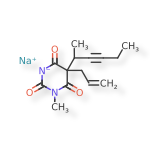
Details
| Stereochemistry | MIXED |
| Molecular Formula | C14H17N2O3.Na |
| Molecular Weight | 284.2861 |
| Optical Activity | UNSPECIFIED |
| Defined Stereocenters | 0 / 2 |
| E/Z Centers | 0 |
| Charge | 0 |
SHOW SMILES / InChI
SMILES
[Na+].CCC#CC(C)C1(CC=C)C(=O)[N-]C(=O)N(C)C1=O
InChI
InChIKey=KDXZREBVGAGZHS-UHFFFAOYSA-M
InChI=1S/C14H18N2O3.Na/c1-5-7-8-10(3)14(9-6-2)11(17)15-13(19)16(4)12(14)18;/h6,10H,2,5,9H2,1,3-4H3,(H,15,17,19);/q;+1/p-1
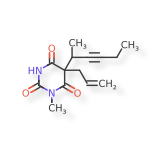
Methohexital is an ultrashort-acting barbiturate widely used in dentistry because of its rapid onset, predictable effects, and short duration of action. It was marked under the name brevital sodium for the intravenous anaesthesia. It has also been commonly used to induce deep sedation. Like other barbiturates, methohexital exerts its effects through the gamma-aminobutyric acid (GABA) receptor complex. By binding to its own receptor on the complex, methohexital augments the inhibitory effect of GABA on neurons and additionally can exert a similar effect independent of GABA.
Approval Year
Targets
| Primary Target | Pharmacology | Condition | Potency |
|---|---|---|---|
Target ID: CHEMBL2093872 |
Conditions
| Condition | Modality | Targets | Highest Phase | Product |
|---|---|---|---|---|
| Preventing | BREVITAL SODIUM Approved UseBrevital Sodium can be used in adults as follows: For intravenous induction of anesthesia prior to the use of other general anesthetic agents. For intravenous induction of anesthesia and as an adjunct to subpotent inhalational anesthetic agents (such as nitrous oxide in oxygen) for short surgical procedures; Brevital Sodium may be given by infusion or intermittent injection. For use along with other parenteral agents, usually narcotic analgesics, to supplement subpotent inhalational anesthetic agents (such as nitrous oxide in oxygen) for longer surgical procedures. As intravenous anesthesia for short surgical, diagnostic, or therapeutic procedures associated with minimal painful stimuli (see WARNINGS ). As an agent for inducing a hypnotic state. Brevital Sodium can be used in pediatric patients older than 1 month as follows: For rectal or intramuscular induction of anesthesia prior to the use of other general anesthetic agents. For rectal or intramuscular induction of anesthesia and as an adjunct to subpotent inhalational anesthetic agents for short surgical procedures. As rectal or intramuscular anesthesia for short surgical, diagnostic, or therapeutic procedures associated with minimal painful stimuli. Launch Date1960 |
Cmax
| Value | Dose | Co-administered | Analyte | Population |
|---|---|---|---|---|
2.8 μg/mL EXPERIMENT https://pubmed.ncbi.nlm.nih.gov/4005094 |
25 mg/kg single, rectal dose: 25 mg/kg route of administration: Rectal experiment type: SINGLE co-administered: |
METHOHEXITAL plasma | Homo sapiens population: HEALTHY age: CHILD sex: FEMALE / MALE food status: UNKNOWN |
AUC
| Value | Dose | Co-administered | Analyte | Population |
|---|---|---|---|---|
2.39 mg × h/L EXPERIMENT https://pubmed.ncbi.nlm.nih.gov/2024566 |
2 mg/kg single, intravenous dose: 2 mg/kg route of administration: Intravenous experiment type: SINGLE co-administered: |
METHOHEXITAL plasma | Homo sapiens population: HEALTHY age: ADULT sex: MALE food status: UNKNOWN |
|
2.24 mg × h/L EXPERIMENT https://pubmed.ncbi.nlm.nih.gov/2024566/ |
2 mg/kg single, intravenous dose: 2 mg/kg route of administration: Intravenous experiment type: SINGLE co-administered: |
METHOHEXITAL plasma | Homo sapiens population: UNHEALTHY age: ADULT sex: FEMALE / MALE food status: UNKNOWN |
|
2.71 mg × h/L EXPERIMENT https://pubmed.ncbi.nlm.nih.gov/2024566/ |
2 mg/kg single, intravenous dose: 2 mg/kg route of administration: Intravenous experiment type: SINGLE co-administered: |
METHOHEXITAL plasma | Homo sapiens population: UNHEALTHY age: ADULT sex: FEMALE / MALE food status: UNKNOWN |
T1/2
| Value | Dose | Co-administered | Analyte | Population |
|---|---|---|---|---|
151 min EXPERIMENT https://pubmed.ncbi.nlm.nih.gov/2024566 |
2 mg/kg single, intravenous dose: 2 mg/kg route of administration: Intravenous experiment type: SINGLE co-administered: |
METHOHEXITAL plasma | Homo sapiens population: HEALTHY age: ADULT sex: MALE food status: UNKNOWN |
|
136 min EXPERIMENT https://pubmed.ncbi.nlm.nih.gov/2024566/ |
2 mg/kg single, intravenous dose: 2 mg/kg route of administration: Intravenous experiment type: SINGLE co-administered: |
METHOHEXITAL plasma | Homo sapiens population: UNHEALTHY age: ADULT sex: FEMALE / MALE food status: UNKNOWN |
|
204 min EXPERIMENT https://pubmed.ncbi.nlm.nih.gov/2024566/ |
2 mg/kg single, intravenous dose: 2 mg/kg route of administration: Intravenous experiment type: SINGLE co-administered: |
METHOHEXITAL plasma | Homo sapiens population: UNHEALTHY age: ADULT sex: FEMALE / MALE food status: UNKNOWN |
|
102 min EXPERIMENT https://pubmed.ncbi.nlm.nih.gov/4005094 |
25 mg/kg single, rectal dose: 25 mg/kg route of administration: Rectal experiment type: SINGLE co-administered: |
METHOHEXITAL plasma | Homo sapiens population: HEALTHY age: CHILD sex: FEMALE / MALE food status: UNKNOWN |
Funbound
| Value | Dose | Co-administered | Analyte | Population |
|---|---|---|---|---|
27.1% EXPERIMENT https://pubmed.ncbi.nlm.nih.gov/17171861 |
1 % single, intravenous dose: 1 % route of administration: Intravenous experiment type: SINGLE co-administered: |
METHOHEXITAL plasma | Homo sapiens population: UNHEALTHY age: ADULT sex: FEMALE / MALE food status: UNKNOWN |
Doses
| Dose | Population | Adverse events |
|---|---|---|
30 mg/kg single, rectal Dose: 30 mg/kg Route: rectal Route: single Dose: 30 mg/kg Sources: |
unhealthy, 2.6 + 2.2 years |
Other AEs: Airways obstruction, Transient nocturnal oxygen desaturation... Other AEs: Airways obstruction (4%) Sources: Transient nocturnal oxygen desaturation (4%) |
2 mg/mL single, intravenous Dose: 2 mg/mL Route: intravenous Route: single Dose: 2 mg/mL Sources: |
unhealthy, adult Health Status: unhealthy Age Group: adult Sources: |
Disc. AE: Seizures, Hepatic dysfunction NOS... AEs leading to discontinuation/dose reduction: Seizures Sources: Hepatic dysfunction NOS (severe) Instability cardiovascular (severe) |
AEs
| AE | Significance | Dose | Population |
|---|---|---|---|
| Airways obstruction | 4% | 30 mg/kg single, rectal Dose: 30 mg/kg Route: rectal Route: single Dose: 30 mg/kg Sources: |
unhealthy, 2.6 + 2.2 years |
| Transient nocturnal oxygen desaturation | 4% | 30 mg/kg single, rectal Dose: 30 mg/kg Route: rectal Route: single Dose: 30 mg/kg Sources: |
unhealthy, 2.6 + 2.2 years |
| Seizures | Disc. AE | 2 mg/mL single, intravenous Dose: 2 mg/mL Route: intravenous Route: single Dose: 2 mg/mL Sources: |
unhealthy, adult Health Status: unhealthy Age Group: adult Sources: |
| Hepatic dysfunction NOS | severe Disc. AE |
2 mg/mL single, intravenous Dose: 2 mg/mL Route: intravenous Route: single Dose: 2 mg/mL Sources: |
unhealthy, adult Health Status: unhealthy Age Group: adult Sources: |
| Instability cardiovascular | severe Disc. AE |
2 mg/mL single, intravenous Dose: 2 mg/mL Route: intravenous Route: single Dose: 2 mg/mL Sources: |
unhealthy, adult Health Status: unhealthy Age Group: adult Sources: |
Overview
| CYP3A4 | CYP2C9 | CYP2D6 | hERG |
|---|---|---|---|
OverviewOther
| Other Inhibitor | Other Substrate | Other Inducer |
|---|---|---|
Drug as perpetrator
| Target | Modality | Activity | Metabolite | Clinical evidence |
|---|---|---|---|---|
Page: 3.0 |
likely | |||
Page: 3.0 |
likely | |||
Page: 3.0 |
likely | |||
| yes | ||||
Page: 1643.0 |
yes | |||
Page: 891.0 |
yes |
Drug as victim
| Target | Modality | Activity | Metabolite | Clinical evidence |
|---|---|---|---|---|
| yes |
Tox targets
| Target | Modality | Activity | Metabolite | Clinical evidence |
|---|---|---|---|---|
Page: 265.0 |
PubMed
| Title | Date | PubMed |
|---|---|---|
| Transient global amnesia after ablation of premature ventricular beats arising from the right coronary cusp. | 2010-08-15 |
|
| Surface area of particle administered versus mass in determining the pulmonary toxicity of ultrafine and fine carbon black: comparison to ultrafine titanium dioxide. | 2009-05-04 |
|
| Pulmonary response to intratracheal instillation of ultrafine versus fine titanium dioxide: role of particle surface area. | 2008-12-01 |
|
| Seizures during intracarotid methohexital and amobarbital testing. | 2007-02 |
|
| Colorectal distension-induced pseudoaffective changes as indices of nociception in the anesthetized female rat: morphine and strain effects on visceral sensitivity. | 2006-09-16 |
|
| Orchiectomy or androgen receptor blockade attenuates baroreflex-mediated bradycardia in conscious rats. | 2006-01-23 |
|
| Effect of testosterone replacement or duration of castration on baroreflex bradycardia in conscious rats. | 2005-03-30 |
|
| Inhibition of activator protein 1 by barbiturates is mediated by differential effects on mitogen-activated protein kinases and the small G proteins ras and rac-1. | 2004-12 |
|
| Acute detoxification of opioid-addicted patients with naloxone during propofol or methohexital anesthesia: a comparison of withdrawal symptoms, neuroendocrine, metabolic, and cardiovascular patterns. | 2000-04 |
|
| Alfentanil decreases the excitatory phenomena of sodium methohexital. | 1998-09 |
|
| Clonidine and methohexital-induced epileptic magnetoencephalographic discharges in patients with focal epilepsies. | 1998-08 |
|
| A prospective evaluation of the safety and efficacy of methohexital in the emergency department. | 1996-07 |
|
| A prospective study of rectal methohexital: efficacy and side effects in 648 cases. | 1995-11 |
|
| The comparative effects of methohexital, propofol, and etomidate for electroconvulsive therapy. | 1995-09 |
|
| Spontaneous seizure after concurrent use of methohexital anesthesia for electroconvulsive therapy and paroxetine: a case report. | 1995-02 |
|
| Rectal methohexital causing apnea in two patients with meningomyeloceles. | 1991-06 |
|
| Pain on injection of methohexitone. The use of lignocaine to modify pain on injection of methohexitone during anaesthesia for electroconvulsive therapy. | 1989-08 |
|
| Drugs as allergens: the molecular basis of IgE binding to thiopentone. | 1987 |
|
| [Generalized seizure induced by methohexital]. | 1987 |
|
| Seizure duration in unilateral electroconvulsive therapy. A comparison of the anaesthetic agents etomidate and Althesin with methohexitone. | 1984-06 |
|
| [Electroclinical aspects of intramuscular methohexital anesthesia in children]. | 1982-11 |
|
| Severe respiratory depression following pentazocine and methohexitone. A case report. | 1982-10 |
|
| The prevention of pain on injection. A study of the effect of intravenous lignocaine before methohexitone. | 1981-09 |
|
| Seizures induced by methohexital. | 1981-04 |
|
| Identification of speech lateralization by intracarotid injection of methohexital. | 1978-07 |
|
| Methohexitone-induced convulsions in epileptics. | 1977-08 |
|
| A comparative study of etomidate and methohexital as induction agents for analgesic anesthesia. | 1976 |
|
| A rare allergic reaction to sodium methohexital. | 1972-12 |
|
| Acute allergic reaction associated with methohexital anesthesia: report of six cases. | 1972-12 |
|
| Intramuscular sodium methohexital as a sole pediatric anesthetic-analgesic agent. | 1972-11-01 |
|
| Methohexitone and thiopentone. Response to stimuli and incidence of some side effects. | 1971-10 |
|
| Activation of the electroencephalogram with intravenous Brietal (methohexitone): the findings in 100 cases. | 1971-10 |
|
| Factors in arrhythmia during dental outpatient general anesthesia. | 1970-09-01 |
|
| Clinical studies on induction agents. 28. A further comparison of venous complications following thiopentone, methohexitone and propanidid. | 1969-08 |
|
| Methohexitone and propanidid. A comparative investigation of the side effects. | 1969-02 |
|
| Placental transfer of tubocurarine. Case report. | 1968-06 |
Patents
Sample Use Guides
Dosage is highly individualized: the drug should be administered only by those completely familiar with its quantitative differences from other barbiturate anesthetics. Adult: brevital sodium (METHOHEXITAL SODIUM) is administered intravenously in a concentration of no higher than 1%. Higher concentrations markedly increase the incidence of muscular movements and irregularities in respiration and blood pressure.
Induction of anesthesia: a 1% solution is administered at a rate of about 1 mL/5 seconds. Gaseous anesthetics and/or skeletal muscle relaxants may be administered concomitantly. The dose required for induction may range from 50 to 120 mg or more but averages about 70 mg. The usual dosage in adults ranges from 1 to 1.5 mg/kg. The induction dose usually provides anesthesia for 5 to 7 minutes. Maintenance of anesthesia: may be accomplished by intermittent injections of the 1% solution or, more easily, by continuous intravenous drip of a 0.2% solution. Intermittent injections of about 20 to 40 mg (2 to 4 mL of a 1% solution) may be given as required, usually every 4 to 7 minutes. For continuous drip, the average rate of administration is about 3 mL of a 0.2% solution/minute (1 drop/second). The rate of flow must be individualized for each patient. For longer surgical procedures, gradual reduction in the rate of administration is recommended
Pediatric Patients: Brevital Sodium is administered intramuscularly in a 5% concentration and administered rectally as a 1% solution.
Induction of anesthesia: by the intramuscular route of administration, the usual dose ranges from 6.6 to 10 mg/kg of the 5% concentration. For rectal administration, the usual dose for induction is 25 mg/kg using the 1% solution.
Route of Administration:
Other
To explore the mechanism by which methohexital (MTH) activates epileptiform activity in patients with epilepsy, it was examined the effects of MTH on hippocampal CA1 and neocortical neurons via extracellular and whole-cell patch-clamp recordings in rat brain slices. Perfusion of slices with 10 to 100 microM MTH caused no significant change in glutamatergic transmission in the hippocampal CA1 region, but enhanced gamma-aminobutyric acid (GABA)A-mediated inhibitory postsynaptic currents and induced spontaneous inhibitory postsynaptic currents in neocortical and hippocampal CA1 neurons. In addition, MTH induced a tonic, bicuculline-sensitive hyperpolarization in association with increases in membrane conductance, suggesting a direct stimulation of GABAA receptors by MTH. Spontaneous epileptiform activity was not observed in the neocortex and hippocampus after exposure of slices to MTH, neither in the standard in vitro condition nor in the presence of 4-aminopyridine, which promotes rhythmic synaptic activities.
| Name | Type | Language | ||
|---|---|---|---|---|
|
Preferred Name | English | ||
|
Common Name | English | ||
|
Systematic Name | English | ||
|
Common Name | English | ||
|
Common Name | English | ||
|
Common Name | English | ||
|
Common Name | English | ||
|
Brand Name | English | ||
|
Common Name | English | ||
|
Common Name | English | ||
|
Common Name | English | ||
|
Common Name | English |
| Classification Tree | Code System | Code | ||
|---|---|---|---|---|
|
NCI_THESAURUS |
C67084
Created by
admin on Mon Mar 31 18:21:35 GMT 2025 , Edited by admin on Mon Mar 31 18:21:35 GMT 2025
|
| Code System | Code | Type | Description | ||
|---|---|---|---|---|---|
|
60634-69-7
Created by
admin on Mon Mar 31 18:21:35 GMT 2025 , Edited by admin on Mon Mar 31 18:21:35 GMT 2025
|
SUPERSEDED | |||
|
100000088254
Created by
admin on Mon Mar 31 18:21:35 GMT 2025 , Edited by admin on Mon Mar 31 18:21:35 GMT 2025
|
PRIMARY | |||
|
309-36-4
Created by
admin on Mon Mar 31 18:21:35 GMT 2025 , Edited by admin on Mon Mar 31 18:21:35 GMT 2025
|
PRIMARY | |||
|
C66117
Created by
admin on Mon Mar 31 18:21:35 GMT 2025 , Edited by admin on Mon Mar 31 18:21:35 GMT 2025
|
PRIMARY | |||
|
23690443
Created by
admin on Mon Mar 31 18:21:35 GMT 2025 , Edited by admin on Mon Mar 31 18:21:35 GMT 2025
|
PRIMARY | |||
|
60200PNZ7Q
Created by
admin on Mon Mar 31 18:21:35 GMT 2025 , Edited by admin on Mon Mar 31 18:21:35 GMT 2025
|
PRIMARY | |||
|
91185
Created by
admin on Mon Mar 31 18:21:35 GMT 2025 , Edited by admin on Mon Mar 31 18:21:35 GMT 2025
|
PRIMARY | RxNorm | ||
|
m7323
Created by
admin on Mon Mar 31 18:21:35 GMT 2025 , Edited by admin on Mon Mar 31 18:21:35 GMT 2025
|
PRIMARY | Merck Index | ||
|
206-217-9
Created by
admin on Mon Mar 31 18:21:35 GMT 2025 , Edited by admin on Mon Mar 31 18:21:35 GMT 2025
|
PRIMARY | |||
|
32671-83-3
Created by
admin on Mon Mar 31 18:21:35 GMT 2025 , Edited by admin on Mon Mar 31 18:21:35 GMT 2025
|
SUPERSEDED | |||
|
DBSALT000631
Created by
admin on Mon Mar 31 18:21:35 GMT 2025 , Edited by admin on Mon Mar 31 18:21:35 GMT 2025
|
PRIMARY | |||
|
CHEMBL7413
Created by
admin on Mon Mar 31 18:21:35 GMT 2025 , Edited by admin on Mon Mar 31 18:21:35 GMT 2025
|
PRIMARY | |||
|
22151-68-4
Created by
admin on Mon Mar 31 18:21:35 GMT 2025 , Edited by admin on Mon Mar 31 18:21:35 GMT 2025
|
SUPERSEDED | |||
|
60200PNZ7Q
Created by
admin on Mon Mar 31 18:21:35 GMT 2025 , Edited by admin on Mon Mar 31 18:21:35 GMT 2025
|
PRIMARY | |||
|
DTXSID6026036
Created by
admin on Mon Mar 31 18:21:35 GMT 2025 , Edited by admin on Mon Mar 31 18:21:35 GMT 2025
|
PRIMARY | |||
|
33975-80-3
Created by
admin on Mon Mar 31 18:21:35 GMT 2025 , Edited by admin on Mon Mar 31 18:21:35 GMT 2025
|
SUPERSEDED | |||
|
6834
Created by
admin on Mon Mar 31 18:21:35 GMT 2025 , Edited by admin on Mon Mar 31 18:21:35 GMT 2025
|
PRIMARY | |||
|
SUB03223MIG
Created by
admin on Mon Mar 31 18:21:35 GMT 2025 , Edited by admin on Mon Mar 31 18:21:35 GMT 2025
|
PRIMARY |
ACTIVE MOIETY
SUBSTANCE RECORD