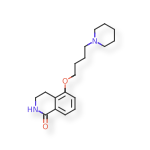
Details
| Stereochemistry | ACHIRAL |
| Molecular Formula | C18H26N2O2 |
| Molecular Weight | 302.4112 |
| Optical Activity | NONE |
| Defined Stereocenters | 0 / 0 |
| E/Z Centers | 0 |
| Charge | 0 |
SHOW SMILES / InChI
SMILES
O=C1NCCC2=C(OCCCCN3CCCCC3)C=CC=C12
InChI
InChIKey=RVOUDNBEIXGHJY-UHFFFAOYSA-N
InChI=1S/C18H26N2O2/c21-18-16-7-6-8-17(15(16)9-10-19-18)22-14-5-4-13-20-11-2-1-3-12-20/h6-8H,1-5,9-14H2,(H,19,21)
DescriptionCurator's Comment: The description was created based on several sources, including
https://www.ncbi.nlm.nih.gov/pubmed/25555733 | https://www.ncbi.nlm.nih.gov/pubmed/11689065 | https://www.ncbi.nlm.nih.gov/pubmed/19800803 | https://www.ncbi.nlm.nih.gov/pubmed/23994215
Curator's Comment: The description was created based on several sources, including
https://www.ncbi.nlm.nih.gov/pubmed/25555733 | https://www.ncbi.nlm.nih.gov/pubmed/11689065 | https://www.ncbi.nlm.nih.gov/pubmed/19800803 | https://www.ncbi.nlm.nih.gov/pubmed/23994215
3,4-Dihydro-5-(4-(1-piperidinyl)butoxy)-1(2H)-isoquinolinone (DPQ) is a potent Poly(ADP-ribose) polymerase (PARP) inhibitor with cardiac protective effects. 3,4-Dihydro-5-(4-(1-piperidinyl)butoxy)-1(2H)-isoquinolinone mimics nicotinamide to competitively inhibit PARP at the NAD binding site. We have demonstrated that in vivo administration of 3,4-Dihydro-5-(4-(1-piperidinyl)butoxy)-1(2H)-isoquinolinone both before and after the onset of ischemia leads to a significant reduction of infarct volume in a focal cerebral ischemia produced by middle cerebral artery (MCA) occlusion in the rat.
Originator
Approval Year
PubMed
| Title | Date | PubMed |
|---|---|---|
| 5-Benzamidoisoquinolin-1-ones and 5-(ω-carboxyalkyl)isoquinolin-1-ones as isoform-selective inhibitors of poly(ADP-ribose) polymerase 2 (PARP-2). | 2011-04-14 |
|
| The KRAS promoter responds to Myc-associated zinc finger and poly(ADP-ribose) polymerase 1 proteins, which recognize a critical quadruplex-forming GA-element. | 2010-07-16 |
|
| Mechanical stretch enhances NF-kappaB-dependent gene expression and poly(ADP-ribose) synthesis in synovial cells. | 2010-05 |
|
| Inhibition of poly adenosine diphosphate-ribose polymerase decreases hepatocellular carcinoma growth by modulation of tumor-related gene expression. | 2010-01 |
|
| Poly(ADP-ribose) polymerase-1 modulation of in vivo response of brain hypoxia-inducible factor-1 to hypoxia/reoxygenation is mediated by nitric oxide and factor inhibiting HIF. | 2009-10 |
|
| MLH1 mediates PARP-dependent cell death in response to the methylating agent N-methyl-N-nitrosourea. | 2009-08-04 |
|
| Calpain activation is not required for AIF translocation in PARP-1-dependent cell death (parthanatos). | 2009-07 |
|
| Involvement of independent mechanism upon poly(ADP-ribose) polymerase (PARP) activation in methylmercury cytotoxicity in rat cerebellar granule cell culture. | 2008-11-15 |
|
| Prolonged exposures of cerebellar granule neurons to S-nitroso-N-acetylpenicillamine (SNAP) induce neuronal damage independently of peroxynitrite. | 2008-09-16 |
|
| Inhibition of the activity of poly (ADP-ribose) polymerase reduces heart ischaemia/reperfusion injury via suppressing JNK-mediated AIF translocation. | 2008-08 |
|
| Adenosine receptor ligands protect against a combination of apoptotic and necrotic cell death in cerebellar granule neurons. | 2008-03 |
|
| Differences among cell types in NAD(+) compartmentalization: a comparison of neurons, astrocytes, and cardiac myocytes. | 2007-11-15 |
|
| N-methyl-N'-nitro-N-nitrosoguanidine activates multiple cell death mechanisms in human fibroblasts. | 2007-09 |
|
| Combination treatment with arsenic trioxide and phytosphingosine enhances apoptotic cell death in arsenic trioxide-resistant cancer cells. | 2007-01 |
|
| Identification of poly(ADP-ribose)polymerase-1 and Ku70/Ku80 as transcriptional regulators of S100A9 gene expression. | 2006-12-22 |
|
| Inhibition of poly(ADP-ribose) polymerase modulates tumor-related gene expression, including hypoxia-inducible factor-1 activation, during skin carcinogenesis. | 2006-06-01 |
|
| Poly(ADP-ribose) polymerase-1 promotes microglial activation, proliferation, and matrix metalloproteinase-9-mediated neuron death. | 2005-02-15 |
|
| Phytosphingosine in combination with ionizing radiation enhances apoptotic cell death in radiation-resistant cancer cells through ROS-dependent and -independent AIF release. | 2005-02-15 |
|
| Group I metabotropic glutamate receptors stimulate the activity of poly(ADP-ribose) polymerase in mammalian mGlu1-transfected cells and in cortical cell cultures. | 2005 |
|
| Caspase-independent cell death by arsenic trioxide in human cervical cancer cells: reactive oxygen species-mediated poly(ADP-ribose) polymerase-1 activation signals apoptosis-inducing factor release from mitochondria. | 2004-12-15 |
|
| NAD+ as a metabolic link between DNA damage and cell death. | 2004-11-25 |
|
| Adenine nucleotide metabolism and cell fate after oxidant exposure of rat cortical neurons: effects of inhibition of poly(ADP-ribose) polymerase. | 2004-07-02 |
|
| An enzymatic assay for poly(ADP-ribose) polymerase-1 (PARP-1) via the chemical quantitation of NAD(+): application to the high-throughput screening of small molecules as potential inhibitors. | 2004-03-01 |
|
| Effect of poly(ADP-ribose) polymerase inhibitors on oxidative stress evoked hydroxyl radical level and macromolecules oxidation in cell free system of rat brain cortex. | 2004-02-06 |
|
| Differential role of poly(ADP-ribose) polymerase-1in apoptotic and necrotic neuronal death induced by mild or intense NMDA exposure in vitro. | 2004-01 |
|
| Hypoglycemic neuronal death and cognitive impairment are prevented by poly(ADP-ribose) polymerase inhibitors administered after hypoglycemia. | 2003-11-19 |
|
| Novel isoquinolinone-derived inhibitors of poly(ADP-ribose) polymerase-1: pharmacological characterization and neuroprotective effects in an in vitro model of cerebral ischemia. | 2003-06 |
|
| Comet assay as a novel approach for studying DNA damage in focal cerebral ischemia: differential effects of NMDA receptor antagonists and poly(ADP-ribose) polymerase inhibitors. | 2002-06 |
|
| Poly(ADP-ribose) polymerase inhibitors attenuate necrotic but not apoptotic neuronal death in experimental models of cerebral ischemia. | 2001-09 |
Patents
Sample Use Guides
Rats were treated with DPQ (3,4-Dihydro-5-(4-(1-piperidinyl)butoxy)-1(2H)-isoquinolinone ) 15mg/kg intraperitoneally at 24 h before ischemic injury
Route of Administration:
Intraperitoneal
Synovial tissue was minced and incubated with 1 mg/ml collagenase in serum-free Dulbecco modified Eagle medium for 3 h at 37C. After digestion, fibroblast-like synoviocytes (FLS) were filtered trough a nylon cell strainer, washed extensively, and cultured in DMEM supplemented with 10% v/v foetal calf serum, 1% penicillinstreptomycin, and 1% L-glutamine in a humidified 5% CO2 atmosphere. After overnight culture, adherent cells were cultured in DMEM supplemented with 10% v/v FCS. Adherent cells was trypsinised and split in a ratio 1:3 when the cells were 80–90% confluent. FLS were used from passages 3 through 8 in the experiments and treated with 3,4-Dihydro-5-(4-(1-piperidinyl)butoxy)-1(2H)-isoquinolinone (DPQ) and 4-amino-1,8-naphthalimida (ANI) from Biomol. ANI was used at 50 mkM and DPQ at 120 mkM in culture medium containing 1% dimethylsulphoxide (DMSO) to improve solubility, and added 2 h before TNF treatment. ANI/DPQ were present in the culture throughout the experiment.
| Name | Type | Language | ||
|---|---|---|---|---|
|
Preferred Name | English | ||
|
Systematic Name | English | ||
|
Common Name | English | ||
|
Systematic Name | English |
| Code System | Code | Type | Description | ||
|---|---|---|---|---|---|
|
DTXSID10433229
Created by
admin on Mon Mar 31 22:23:15 GMT 2025 , Edited by admin on Mon Mar 31 22:23:15 GMT 2025
|
PRIMARY | |||
|
5007H57E2L
Created by
admin on Mon Mar 31 22:23:15 GMT 2025 , Edited by admin on Mon Mar 31 22:23:15 GMT 2025
|
PRIMARY | |||
|
m4761
Created by
admin on Mon Mar 31 22:23:15 GMT 2025 , Edited by admin on Mon Mar 31 22:23:15 GMT 2025
|
PRIMARY | Merck Index | ||
|
129075-73-6
Created by
admin on Mon Mar 31 22:23:15 GMT 2025 , Edited by admin on Mon Mar 31 22:23:15 GMT 2025
|
PRIMARY | |||
|
9948349
Created by
admin on Mon Mar 31 22:23:15 GMT 2025 , Edited by admin on Mon Mar 31 22:23:15 GMT 2025
|
PRIMARY |
SUBSTANCE RECORD