Details
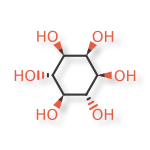
| Stereochemistry | ACHIRAL |
| Molecular Formula | C6H12O6 |
| Molecular Weight | 180.1559 |
| Optical Activity | UNSPECIFIED |
| Defined Stereocenters | 6 / 6 |
| E/Z Centers | 0 |
| Charge | 0 |
SHOW SMILES / InChI
SMILES
O[C@@H]1[C@H](O)[C@H](O)[C@@H](O)[C@H](O)[C@H]1O
InChI
InChIKey=CDAISMWEOUEBRE-GPIVLXJGSA-N
InChI=1S/C6H12O6/c7-1-2(8)4(10)6(12)5(11)3(1)9/h1-12H/t1-,2-,3-,4+,5-,6-
DescriptionCurator's Comment: description was created based on several sources, including:
http://www.fda.gov/Food/IngredientsPackagingLabeling/GRAS/SCOGS/ucm260436.htm
Curator's Comment: description was created based on several sources, including:
http://www.fda.gov/Food/IngredientsPackagingLabeling/GRAS/SCOGS/ucm260436.htm
Inositol is a vitamin-like substance. It is found in many plants and animals. It is produced by the human body from glucose, it is not an essential nutrient. Inositol and some of its mono- and polyphosphates function as the basis for a number of signaling and secondary messenger molecules. Inositol is used for diabetic nerve pain, panic disorder, high cholesterol, insomnia, cancer, depression, schizophrenia, Alzheimer’s disease, attention deficit-hyperactivity disorder (ADHD), autism, promoting hair growth, a skin disorder called psoriasis, and treating side effects of medical treatment with lithium. Inositol is also used by mouth for treating conditions associated with polycystic ovary syndrome, including failure to ovulate; high blood pressure; high triglycerides; and high levels of testosterone. Inositol is possibly safe for most adults. It can cause nausea, tiredness, headache, and dizziness.
Approval Year
Targets
| Primary Target | Pharmacology | Condition | Potency |
|---|---|---|---|
Target ID: CHEMBL2095200 |
Conditions
| Condition | Modality | Targets | Highest Phase | Product |
|---|---|---|---|---|
| Primary | MYOFORT-3G Approved UseUnknown |
|||
| Primary | MYOFORT-3G Approved UseUnknown |
|||
| Primary | MYOFORT-3G Approved UseGRAS. The formula is useful in polycystic ovary syndrome treatment. |
PubMed
| Title | Date | PubMed |
|---|---|---|
| Inositol phosphates from barley low-phytate grain mutants analysed by metal-dye detection HPLC and NMR. | 2001-03-01 |
|
| Characterization and mapping of the 12 kDa FK506-binding protein (FKBP12)-binding site on different isoforms of the ryanodine receptor and of the inositol 1,4,5-trisphosphate receptor. | 2001-03-01 |
|
| Evidence that 2-aminoethyl diphenylborate is a novel inhibitor of store-operated Ca2+ channels in liver cells, and acts through a mechanism which does not involve inositol trisphosphate receptors. | 2001-03-01 |
|
| Regulation of slow wave frequency by IP(3)-sensitive calcium release in the murine small intestine. | 2001-03 |
|
| Desensitization of angiotensin II: effect on [Ca2+]i, inositol triphosphate, and prolactin in pituitary cells. | 2001-03 |
|
| Muscarinic stimulation increases basal Ca(2+) and inhibits spontaneous Ca(2+) transients in murine colonic myocytes. | 2001-03 |
|
| Progesterone treatment abolishes exogenously expressed ionic currents in Xenopus oocytes. | 2001-03 |
|
| Integrin mobilizes intracellular Ca(2+) in renal vascular smooth muscle cells. | 2001-03 |
|
| Intracellular calcium dynamics and membrane conductance changes evoked by Deiters' cell purinoceptor activation in the organ of Corti. | 2001-03 |
|
| Multiple effects of caffeine on Ca2+ release and influx in human B lymphocytes. | 2001-03 |
|
| Role of the ENTH domain in phosphatidylinositol-4,5-bisphosphate binding and endocytosis. | 2001-02-09 |
|
| Melanocortin receptor-mediated mobilization of intracellular free calcium in HEK293 cells. | 2001-02-07 |
|
| 1,10-Phenanthroline inhibits glycosylphosphatidylinositol anchoring by preventing phosphoethanolamine addition to glycosylphosphatidylinositol anchor precursors. | 2001-02-06 |
|
| Crucial role of type 1, but not type 3, inositol 1,4,5-trisphosphate (IP(3)) receptors in IP(3)-induced Ca(2+) release, capacitative Ca(2+) entry, and proliferation of A7r5 vascular smooth muscle cells. | 2001-02-02 |
|
| Inositol 1,4,5-trisphosphate receptor isoform expression in mouse pancreatic islets: effects of carbachol. | 2001-02-01 |
|
| A two-state receptor model for the interaction between angiotensin II type 1 receptors and non-peptide antagonists. | 2001-02-01 |
|
| Sarcoplasmic/endoplasmic-reticulum-Ca2+-ATPase-mediated Ca2+ reuptake, and not Ins(1,4,5)P3 receptor inactivation, prevents the activation of macroscopic Ca2+ release-activated Ca2+ current in the presence of physiological Ca2+ buffer in rat basophilic leukaemia-1 cells. | 2001-02-01 |
|
| Role of Ins(1,4,5)P3, cADP-ribose and nicotinic acid-adenine dinucleotide phosphate in Ca2+ signalling in mouse submandibular acinar cells. | 2001-02-01 |
|
| Nicotinic acid-adenine dinucleotide phosphate (NAADP) elicits specific microsomal Ca2+ release from mammalian cells. | 2001-02-01 |
|
| Calcium currents and arrhythmias: insights from molecular biology. | 2001-02-01 |
|
| Injection of a sperm extract triggers egg activation in the newt Cynops pyrrhogaster. | 2001-02-01 |
|
| Rac and phosphatidylinositol 3-kinase regulate the protein kinase B in Fc epsilon RI signaling in RBL 2H3 mast cells. | 2001-02-01 |
|
| The endoplasmic reticulum is a glucose-modulated high-affinity sink for Ca2+ in mouse pancreatic beta-cells. | 2001-02-01 |
|
| Inositol-1,4,5-trisphosphate-binding proteins controlling the phototransduction cascade of invertebrate visual cells. | 2001-02 |
|
| Human platelets bind and degrade 2-arachidonoylglycerol, which activates these cells through a cannabinoid receptor. | 2001-02 |
|
| Clinical usefulness of measuring urinary polyol excretion by gas-chromatography/mass-spectrometry in type 2 diabetes to assess polyol pathway activity. | 2001-02 |
|
| 2-Aminoethoxydiphenyl borate affects the inositol 1,4,5-trisphosphate receptor, the intracellular Ca2+ pump and the non-specific Ca2+ leak from the non-mitochondrial Ca2+ stores in permeabilized A7r5 cells. | 2001-02 |
|
| Voltage dependence of the [Ca2+](i) oscillations system, in the Mg2+ -stimulated oocyte of the prawn Palaemon serratus. | 2001-02 |
|
| Regulation of thromboxane receptor (TP) phosphorylation by protein phosphatase 1 (PP1) and PP2A. | 2001-02 |
|
| Signaling mechanisms for the selective vasoconstrictor effect of norbormide on the rat small arteries. | 2001-02 |
|
| Requirement for Ca2+ signaling in the mechanism of thrombin-induced increase in endothelial permeability. | 2001-02 |
|
| PTH and PTH-related peptide enhance steroid secretion from human adrenocortical cells. | 2001-02 |
|
| Brain proton magnetic resonance spectroscopy and imaging in children exposed to cocaine in utero. | 2001-02 |
|
| Human angiotensin II type 1 receptor isoforms encoded by messenger RNA splice variants are functionally distinct. | 2001-02 |
|
| Adenosine triphosphate-evoked cytosolic calcium oscillations in human granulosa-luteal cells: role of protein kinase C. | 2001-02 |
|
| Quantitative short echo time proton magnetic resonance spectroscopic imaging study of malformations of cortical development causing epilepsy. | 2001-02 |
|
| Crystal structure and catalytic mechanism of the MJ0109 gene product: a bifunctional enzyme with inositol monophosphatase and fructose 1,6-bisphosphatase activities. | 2001-01-23 |
|
| Inhibition of CaT1 channel activity by a noncompetitive IP3 antagonist. | 2001-01-12 |
|
| Structure elucidation of sphingolipids from the mycopathogen Sporothrix schenckii: identification of novel glycosylinositol phosphorylceramides with core manalpha1-->6Ins linkage. | 2001-01-12 |
|
| The antidepressant activity of inositol in the forced swim test involves 5-HT(2) receptors. | 2001-01-08 |
|
| Alternative splice variants of hTrp4 differentially interact with the C-terminal portion of the inositol 1,4,5-trisphosphate receptors. | 2001-01-05 |
|
| The effects of inositol treatment in animal models of psychiatric disorders. | 2001-01 |
|
| Traumatic injury of cultured astrocytes alters inositol (1,4,5)-trisphosphate-mediated signaling. | 2001-01 |
|
| Polymeric IgA binding to the human pIgR elicits intracellular signalling, but fails to stimulate pIgR-transcytosis. | 2001-01 |
|
| Novel effects of 5,8,11-eicosatriynoic acid, a lipoxygenase inhibitor, on Ca2+ mobilization in Madin Darby canine kidney cells. | 2001-01 |
|
| Saccharin activates cation conductance via inositol 1,4,5-trisphosphate production in a subset of isolated rod taste cells in the frog. | 2001-01 |
|
| Effects of extracellular nucleotides and nucleosides on prostate carcinoma cells. | 2001-01 |
|
| Chlorpromazine inhibits store-operated calcium entry and subsequent noradrenaline secretion in PC12 cells. | 2001-01 |
|
| Intercellular Ca2+ wave propagation through gap-junctional Ca2+ diffusion: a theoretical study. | 2001-01 |
|
| Differential neuronal localizations and dynamics of phosphorylated and unphosphorylated type 1 inositol 1,4,5-trisphosphate receptors. | 2001 |
Patents
Sample Use Guides
For panic disorder: 12 to 18 grams per day.
For obsessive-compulsive disorder: inositol 18 grams per day.
For treating symptoms associated with polycystic ovary syndrome: D-chiro-inositol 1200 mg per day.
For treating lithium-related psoriasis: 6 grams daily.
Route of Administration:
Oral
| Name | Type | Language | ||
|---|---|---|---|---|
|
Preferred Name | English | ||
|
Official Name | English | ||
|
Common Name | English | ||
|
Common Name | English | ||
|
Common Name | English | ||
|
Common Name | English | ||
|
Common Name | English | ||
|
Common Name | English | ||
|
Common Name | English | ||
|
Code | English | ||
|
Code | English | ||
|
Common Name | English | ||
|
Common Name | English | ||
|
Code | English | ||
|
Common Name | English | ||
|
Common Name | English | ||
|
Code | English | ||
|
Common Name | English | ||
|
Common Name | English | ||
|
Common Name | English |
| Classification Tree | Code System | Code | ||
|---|---|---|---|---|
|
WHO-ATC |
A11HA07
Created by
admin on Mon Mar 31 17:55:06 GMT 2025 , Edited by admin on Mon Mar 31 17:55:06 GMT 2025
|
||
|
DSLD |
85 (Number of products:3724)
Created by
admin on Mon Mar 31 17:55:06 GMT 2025 , Edited by admin on Mon Mar 31 17:55:06 GMT 2025
|
||
|
NCI_THESAURUS |
C1903
Created by
admin on Mon Mar 31 17:55:06 GMT 2025 , Edited by admin on Mon Mar 31 17:55:06 GMT 2025
|
||
|
FDA ORPHAN DRUG |
202105
Created by
admin on Mon Mar 31 17:55:06 GMT 2025 , Edited by admin on Mon Mar 31 17:55:06 GMT 2025
|
||
|
CFR |
21 CFR 184.1370
Created by
admin on Mon Mar 31 17:55:06 GMT 2025 , Edited by admin on Mon Mar 31 17:55:06 GMT 2025
|
||
|
WHO-VATC |
QA11HA07
Created by
admin on Mon Mar 31 17:55:06 GMT 2025 , Edited by admin on Mon Mar 31 17:55:06 GMT 2025
|
| Code System | Code | Type | Description | ||
|---|---|---|---|---|---|
|
8101
Created by
admin on Mon Mar 31 17:55:06 GMT 2025 , Edited by admin on Mon Mar 31 17:55:06 GMT 2025
|
PRIMARY | |||
|
4L6452S749
Created by
admin on Mon Mar 31 17:55:06 GMT 2025 , Edited by admin on Mon Mar 31 17:55:06 GMT 2025
|
PRIMARY | |||
|
55551
Created by
admin on Mon Mar 31 17:55:06 GMT 2025 , Edited by admin on Mon Mar 31 17:55:06 GMT 2025
|
PRIMARY | |||
|
230-024-9
Created by
admin on Mon Mar 31 17:55:06 GMT 2025 , Edited by admin on Mon Mar 31 17:55:06 GMT 2025
|
ALTERNATIVE | |||
|
DTXSID7023146
Created by
admin on Mon Mar 31 17:55:06 GMT 2025 , Edited by admin on Mon Mar 31 17:55:06 GMT 2025
|
PRIMARY | |||
|
SUB02688MIG
Created by
admin on Mon Mar 31 17:55:06 GMT 2025 , Edited by admin on Mon Mar 31 17:55:06 GMT 2025
|
PRIMARY | |||
|
INOSITOL
Created by
admin on Mon Mar 31 17:55:06 GMT 2025 , Edited by admin on Mon Mar 31 17:55:06 GMT 2025
|
PRIMARY | |||
|
6917-35-7
Created by
admin on Mon Mar 31 17:55:06 GMT 2025 , Edited by admin on Mon Mar 31 17:55:06 GMT 2025
|
NON-SPECIFIC STEREOCHEMISTRY | |||
|
24848
Created by
admin on Mon Mar 31 17:55:06 GMT 2025 , Edited by admin on Mon Mar 31 17:55:06 GMT 2025
|
PRIMARY | |||
|
m6291
Created by
admin on Mon Mar 31 17:55:06 GMT 2025 , Edited by admin on Mon Mar 31 17:55:06 GMT 2025
|
PRIMARY | Merck Index | ||
|
404118
Created by
admin on Mon Mar 31 17:55:06 GMT 2025 , Edited by admin on Mon Mar 31 17:55:06 GMT 2025
|
PRIMARY | |||
|
1340960
Created by
admin on Mon Mar 31 17:55:06 GMT 2025 , Edited by admin on Mon Mar 31 17:55:06 GMT 2025
|
PRIMARY | |||
|
17268
Created by
admin on Mon Mar 31 17:55:06 GMT 2025 , Edited by admin on Mon Mar 31 17:55:06 GMT 2025
|
PRIMARY | |||
|
87-89-8
Created by
admin on Mon Mar 31 17:55:06 GMT 2025 , Edited by admin on Mon Mar 31 17:55:06 GMT 2025
|
PRIMARY | |||
|
D007294
Created by
admin on Mon Mar 31 17:55:06 GMT 2025 , Edited by admin on Mon Mar 31 17:55:06 GMT 2025
|
PRIMARY | |||
|
4L6452S749
Created by
admin on Mon Mar 31 17:55:06 GMT 2025 , Edited by admin on Mon Mar 31 17:55:06 GMT 2025
|
PRIMARY | |||
|
100000086407
Created by
admin on Mon Mar 31 17:55:06 GMT 2025 , Edited by admin on Mon Mar 31 17:55:06 GMT 2025
|
PRIMARY | |||
|
CD-74
Created by
admin on Mon Mar 31 17:55:06 GMT 2025 , Edited by admin on Mon Mar 31 17:55:06 GMT 2025
|
PRIMARY | |||
|
10437
Created by
admin on Mon Mar 31 17:55:06 GMT 2025 , Edited by admin on Mon Mar 31 17:55:06 GMT 2025
|
PRIMARY | |||
|
SUB123686
Created by
admin on Mon Mar 31 17:55:06 GMT 2025 , Edited by admin on Mon Mar 31 17:55:06 GMT 2025
|
PRIMARY | |||
|
C28163
Created by
admin on Mon Mar 31 17:55:06 GMT 2025 , Edited by admin on Mon Mar 31 17:55:06 GMT 2025
|
PRIMARY | |||
|
1444
Created by
admin on Mon Mar 31 17:55:06 GMT 2025 , Edited by admin on Mon Mar 31 17:55:06 GMT 2025
|
PRIMARY | |||
|
5833
Created by
admin on Mon Mar 31 17:55:06 GMT 2025 , Edited by admin on Mon Mar 31 17:55:06 GMT 2025
|
PRIMARY | RxNorm | ||
|
CHEMBL1222251
Created by
admin on Mon Mar 31 17:55:06 GMT 2025 , Edited by admin on Mon Mar 31 17:55:06 GMT 2025
|
PRIMARY | |||
|
25142
Created by
admin on Mon Mar 31 17:55:06 GMT 2025 , Edited by admin on Mon Mar 31 17:55:06 GMT 2025
|
PRIMARY | |||
|
201-781-2
Created by
admin on Mon Mar 31 17:55:06 GMT 2025 , Edited by admin on Mon Mar 31 17:55:06 GMT 2025
|
PRIMARY | |||
|
DB13178
Created by
admin on Mon Mar 31 17:55:06 GMT 2025 , Edited by admin on Mon Mar 31 17:55:06 GMT 2025
|
PRIMARY |
ACTIVE MOIETY