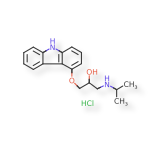
Details
| Stereochemistry | RACEMIC |
| Molecular Formula | C18H22N2O2.ClH |
| Molecular Weight | 334.84 |
| Optical Activity | ( + / - ) |
| Defined Stereocenters | 0 / 1 |
| E/Z Centers | 0 |
| Charge | 0 |
SHOW SMILES / InChI
SMILES
Cl.CC(C)NCC(O)COC1=CC=CC2=C1C3=C(N2)C=CC=C3
InChI
InChIKey=DXYNUICMBSWZMR-UHFFFAOYSA-N
InChI=1S/C18H22N2O2.ClH/c1-12(2)19-10-13(21)11-22-17-9-5-8-16-18(17)14-6-3-4-7-15(14)20-16;/h3-9,12-13,19-21H,10-11H2,1-2H3;1H
Carazolol is a beta1/beta2 adrenoreceptor blocking agent. Activity and safety of the drug were evaluated in clinical trials that were conducted in healthy subjects and in patients suffering from either chronic bronchitis or asthma. The drug, however, was not developed for human use. Instead, carazolol is used in to reduce stress in animals during transportation. In veterinary medicine, carazolol is given by intramuscular injection to pigs is indicated in stress-inducing situations. In cattle, carazolol is intended to be used for the prevention of shipment stress caused by transportation and formation of new herds.
Approval Year
PubMed
| Title | Date | PubMed |
|---|---|---|
| A full pharmacological analysis of the three turkey β-adrenoceptors and comparison with the human β-adrenoceptors. | 2010-11-30 |
|
| Human health risk assessment of pharmaceuticals in water: issues and challenges ahead. | 2010-11 |
|
| FoldGPCR: structure prediction protocol for the transmembrane domain of G protein-coupled receptors from class A. | 2010-08-01 |
|
| Structure-based discovery of A2A adenosine receptor ligands. | 2010-05-13 |
|
| Forced unbinding of GPR17 ligands from wild type and R255I mutant receptor models through a computational approach. | 2010-03-16 |
|
| Cell distribution after intracoronary bone marrow stem cell delivery in damaged and undamaged myocardium: implications for clinical trials. | 2010-03-15 |
|
| Predicting drug-target interaction networks based on functional groups and biological features. | 2010-03-11 |
|
| Lambing rates and litter size following carazolol administration prior to insemination in Kivircik ewes. | 2010-03 |
|
| Dynamics of the beta2-adrenergic G-protein coupled receptor revealed by hydrogen-deuterium exchange. | 2010-02-01 |
|
| Ligand-specific regulation of the extracellular surface of a G-protein-coupled receptor. | 2010-01-07 |
|
| Chiral separations of some beta-adrenergic agonists and antagonists on AmyCoat column by HPLC. | 2010-01 |
|
| Ligand-regulated oligomerization of beta(2)-adrenoceptors in a model lipid bilayer. | 2009-11-04 |
|
| Ligand entry and exit pathways in the beta2-adrenergic receptor. | 2009-10-02 |
|
| X-ray structure breakthroughs in the GPCR transmembrane region. | 2009-07-01 |
|
| Identifying conformational changes of the beta(2) adrenoceptor that enable accurate prediction of ligand/receptor interactions and screening for GPCR modulators. | 2009-05 |
|
| Chiral separation of beta-adrenergic blockers on CelluCoat column by HPLC. | 2009-04-30 |
|
| Analysis of full and partial agonists binding to beta2-adrenergic receptor suggests a role of transmembrane helix V in agonist-specific conformational changes. | 2009-04-09 |
|
| Rapid method for the determination of tranquilizers and a beta-blocker in porcine and bovine kidney by liquid chromatography with tandem mass spectrometry. | 2009-04-01 |
|
| Allosteric modulation of adenosine receptors. | 2009-03 |
|
| G-protein-coupled receptor structure: what can we learn? | 2009-02-24 |
|
| [Determination of azaperone and carazolol residues in animals kidney using LC-MS/MS method]. | 2009 |
|
| Computing highly correlated positions using mutual information and graph theory for G protein-coupled receptors. | 2009 |
|
| Structural constraints for the binding of short peptides to claudin-4 revealed by surface plasmon resonance. | 2008-11-07 |
|
| Structural basis for ligand binding and specificity in adrenergic receptors: implications for GPCR-targeted drug discovery. | 2008-10-21 |
|
| Use of the X-ray structure of the beta2-adrenergic receptor for drug discovery. Part 2: Identification of active compounds. | 2008-10-15 |
|
| Virtual screening of GPCRs: an in silico chemogenomics approach. | 2008-09-06 |
|
| Selective structure-based virtual screening for full and partial agonists of the beta2 adrenergic receptor. | 2008-08-28 |
|
| Structure of a beta1-adrenergic G-protein-coupled receptor. | 2008-07-24 |
|
| Active state-like conformational elements in the beta2-AR and a photoactivated intermediate of rhodopsin identified by dynamic properties of GPCRs. | 2008-07-15 |
|
| Comprehensive screening and quantification of veterinary drugs in milk using UPLC-ToF-MS. | 2008-07 |
|
| On the applicability of GPCR homology models to computer-aided drug discovery: a comparison between in silico and crystal structures of the beta2-adrenergic receptor. | 2008-05-22 |
|
| Crystallizing thinking about the beta2-adrenergic receptor. | 2008-05 |
|
| Biochemistry. Signaling across the cell membrane. | 2007-11-23 |
|
| High-resolution crystal structure of an engineered human beta2-adrenergic G protein-coupled receptor. | 2007-11-23 |
|
| GPCR engineering yields high-resolution structural insights into beta2-adrenergic receptor function. | 2007-11-23 |
|
| Effect of carazolol on the oestrous behaviour and concentrations of luteinising hormone and steroids in lactating cows during the periovulatory period. | 2007-06-09 |
|
| Determination of residues of azaperone in the kidneys by liquid chromatography with fluorescence detection. | 2007-03-14 |
|
| The influence of alpha-adrenergic receptors stimulator and blockers and beta-blocker on the ovary and endocrinological activity in heifers during superovulation. | 2006-11 |
|
| Adrenergic stimulation and blocking of hormonal secretion activity of cultured cow granulosa cells. | 2006-11 |
|
| Influence of supplemental magnesium, tryptophan, vitamin C, and vitamin E on stress responses of pigs to vibration. | 2005-07 |
|
| Screening for library-assisted identification and fully validated quantification of 22 beta-blockers in blood plasma by liquid chromatography-mass spectrometry with atmospheric pressure chemical ionization. | 2004-11-26 |
|
| Development of a rapid screening test for veterinary sedatives and the beta-blocker carazolol in porcine kidney by ELISA. | 2004-02 |
|
| Integrated acquisition of analytical and biopharmaceutical screening data for beta-adrenergic-drugs employing diversified macrocycle supported potentiometric detection in HPLC systems. | 2002-08 |
|
| Separation of carvedilol enantiomers in very small volumes of human plasma by capillary electrophoresis with laser-induced fluorescence. | 2001-05-05 |
|
| Evidence for the binding of beta-adrenoceptor blockers to microsomal Na+/K+-ATPase in guinea pig heart preparations. | 2001-01 |
|
| Multiresidue analysis of tranquilizers and the beta-blocker Carazolol in meat by liquid chromatography/tandem mass spectrometry. | 2001 |
|
| Carazolol: a potent, selective beta 3-adrenoceptor agonist. | 1995-11-30 |
|
| Carazolol, an extremely potent beta-adrenergic blocker: binding to beta-receptors in brain membranes. | 1979-06-11 |
| Name | Type | Language | ||
|---|---|---|---|---|
|
Common Name | English | ||
|
Preferred Name | English | ||
|
Systematic Name | English |
| Code System | Code | Type | Description | ||
|---|---|---|---|---|---|
|
300000029155
Created by
admin on Mon Mar 31 23:38:46 GMT 2025 , Edited by admin on Mon Mar 31 23:38:46 GMT 2025
|
PRIMARY | |||
|
305336
Created by
admin on Mon Mar 31 23:38:46 GMT 2025 , Edited by admin on Mon Mar 31 23:38:46 GMT 2025
|
PRIMARY | |||
|
4IVL5T473E
Created by
admin on Mon Mar 31 23:38:46 GMT 2025 , Edited by admin on Mon Mar 31 23:38:46 GMT 2025
|
PRIMARY | |||
|
20032198
Created by
admin on Mon Mar 31 23:38:46 GMT 2025 , Edited by admin on Mon Mar 31 23:38:46 GMT 2025
|
PRIMARY | |||
|
51997-43-4
Created by
admin on Mon Mar 31 23:38:46 GMT 2025 , Edited by admin on Mon Mar 31 23:38:46 GMT 2025
|
PRIMARY |
SUBSTANCE RECORD