


Details
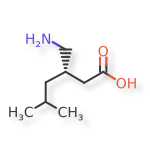
| Stereochemistry | ABSOLUTE |
| Molecular Formula | C8H16NO2.Na |
| Molecular Weight | 181.2079 |
| Optical Activity | ( + ) |
| Defined Stereocenters | 1 / 1 |
| E/Z Centers | 0 |
| Charge | 0 |
SHOW SMILES / InChI
SMILES
[Na+].CC(C)C[C@H](CN)CC([O-])=O
InChI
InChIKey=RDOYGLCZFATQEB-FJXQXJEOSA-M
InChI=1S/C8H17NO2.Na/c1-6(2)3-7(5-9)4-8(10)11;/h6-7H,3-5,9H2,1-2H3,(H,10,11);/q;+1/p-1/t7-;/m0./s1
DescriptionCurator's Comment: description was created based on several sources, including
https://www.ncbi.nlm.nih.gov/pubmed/17126531
Curator's Comment: description was created based on several sources, including
https://www.ncbi.nlm.nih.gov/pubmed/17126531
Pregabalin, marketed under the brand name Lyrica among others. LYRICA is indicated for: Neuropathic pain associated with diabetic peripheral neuropathy (DPN) Postherpetic neuralgia (PHN); Adjunctive therapy for adult patients with partial onset seizures; Fibromyalgia; Neuropathic pain associated with spinal cord injury. It has been shown the clinical effects of pregabalin are likely due to direct and selective interactions with α(2)δ-1 and α(2)δ-2 subunits of voltage-gated calcium channels. While pregabalin is a structural derivative of the inhibitory neurotransmitter gamma aminobutyric acid (GABA), it does not bind directly to GABAA, GABAB, or benzodiazepine receptors, does not augment GABAA responses in cultured neurons, does not alter rat brain GABA concentration or have acute effects on GABA uptake or degradation. However, in cultured neurons prolonged application of pregabalin increases the density of GABA transporter protein and increases the rate of functional GABA transport. Pregabalin does not block sodium channels, is not active at opiate receptors, and does not alter cyclooxygenase enzyme activity. It is inactive at serotonin and dopamine receptors and does not inhibit dopamine, serotonin, or noradrenaline reuptake.
Approval Year
Targets
| Primary Target | Pharmacology | Condition | Potency |
|---|---|---|---|
Target ID: CHEMBL3896 |
|||
Target ID: CHEMBL1919 |
Conditions
| Condition | Modality | Targets | Highest Phase | Product |
|---|---|---|---|---|
| Palliative | LYRICA Approved UseLYRICA is indicated for: Management of neuropathic pain associated with diabetic peripheral neuropathy Management of postherpetic neuralgia Adjunctive therapy for adult patients with partial onset seizures Management of fibromyalgia Management of neuropathic pain associated with spinal cord injury LYRICA is indicated for: Neuropathic pain associated with diabetic peripheral neuropathy (DPN) (1) Postherpetic neuralgia (PHN) (1) Adjunctive therapy for adult patients with partial onset seizures (1) Fibromyalgia (1) Neuropathic pain associated with spinal cord injury (1) Launch Date2004 |
|||
| Palliative | LYRICA Approved UseLYRICA is indicated for: Management of neuropathic pain associated with diabetic peripheral neuropathy Management of postherpetic neuralgia Adjunctive therapy for adult patients with partial onset seizures Management of fibromyalgia Management of neuropathic pain associated with spinal cord injury LYRICA is indicated for: Neuropathic pain associated with diabetic peripheral neuropathy (DPN) (1) Postherpetic neuralgia (PHN) (1) Adjunctive therapy for adult patients with partial onset seizures (1) Fibromyalgia (1) Neuropathic pain associated with spinal cord injury (1) Launch Date2004 |
|||
| Palliative | LYRICA Approved UseLYRICA is indicated for: Management of neuropathic pain associated with diabetic peripheral neuropathy Management of postherpetic neuralgia Adjunctive therapy for adult patients with partial onset seizures Management of fibromyalgia Management of neuropathic pain associated with spinal cord injury LYRICA is indicated for: Neuropathic pain associated with diabetic peripheral neuropathy (DPN) (1) Postherpetic neuralgia (PHN) (1) Adjunctive therapy for adult patients with partial onset seizures (1) Fibromyalgia (1) Neuropathic pain associated with spinal cord injury (1) Launch Date2004 |
|||
| Palliative | LYRICA Approved UseLYRICA is indicated for: Management of neuropathic pain associated with diabetic peripheral neuropathy Management of postherpetic neuralgia Adjunctive therapy for adult patients with partial onset seizures Management of fibromyalgia Management of neuropathic pain associated with spinal cord injury LYRICA is indicated for: Neuropathic pain associated with diabetic peripheral neuropathy (DPN) (1) Postherpetic neuralgia (PHN) (1) Adjunctive therapy for adult patients with partial onset seizures (1) Fibromyalgia (1) Neuropathic pain associated with spinal cord injury (1) Launch Date2004 |
Cmax
| Value | Dose | Co-administered | Analyte | Population |
|---|---|---|---|---|
4155.7 ng/mL EXPERIMENT https://pubmed.ncbi.nlm.nih.gov/34256964/ |
300 mg 1 times / day multiple, oral dose: 300 mg route of administration: Oral experiment type: MULTIPLE co-administered: |
PREGABALIN plasma | Homo sapiens population: HEALTHY age: ADULT sex: MALE food status: FED |
|
3547.82 ng/mL EXPERIMENT https://pubmed.ncbi.nlm.nih.gov/34256964/ |
150 mg 2 times / day multiple, oral dose: 150 mg route of administration: Oral experiment type: MULTIPLE co-administered: |
PREGABALIN plasma | Homo sapiens population: HEALTHY age: ADULT sex: MALE food status: FED |
|
3814.52 ng/mL EXPERIMENT https://pubmed.ncbi.nlm.nih.gov/34256964/ |
300 mg single, oral dose: 300 mg route of administration: Oral experiment type: SINGLE co-administered: |
PREGABALIN plasma | Homo sapiens population: HEALTHY age: ADULT sex: MALE food status: HIGH-FAT |
|
2273.792 ng/mL EXPERIMENT https://pubmed.ncbi.nlm.nih.gov/34256964/ |
300 mg single, oral dose: 300 mg route of administration: Oral experiment type: SINGLE co-administered: |
PREGABALIN plasma | Homo sapiens population: HEALTHY age: ADULT sex: MALE food status: FASTED |
|
4568.68 ng/mL EXPERIMENT https://www.ncbi.nlm.nih.gov/pubmed/28513426 |
150 mg single, oral dose: 150 mg route of administration: Oral experiment type: SINGLE co-administered: |
PREGABALIN plasma | Homo sapiens population: HEALTHY age: ADULT sex: FEMALE / MALE food status: FASTED |
AUC
| Value | Dose | Co-administered | Analyte | Population |
|---|---|---|---|---|
52115.92 ng × h/mL EXPERIMENT https://pubmed.ncbi.nlm.nih.gov/34256964/ |
300 mg 1 times / day multiple, oral dose: 300 mg route of administration: Oral experiment type: MULTIPLE co-administered: |
PREGABALIN plasma | Homo sapiens population: HEALTHY age: ADULT sex: MALE food status: FED |
|
53348.16 ng × h/mL EXPERIMENT https://pubmed.ncbi.nlm.nih.gov/34256964/ |
150 mg 2 times / day multiple, oral dose: 150 mg route of administration: Oral experiment type: MULTIPLE co-administered: |
PREGABALIN plasma | Homo sapiens population: HEALTHY age: ADULT sex: MALE food status: FED |
|
47696.84 ng × h/mL EXPERIMENT https://pubmed.ncbi.nlm.nih.gov/34256964/ |
300 mg single, oral dose: 300 mg route of administration: Oral experiment type: SINGLE co-administered: |
PREGABALIN plasma | Homo sapiens population: HEALTHY age: ADULT sex: MALE food status: HIGH-FAT |
|
26007.5 ng × h/mL EXPERIMENT https://pubmed.ncbi.nlm.nih.gov/34256964/ |
300 mg single, oral dose: 300 mg route of administration: Oral experiment type: SINGLE co-administered: |
PREGABALIN plasma | Homo sapiens population: HEALTHY age: ADULT sex: MALE food status: FASTED |
|
29831.454 ng × h/mL EXPERIMENT https://www.ncbi.nlm.nih.gov/pubmed/28513426 |
150 mg single, oral dose: 150 mg route of administration: Oral experiment type: SINGLE co-administered: |
PREGABALIN plasma | Homo sapiens population: HEALTHY age: ADULT sex: FEMALE / MALE food status: FASTED |
T1/2
| Value | Dose | Co-administered | Analyte | Population |
|---|---|---|---|---|
6.09 h EXPERIMENT https://pubmed.ncbi.nlm.nih.gov/34256964/ |
300 mg 1 times / day multiple, oral dose: 300 mg route of administration: Oral experiment type: MULTIPLE co-administered: |
PREGABALIN plasma | Homo sapiens population: HEALTHY age: ADULT sex: MALE food status: FED |
|
6.22 h EXPERIMENT https://pubmed.ncbi.nlm.nih.gov/34256964/ |
150 mg 2 times / day multiple, oral dose: 150 mg route of administration: Oral experiment type: MULTIPLE co-administered: |
PREGABALIN plasma | Homo sapiens population: HEALTHY age: ADULT sex: MALE food status: FED |
|
6.53 h EXPERIMENT https://pubmed.ncbi.nlm.nih.gov/34256964/ |
300 mg single, oral dose: 300 mg route of administration: Oral experiment type: SINGLE co-administered: |
PREGABALIN plasma | Homo sapiens population: HEALTHY age: ADULT sex: MALE food status: HIGH-FAT |
|
7.78 h EXPERIMENT https://pubmed.ncbi.nlm.nih.gov/34256964/ |
300 mg single, oral dose: 300 mg route of administration: Oral experiment type: SINGLE co-administered: |
PREGABALIN plasma | Homo sapiens population: HEALTHY age: ADULT sex: MALE food status: FASTED |
|
6.3 h |
unknown, oral |
PREGABALIN plasma | Homo sapiens population: UNKNOWN age: ADULT sex: UNKNOWN food status: UNKNOWN |
Overview
| CYP3A4 | CYP2C9 | CYP2D6 | hERG |
|---|---|---|---|
OverviewOther
| Other Inhibitor | Other Substrate | Other Inducer |
|---|---|---|
Drug as perpetrator
| Target | Modality | Activity | Metabolite | Clinical evidence |
|---|---|---|---|---|
| no | ||||
| no | ||||
| no | ||||
| no | ||||
| no | ||||
| no | ||||
| no | ||||
| no | ||||
| no |
Drug as victim
| Target | Modality | Activity | Metabolite | Clinical evidence |
|---|---|---|---|---|
Page: 6.0 |
no | |||
Page: 6.0 |
no | |||
Page: 6.0 |
no | |||
| no | ||||
Page: 5.0 |
yes | |||
Page: 5.0 |
yes |
Tox targets
| Target | Modality | Activity | Metabolite | Clinical evidence |
|---|---|---|---|---|
PubMed
| Title | Date | PubMed |
|---|---|---|
| Pregabalin: in the treatment of postherpetic neuralgia. | 2005 |
|
| Pregabalin relieves symptoms of painful diabetic neuropathy: a randomized controlled trial. | 2004-12-14 |
|
| Progress report on new antiepileptic drugs: a summary of the Seventh Eilat Conference (EILAT VII). | 2004-12-02 |
|
| Gateways to clinical trials. | 2004-11 |
|
| Simultaneous high-performance liquid chromatographic analysis of pregabalin, gabapentin and vigabatrin in human serum by precolumn derivatization with o-phtaldialdehyde and fluorescence detection. | 2004-10-25 |
|
| Gateways to clinical trials. | 2004-10 |
|
| Efficacy and tolerability of the new antiepileptic drugs: comparison of two recent guidelines. | 2004-10 |
|
| 'Protective premedication': an option with gabapentin and related drugs? A review of gabapentin and pregabalin in in the treatment of post-operative pain. | 2004-10 |
|
| Practice parameter: treatment of postherpetic neuralgia: an evidence-based report of the Quality Standards Subcommittee of the American Academy of Neurology. | 2004-09-28 |
|
| Gateways to clinical trials. | 2004-09-07 |
|
| Dual effects of gabapentin and pregabalin on glutamate release at rat entorhinal synapses in vitro. | 2004-09 |
|
| A study comparing the actions of gabapentin and pregabalin on the electrophysiological properties of cultured DRG neurones from neonatal rats. | 2004-08-04 |
|
| Mechanism of action of alpha2delta ligands: voltage sensitive calcium channel (VSCC) modulators. | 2004-08 |
|
| Pregabalin for the treatment of painful diabetic peripheral neuropathy: a double-blind, placebo-controlled trial. | 2004-08 |
|
| Pharmaceutical treatment options for fibromyalgia. | 2004-08 |
|
| Neuromodulating drugs for the symptomatic treatment of neuropathic pain. | 2004-06 |
|
| [New options in the treatment of various forms of diabetic neuropathy]. | 2004-05-20 |
|
| Highly selective asymmetric hydrogenation using a three hindered quadrant bisphosphine rhodium catalyst. | 2004-05-19 |
|
| Effect of gabapentin derivates on mechanical allodynia-like behaviour in a rat model of chronic sciatic constriction injury. | 2004-05-17 |
|
| Anticonvulsants and the relief of chronic pain: pregabalin and gabapentin as alpha(2)delta ligands at voltage-gated calcium channels. | 2004-05 |
|
| American Chemical Society--227th annual meeting. Neuroprotection. 28 March - 1 April 2004, Anaheim, CA, USA. | 2004-05 |
|
| Pregabalin reduces pain and improves sleep and mood disturbances in patients with post-herpetic neuralgia: results of a randomised, placebo-controlled clinical trial. | 2004-05 |
|
| [How neuropathic is sciatica? The mixed pain concept]. | 2004-05 |
|
| Efficacy of the novel anxiolytic pregabalin in social anxiety disorder: a placebo-controlled, multicenter study. | 2004-04 |
|
| Gateways to clinical trials. | 2004-04 |
|
| Anticonvulsants as anxiolytics, part 2: Pregabalin and gabapentin as alpha(2)delta ligands at voltage-gated calcium channels. | 2004-04 |
|
| Gateways to clinical trials. | 2004-03 |
|
| Pharmacologic management part 1: better-studied neuropathic pain diseases. | 2004-03 |
|
| Gateways to clinical trials. | 2004-02-28 |
|
| High dose pregabalin is effective for the treatment of generalised anxiety disorder. | 2004-02 |
|
| Pregabalin (Pfizer). | 2004-01 |
|
| Pregabalin add-on treatment: a randomized, double-blind, placebo-controlled, dose-response study in adults with partial seizures. | 2004-01 |
|
| Pregabalin: in the treatment of painful diabetic peripheral neuropathy. | 2004 |
|
| [New molecular targets in pharmacological treatment of anxiety disorders]. | 2004 |
|
| Antiepileptic drugs in the treatment of anxiety disorders: role in therapy. | 2004 |
|
| Selecting pharmacotherapy for generalized anxiety disorder. | 2004 |
|
| The biology and pharmacology of calcium channel alpha2-delta proteins Pfizer Satellite Symposium to the 2003 Society for Neuroscience Meeting. Sheraton New Orleans Hotel, New Orleans, LA November 10, 2003. | 2004 |
|
| Pregabalin as adjunctive therapy for partial seizures. | 2004 |
|
| Pregabalin pharmacology and its relevance to clinical practice. | 2004 |
|
| Newer anticonvulsants in the treatment of bipolar disorder. | 2004 |
|
| Gateways to clinical trials. | 2003-12 |
|
| Genotype-dependence of gabapentin and pregabalin sensitivity: the pharmacogenetic mediation of analgesia is specific to the type of pain being inhibited. | 2003-12 |
|
| Future Pain Drugs - Europe 2003. 15-16 September 2003, London, UK. | 2003-11 |
|
| The use of clinical trial simulation to support dose selection: application to development of a new treatment for chronic neuropathic pain. | 2003-11 |
|
| Gateways to clinical trials. | 2003-10 |
|
| Gateways to clinical trials. | 2003-09 |
|
| Pregabalin and gabapentin reduce release of substance P and CGRP from rat spinal tissues only after inflammation or activation of protein kinase C. | 2003-09 |
|
| Evaluation of mixture modeling with count data using NONMEM. | 2003-06 |
|
| The role of GABA in the pathophysiology and treatment of anxiety disorders. | 2003 |
|
| New single-isomer compounds on the horizon. | 2002-04 |
Patents
Sample Use Guides
Neuropathic Pain Associated with Diabetic Peripheral Neuropathy:
The maximum recommended dose is 100 mg three times a day (300 mg/day) in patients with creatinine clearance of at least 60 mL/min.
Postherpetic Neuralgia:
The recommended dose is 75 to 150 mg two times a day, or 50 to 100 mg three times a day (150 to 300 mg/day) in patients with creatinine clearance of at least 60 mL/min. Begin dosing at 75 mg two times a day, or 50 mg three times a day (150 mg/day). The dose may be increased to 300 mg/day within 1 week based on efficacy and tolerability.
Adjunctive Therapy for Adult Patients with Partial Onset Seizures:
LYRICA at doses of 150 to 600 mg/day has been shown to be effective as adjunctive therapy in
the treatment of partial onset seizures in adults. Both the efficacy and adverse event profiles of
In general, it is recommended that patients be started on a total daily dose no greater than 150 mg/day (75 mg two times a day, or 50 mg three times a day).
Management of Fibromyalgia:
The recommended dose is 300 to 450 mg/day. Begin dosing at
75 mg two times a day (150 mg/day). The dose may be increased to 150 mg two times a day (300 mg/day) within 1 week based on efficacy and tolerability.
Neuropathic Pain Associated with Spinal Cord Injury:
The recommended dose range is 150 to 600 mg/day. The recommended starting dose is 75 mg two times a day (150 mg/day). The dose may be increased to 150 mg two times a day (300 mg/day) within 1 week based on efficacy and tolerability.
Route of Administration:
Oral
| Name | Type | Language | ||
|---|---|---|---|---|
|
Common Name | English | ||
|
Preferred Name | English | ||
|
Systematic Name | English |
| Code System | Code | Type | Description | ||
|---|---|---|---|---|---|
|
914254-22-1
Created by
admin on Wed Apr 02 11:06:43 GMT 2025 , Edited by admin on Wed Apr 02 11:06:43 GMT 2025
|
PRIMARY | |||
|
23669189
Created by
admin on Wed Apr 02 11:06:43 GMT 2025 , Edited by admin on Wed Apr 02 11:06:43 GMT 2025
|
PRIMARY | |||
|
3DA4H8E58A
Created by
admin on Wed Apr 02 11:06:43 GMT 2025 , Edited by admin on Wed Apr 02 11:06:43 GMT 2025
|
PRIMARY |
ACTIVE MOIETY
SUBSTANCE RECORD
