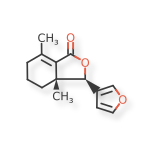
Details
| Stereochemistry | ABSOLUTE |
| Molecular Formula | C14H16O3 |
| Molecular Weight | 232.275 |
| Optical Activity | UNSPECIFIED |
| Defined Stereocenters | 2 / 2 |
| E/Z Centers | 0 |
| Charge | 0 |
SHOW SMILES / InChI
SMILES
CC1=C2C(=O)O[C@@H](C3=COC=C3)[C@]2(C)CCC1
InChI
InChIKey=XYYAFLHHHZVPRN-GXTWGEPZSA-N
InChI=1S/C14H16O3/c1-9-4-3-6-14(2)11(9)13(15)17-12(14)10-5-7-16-8-10/h5,7-8,12H,3-4,6H2,1-2H3/t12-,14+/m0/s1
Fraxinellone is formed by the natural degradation of limonoids isolated from the root bark of Dictamnus dasycarpus. Fraxinellone has been reported to possess neuroprotective and vasorelaxing activities, but the effects and the mechanism of fraxinellone in inflammation have not been fully characterized. It was shown, that fraxinellone significantly reduced lipopolysaccharide (LPS)-induced production of nitric oxide (NO), IL-1β and IL-18 as well as the activity of iNOS in both THP-1 cells and mouse primary peritoneal macrophages. The mechanisms responsible for these effects were attributed to the inhibitory role of fraxinellone in NF-κB signaling and NLRP3 inflammasome activation. Moreover, these results proved that fraxinellone could be use as a novel drug candidate in the treatment of colonic inflammation.
Originator
Approval Year
PubMed
| Title | Date | PubMed |
|---|---|---|
| Fraxinellone inhibits lipopolysaccharide-induced inducible nitric oxide synthase and cyclooxygenase-2 expression by negatively regulating nuclear factor-kappa B in RAW 264.7 macrophages cells. | 2009-06 |
|
| Feeding deterrents from Dictamnus dasycarpus Turcz against two stored-product insects. | 2002-03-13 |
Patents
Sample Use Guides
To investigate the effects of fraxinellone on LPS-induced NO and PGE2 production in RAW 264.7 cells, culture media were harvested, and nitrite and PGE2 levels were determined. It was shown, that LPS (1 mg/ml) increased NO production by approximately 100 fold, but when fraxinellone was pretreated at 6.25, 12.5, and 25 mM for 1 h before LPS was treated, NO production was found to have decreased by 69, 72 and 83%, respectively. To examine whether fraxinellone inhibits PGE2 production, cells were preincubated with fraxinellone (6.25, 12.5, 25 mM) for 1 h and then activated with 1 mg/ml LPS for 24 h. it was found, it was found, that fraxinellone significantly attenuated the production of PGE2 in a dose-dependent manner.
| Name | Type | Language | ||
|---|---|---|---|---|
|
Preferred Name | English | ||
|
Common Name | English | ||
|
Systematic Name | English | ||
|
Systematic Name | English |
| Code System | Code | Type | Description | ||
|---|---|---|---|---|---|
|
DTXSID30951450
Created by
admin on Mon Mar 31 21:46:31 GMT 2025 , Edited by admin on Mon Mar 31 21:46:31 GMT 2025
|
PRIMARY | |||
|
2HP328XN7C
Created by
admin on Mon Mar 31 21:46:31 GMT 2025 , Edited by admin on Mon Mar 31 21:46:31 GMT 2025
|
PRIMARY | |||
|
124039
Created by
admin on Mon Mar 31 21:46:31 GMT 2025 , Edited by admin on Mon Mar 31 21:46:31 GMT 2025
|
PRIMARY | |||
|
28808-62-0
Created by
admin on Mon Mar 31 21:46:31 GMT 2025 , Edited by admin on Mon Mar 31 21:46:31 GMT 2025
|
PRIMARY |
SUBSTANCE RECORD