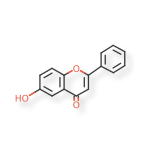
Details
| Stereochemistry | ACHIRAL |
| Molecular Formula | C15H10O3 |
| Molecular Weight | 238.2381 |
| Optical Activity | NONE |
| Defined Stereocenters | 0 / 0 |
| E/Z Centers | 0 |
| Charge | 0 |
SHOW SMILES / InChI
SMILES
OC1=CC2=C(OC(=CC2=O)C3=CC=CC=C3)C=C1
InChI
InChIKey=GPZYYYGYCRFPBU-UHFFFAOYSA-N
InChI=1S/C15H10O3/c16-11-6-7-14-12(8-11)13(17)9-15(18-14)10-4-2-1-3-5-10/h1-9,16H
DescriptionCurator's Comment: The description was created based on several sources, including
https://www.ncbi.nlm.nih.gov/pubmed/24795772 | https://www.ncbi.nlm.nih.gov/pubmed/19592245 | https://www.ncbi.nlm.nih.gov/pubmed/21129983 | https://www.ncbi.nlm.nih.gov/pubmed/14637197
Curator's Comment: The description was created based on several sources, including
https://www.ncbi.nlm.nih.gov/pubmed/24795772 | https://www.ncbi.nlm.nih.gov/pubmed/19592245 | https://www.ncbi.nlm.nih.gov/pubmed/21129983 | https://www.ncbi.nlm.nih.gov/pubmed/14637197
6-Hydroxyflavone is a naturally occurring flavone found in the leaves of Barleria prionitis, a plant species in the Acanthaceae family native to India that is widely used against neurological disorders such as paraplegia, sciatica, etc. 6-Hydroxyflavone partially potentiated GABA-induced currents in native GABAA receptors expressed in cortical neurons via BZ site, as the enhancement was blocked by the antagonist flumazenil. Furthermore, in patch clamp studies, 6-Hydroxyflavone displayed the significant preference for a2- and a3- containing subtypes, which were thought to mediate anxiolytic effect, compared to a1- and a5- containing subtypes expressed in HEK 293T cells. In mice, 6-Hydroxyflavone exhibited the anxiolytic-like effect in the elevated plus-maze test, unaccompanied at anxiolytic doses by the sedative, cognitive impairing, myorelaxant, motor incoordination and anticonvulsant effects commonly associated with classical BZs when tested in the hole-board, step-through passive avoidance, horizontal wire, rotarod, and pentylenetetrazol (PTZ)-induced seizure tests, respectively. The findings, therefore, identified 6-Hydroxyflavone as a promising drug candidate for the treatment of anxiety-like disorders.
Originator
Approval Year
Targets
| Primary Target | Pharmacology | Condition | Potency |
|---|---|---|---|
Target ID: CHEMBL6093 |
5.2 µM [IC50] | ||
Target ID: CHEMBL2034 |
7.1 µM [EC50] | ||
Target ID: CHEMBL1871 |
7.1 µM [EC50] | ||
Target ID: CHEMBL2093872 |
2.64 nM [Ki] |
Conditions
| Condition | Modality | Targets | Highest Phase | Product |
|---|---|---|---|---|
| Primary | Unknown Approved UseUnknown |
PubMed
| Title | Date | PubMed |
|---|---|---|
| In vitro effects of some flavones on human pyruvate kinase isoenzyme M2. | 2015-03 |
|
| Human sex hormone-binding globulin binding affinities of 125 structurally diverse chemicals and comparison with their binding to androgen receptor, estrogen receptor, and α-fetoprotein. | 2015-02 |
|
| A comparative study of flavonoid analogues on streptozotocin-nicotinamide induced diabetic rats: quercetin as a potential antidiabetic agent acting via 11beta-hydroxysteroid dehydrogenase type 1 inhibition. | 2010-06 |
|
| GABA(A) receptor subtype selectivity underlying anxiolytic effect of 6-hydroxyflavone. | 2010-05-01 |
|
| [Effect of seven kinds of flavonoids on recombinant human protein tyrosine phosphatase]. | 2010-05 |
|
| 2-(4-Bromo-phen-yl)-6-methyl-4H-1-benzopyran-4-one (4'-bromo-6-methyl-flavone). | 2010-03-27 |
|
| Mechanism of CYP2C9 inhibition by flavones and flavonols. | 2009-03 |
|
| Secretion of cortisol and aldosterone as a vulnerable target for adrenal endocrine disruption - screening of 30 selected chemicals in the human H295R cell model. | 2008-11 |
|
| Microbial metabolism part 9. Structure and antioxidant significance of the metabolites of 5,7-dihydroxyflavone (chrysin), and 5- and 6-hydroxyflavones. | 2008-04 |
|
| [Effects of flavonoids with different structures on proliferation of leukemia cell line HL-60]. | 2007-12 |
|
| Analysis of flavonoids by CE using capacitively coupled contactless conductivity detection. | 2007-03 |
|
| Prediction of estrogen receptor agonists and characterization of associated molecular descriptors by statistical learning methods. | 2006-11 |
|
| Flavonoid inhibition of overexpressed human 3beta-hydroxysteroid dehydrogenase type II. | 2004-02 |
|
| Relaxant effects of flavonoids in isolated guinea pig trachea and their structure-activity relationships. | 2003-12 |
|
| Effects of flavonoid phytochemicals on cortisol production and on activities of steroidogenic enzymes in human adrenocortical H295R cells. | 2002-03 |
|
| Covalent alteration of the CYP3A4 active site: evidence for multiple substrate binding domains. | 2001-07-01 |
|
| Differential inhibitory effects of various flavonoids on the activities of reverse transcriptase and cellular DNA and RNA polymerases. | 1990-07-05 |
Patents
Sample Use Guides
ICR mice were treated with 6, 12, 25, 50 or 100 mg/kg, p.o.
Route of Administration:
Oral
The cytotoxic effects of the flavones (flavone, 6-OH-F, 7-OH-F, baicalein, and luteolin) on the MC3T3 cells were evaluated using an MTT assay. The MC3T3-E1 cells were seeded in a 96-well plate at 3000 cells per well and cultured for 48 h. After rinsing with PBS, the cells were treated with various concentrations of the selected flavones in a fresh medium for 24 h. The viable cells were then treated with a newly prepared medium containing 10 𝜇L of 5mg/mL MTT and 90 𝜇L of the 𝛼-MEM (10% FBS, 1x anti-anti) in a CO2 incubator for 2 h. The MTT was transformed by the living cells to a purple formazan dye which was dissolved in 100 𝜇L DMSO by shaking at 150 rpm for 10min with an ELISA shaker. Finally, the relative colorimetric intensity of each well was evaluated using a Varioskan flash multimode reader (Thermo Fisher Scientific Inc., MA, USA) at a 570 nm wavelength. The cell viability of the control group without exposure to the flavones was defined as 100%.
| Name | Type | Language | ||
|---|---|---|---|---|
|
Systematic Name | English | ||
|
Preferred Name | English | ||
|
Systematic Name | English | ||
|
Systematic Name | English | ||
|
Systematic Name | English | ||
|
Systematic Name | English | ||
|
Systematic Name | English |
| Code System | Code | Type | Description | ||
|---|---|---|---|---|---|
|
DTXSID8022327
Created by
admin on Mon Mar 31 19:29:52 GMT 2025 , Edited by admin on Mon Mar 31 19:29:52 GMT 2025
|
PRIMARY | |||
|
229-704-8
Created by
admin on Mon Mar 31 19:29:52 GMT 2025 , Edited by admin on Mon Mar 31 19:29:52 GMT 2025
|
PRIMARY | |||
|
26744
Created by
admin on Mon Mar 31 19:29:52 GMT 2025 , Edited by admin on Mon Mar 31 19:29:52 GMT 2025
|
PRIMARY | |||
|
72279
Created by
admin on Mon Mar 31 19:29:52 GMT 2025 , Edited by admin on Mon Mar 31 19:29:52 GMT 2025
|
PRIMARY | |||
|
148S6Z78H6
Created by
admin on Mon Mar 31 19:29:52 GMT 2025 , Edited by admin on Mon Mar 31 19:29:52 GMT 2025
|
PRIMARY | |||
|
6665-83-4
Created by
admin on Mon Mar 31 19:29:52 GMT 2025 , Edited by admin on Mon Mar 31 19:29:52 GMT 2025
|
PRIMARY | |||
|
6-HYDROXYFLAVONE
Created by
admin on Mon Mar 31 19:29:52 GMT 2025 , Edited by admin on Mon Mar 31 19:29:52 GMT 2025
|
PRIMARY |
SUBSTANCE RECORD