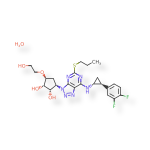
Details
| Stereochemistry | ABSOLUTE |
| Molecular Formula | C23H28F2N6O4S.H2O |
| Molecular Weight | 540.583 |
| Optical Activity | UNSPECIFIED |
| Defined Stereocenters | 6 / 6 |
| E/Z Centers | 0 |
| Charge | 0 |
SHOW SMILES / InChI
SMILES
O.CCCSC1=NC2=C(N=NN2[C@@H]3C[C@H](OCCO)[C@@H](O)[C@H]3O)C(N[C@@H]4C[C@H]4C5=CC(F)=C(F)C=C5)=N1
InChI
InChIKey=LXLCTRJKFYBHRD-VQNGXBDNSA-N
InChI=1S/C23H28F2N6O4S.H2O/c1-2-7-36-23-27-21(26-15-9-12(15)11-3-4-13(24)14(25)8-11)18-22(28-23)31(30-29-18)16-10-17(35-6-5-32)20(34)19(16)33;/h3-4,8,12,15-17,19-20,32-34H,2,5-7,9-10H2,1H3,(H,26,27,28);1H2/t12-,15+,16+,17-,19-,20+;/m0./s1
DescriptionCurator's Comment: description was created based on several sources, including http://www.ema.europa.eu/docs/en_GB/document_library/PIP_decision/WC500123240.pdf; http://www.ema.europa.eu/docs/en_GB/document_library/EPAR_-_Summary_for_the_public/human/002303/WC500100562.pdf; https://www.accessdata.fda.gov/drugsatfda_docs/nda/2011/022433Orig1s000PharmR.pdf
Curator's Comment: description was created based on several sources, including http://www.ema.europa.eu/docs/en_GB/document_library/PIP_decision/WC500123240.pdf; http://www.ema.europa.eu/docs/en_GB/document_library/EPAR_-_Summary_for_the_public/human/002303/WC500100562.pdf; https://www.accessdata.fda.gov/drugsatfda_docs/nda/2011/022433Orig1s000PharmR.pdf
Ticagrelor (known trade names Brilinta, Brilique and Possia) is a P2Y12 platelet inhibitor. Brilinta has been approved by the US Food and Drug administration (FDA) in 2011 and is indicated to reduce the rate of cardiovascular death, myocardial infarction, and stroke in patients with acute coronary syndrome (ACS) or a history of myocardial infarction. Brilinta also reduces the rate of stent thrombosis in patients who have been stented for treatment of ACS. Ticagrelor and its major metabolite reversibly interact with the platelet P2Y12 ADP-receptor to prevent signal transduction and platelet activation. Ticagrelor and its active metabolite are approximately equipotent. In vitro metabolism studies demonstrate that ticagrelor and its major active metabolite are weak inhibitors of CYP3A4, potential activators of CYP3A5 and inhibitors of the P-gp transporter. Most common adverse reactions are bleeding 12% and dyspnea 14%.
Originator
Approval Year
Targets
| Primary Target | Pharmacology | Condition | Potency |
|---|---|---|---|
Target ID: CHEMBL2001 |
Conditions
| Condition | Modality | Targets | Highest Phase | Product |
|---|---|---|---|---|
| Secondary | BRILINTA Approved UseIndicated to reduce the rate of cardiovascular death, myocardial infarction, and stroke in patients with acute coronary syndrome (ACS) or a history of myocardial infarction (MI). For at least the first 12 months following ACS, it is superior to clopidogrel. Reduces the rate of stent thrombosis in patients who have been stented for treatment of ACS. Launch Date2011 |
|||
| Secondary | BRILINTA Approved UseIndicated to reduce the rate of cardiovascular death, myocardial infarction, and stroke in patients with acute coronary syndrome (ACS) or a history of myocardial infarction (MI). For at least the first 12 months following ACS, it is superior to clopidogrel. Reduces the rate of stent thrombosis in patients who have been stented for treatment of ACS. Launch Date2011 |
Cmax
| Value | Dose | Co-administered | Analyte | Population |
|---|---|---|---|---|
1208 ng/mL Clinical Trial https://clinicaltrials.gov/ct2/show/NCT01898442 |
270 mg single, oral dose: 270 mg route of administration: oral experiment type: single co-administered: |
TICAGRELOR plasma | Homo sapiens |
|
1208 ng/mL Clinical Trial https://clinicaltrials.gov/ct2/show/NCT01898442 |
360 mg single, oral dose: 360 mg route of administration: oral experiment type: single co-administered: |
TICAGRELOR plasma | Homo sapiens |
|
1583 ng/mL EXPERIMENT https://pubmed.ncbi.nlm.nih.gov/20642549/ |
200 mg 2 times / day multiple, oral dose: 200 mg route of administration: Oral experiment type: MULTIPLE co-administered: |
TICAGRELOR plasma | Homo sapiens population: HEALTHY age: ADULT sex: FEMALE / MALE food status: FASTED |
AUC
| Value | Dose | Co-administered | Analyte | Population |
|---|---|---|---|---|
12379 ng*h/mL Clinical Trial https://clinicaltrials.gov/ct2/show/NCT01898442 |
270 mg single, oral dose: 270 mg route of administration: oral experiment type: single co-administered: |
TICAGRELOR plasma | Homo sapiens |
|
12381 ng*h/mL Clinical Trial https://clinicaltrials.gov/ct2/show/NCT01898442 |
360 mg single, oral dose: 360 mg route of administration: oral experiment type: single co-administered: |
TICAGRELOR plasma | Homo sapiens |
|
10160 ng × h/mL EXPERIMENT https://pubmed.ncbi.nlm.nih.gov/20642549/ |
200 mg 2 times / day multiple, oral dose: 200 mg route of administration: Oral experiment type: MULTIPLE co-administered: |
TICAGRELOR plasma | Homo sapiens population: HEALTHY age: ADULT sex: FEMALE / MALE food status: FASTED |
T1/2
| Value | Dose | Co-administered | Analyte | Population |
|---|---|---|---|---|
7 h |
90 mg single, oral dose: 90 mg route of administration: Oral experiment type: SINGLE co-administered: |
TICAGRELOR plasma | Homo sapiens population: UNKNOWN age: ADULT sex: FEMALE / MALE food status: UNKNOWN |
Funbound
| Value | Dose | Co-administered | Analyte | Population |
|---|---|---|---|---|
1% |
90 mg single, oral dose: 90 mg route of administration: Oral experiment type: SINGLE co-administered: |
TICAGRELOR plasma | Homo sapiens population: UNKNOWN age: ADULT sex: FEMALE / MALE food status: UNKNOWN |
Doses
| Dose | Population | Adverse events |
|---|---|---|
1260 mg single, oral Highest studied dose Dose: 1260 mg Route: oral Route: single Dose: 1260 mg Sources: |
healthy |
DLT: Gastrointestinal disorder NOS, Sinus arrest... Dose limiting toxicities: Gastrointestinal disorder NOS (50%) Sources: Sinus arrest (serious, 16.7%) High grade atrioventricular block (serious, 16.7%) Ventricular escape rhythm (serious, 16.7%) |
900 mg single, oral MTD |
healthy |
|
90 mg 2 times / day multiple, oral Recommended Dose: 90 mg, 2 times / day Route: oral Route: multiple Dose: 90 mg, 2 times / day Sources: |
unhealthy Health Status: unhealthy Sex: M+F Sources: |
Disc. AE: Dyspnea... AEs leading to discontinuation/dose reduction: Dyspnea (0.9%) Sources: |
90 mg 2 times / day multiple, oral Recommended Dose: 90 mg, 2 times / day Route: oral Route: multiple Dose: 90 mg, 2 times / day Sources: |
unhealthy Health Status: unhealthy Sources: |
Disc. AE: Bleeding... AEs leading to discontinuation/dose reduction: Bleeding (grade 3-5) Sources: |
AEs
| AE | Significance | Dose | Population |
|---|---|---|---|
| Gastrointestinal disorder NOS | 50% DLT |
1260 mg single, oral Highest studied dose Dose: 1260 mg Route: oral Route: single Dose: 1260 mg Sources: |
healthy |
| High grade atrioventricular block | serious, 16.7% DLT |
1260 mg single, oral Highest studied dose Dose: 1260 mg Route: oral Route: single Dose: 1260 mg Sources: |
healthy |
| Sinus arrest | serious, 16.7% DLT |
1260 mg single, oral Highest studied dose Dose: 1260 mg Route: oral Route: single Dose: 1260 mg Sources: |
healthy |
| Ventricular escape rhythm | serious, 16.7% DLT |
1260 mg single, oral Highest studied dose Dose: 1260 mg Route: oral Route: single Dose: 1260 mg Sources: |
healthy |
| Dyspnea | 0.9% Disc. AE |
90 mg 2 times / day multiple, oral Recommended Dose: 90 mg, 2 times / day Route: oral Route: multiple Dose: 90 mg, 2 times / day Sources: |
unhealthy Health Status: unhealthy Sex: M+F Sources: |
| Bleeding | grade 3-5 Disc. AE |
90 mg 2 times / day multiple, oral Recommended Dose: 90 mg, 2 times / day Route: oral Route: multiple Dose: 90 mg, 2 times / day Sources: |
unhealthy Health Status: unhealthy Sources: |
Overview
OverviewOther
Drug as perpetrator
| Target | Modality | Activity | Metabolite | Clinical evidence |
|---|---|---|---|---|
| likely | ||||
| likely | ||||
| likely | ||||
| likely | ||||
| moderate [IC50 10.5 uM] | ||||
| moderate [IC50 11.7 uM] | ||||
| moderate [IC50 26.7 uM] | ||||
| moderate [IC50 33 uM] | ||||
| moderate [IC50 43 uM] | ||||
| moderate [IC50 6.9 uM] | no (co-administration study) Comment: Human liver microsomes, dicrofenac (substrate); Co-administration of ticagrelor (180 mg BID x 9 days) did not alter the systemic exposure of tolbutamide (500 mg QD on Day 5, CYP2C9 substrate) (GM ratio of AUCinf and Cmax were 103%, 110%, while 4-OH tolbutamide AUCinf GM ratio and Cmax GM ratio were 94% and 90%). Sources: https://www.accessdata.fda.gov/drugsatfda_docs/nda/2011/022433Orig1s000ClinPharmR.pdf#page=9, Page: 9-11 |
|||
| moderate [IC50 7.6 uM] | ||||
Page: 9-12, 60-61, 66-67, (PMDA) 130 |
moderate [IC50 8.2 uM] | yes (co-administration study) Comment: Human liver microsomes, midazolam (4-hydroxylation, substrate), no time-dependent inhibition; Co-administration of ticagrelor (270 mg AM + 180 mg PM on Day1, 180 mg BID on Days 2-7) significantly increased simvastatin (80 mg on Day 5, CYP3A4/5 substrate) AUCinf by 56% and Cmax 81%, and simvastatin acid AUCinf by 52% and Cmax by 64%. Co-administration of ticagrelor (270 mg AM + 180 mg PM on Day1, 180 mg BID on Days 2-7) significantly reduced oral midazolam (7.5 mg AM on Days 1 & 7) AUCinf by 10%, and 4’-OH-midazolam by 42%. Co-administration of ticagrelor (270 mg AM + 180 mg PM on Day 1, 180 mg BID on Days 2-7) does not alter the systemic exposure of IV midazolam (2.5 mg IV over 2 min AM on Days 1 & 7) and significantly reduced 4’-OH- midazolam systemic exposure by ~ 23%. Page: 9-12, 60-61, 66-67, (PMDA) 130 |
||
| no [IC50 40 uM] | ||||
| no [IC50 >50 uM] | ||||
| no [IC50 >50 uM] | ||||
| no [IC50 >50 uM] | ||||
| no [IC50 >50 uM] | ||||
| no [IC50 >50 uM] | ||||
| no [IC50 >50 uM] | ||||
| no [IC50 >50 uM] | weak (co-administration study) Comment: Human liver microsomes, midazolam (1-hydroxylation, substrate), midazolam 1-hydroxylation was activated in the presence of Cyt-b5 by 144.9% (CYP3A4 (cDNA expressed enzyme):Cyp-b5 = 1: 3 + 5.56 mcM ticagrelor), no time-dependent inhibition; Inhibited testosterone intrinsic clearance (IC50 = 23 mcM, pooled human liver microsomes (33 male and female donors); Co-administration of ticagrelor (270 mg AM + 90 mg PM on Day 1, 90 mg BID on Days 2-7) significantly increased atorvastatin (80 mg QD on Day 5) AUCinf 36% and Cmax 23%, atorvastatin lactone AUCinf 32% and Cmax 39%, s 2-OH atorvastatin AUCinf 33% and Cmax 13%, and 4-OH atorvastatin AUCinf 67% and Cmax 55%. Co-administration of ticagrelor (90 mg BID x 21 days) significantly increased ethinyl estradiol AUCinf, Cmax, and Cmin by 20%, 30.6%, and 20.2%, respectively. Co-administration of ticagrelor does not alter the systemic exposure of levonorgestrel. Co-administration of ticagrelor (270 mg AM + 180 mg PM on Day1, 180 mg BID on Days 2-7) significantly reduced oral midazolam (7.5 mg AM on Days 1 & 7) AUCinf by 10%, but did not alter 1’-OH- midazolam AUC. Co-administration of ticagrelor (270 mg AM + 180 mg PM on Day 1, 180 mg BID on Days 2-7) did not alter the systemic exposure of IV midazolam (2.5 mg IV over 2 min AM on Days 1 & 7) and 1’-OH-midazolam. Page: 9-12, 62-63, 64-65, 66-67 (PMDA) 124-125, 130 |
|||
| no | ||||
| no | ||||
| no | ||||
| no | ||||
| no | ||||
| no | ||||
Page: (PMDA) 160-161 |
no | |||
Page: (PMDA) 160-161 |
no | |||
Page: (PMDA) 160-161 |
strong [Ki 13.4 uM] | |||
Page: (PMDA) 160-161 |
strong [Ki 16.3 uM] | |||
Page: (PMDA) 160-161 |
strong [Ki 4.9 uM] | |||
Page: (PMDA) 160-161 |
strong | |||
| weak | ||||
| weak | ||||
| yes [IC50 0.759 uM] | ||||
| yes [IC50 1 uM] | ||||
| yes [IC50 10 uM] | ||||
| yes [IC50 16.9 uM] | ||||
| yes [IC50 19.2 uM] | ||||
| yes [IC50 19.9 uM] | ||||
Page: 4-5, 58-59 (PMDA) 157 |
yes [IC50 7.8 uM] | yes (co-administration study) Comment: MDR1-MDCK monolayer, H3-digoxin (5 mcM) as a substrate, Flux ratio = 19.5 (digoxin only), 3.1 (digoxin + 10 mcM Ticagrelor); Co-administration of ticagrelor (400 mg QD, Days 1-16) significantly increased digoxin (0.25 mg BID on Day 6, 0.25 mg QD on Days 7-14, P-gp substrate) AUC0-72, Css,max, and Css, min by 28%, 75% and 31%, respectively. Page: 4-5, 58-59 (PMDA) 157 |
||
| yes [IC50 9.9 uM] |
Drug as victim
| Target | Modality | Activity | Metabolite | Clinical evidence |
|---|---|---|---|---|
Page: 123, (ClinPharm) 5-6, 43-44, 45-47, 47-49 |
major [Km 11 uM] | yes (co-administration study) Comment: Human liver microsomes (determination of CYPs) and human cDNA expressed emzymes (Km for AR-C124910XX formation), Km (AR-C124910XX, human liver microsomes) = 27 mcM; Km (AR-C133913XX formation) = 41 mcM; Co-administration of ketoconazole (200 mg BID for 10 days, CYP3A4 inhibitor) significantly increased ticagrelor (90 mg QD on Day 4) AUCinf by 7.32 fold and Cmax by 2.35 fold, and decreased AR-C124910XX AUCinf by 56% and Cmax by 89%. Co-administration of diltiazem (240 mg QD x 14 days, moderate CYP3A4 inhibitor) significantly increased ticagrelor (90 mg QD on Day 8) AUCinf by 2.74 fold and Cmax by 1.69, and decreased AR-C124910XX AUCinf by 13% and Cmax by 38%. Co-administration of rifampin (600 mg QD Days 4-17, strong CYP3A4/P-gp inducer) significantly decreased ticagrelor (180 mg QD Days 1 & 15) AUCinf by 86% and Cmax by 73%, and decreased AR-C124910XX AUCinf by 46% and did not affect Cmax. Page: 123, (ClinPharm) 5-6, 43-44, 45-47, 47-49 |
||
| no | ||||
| no | ||||
| no | ||||
| no | ||||
| no | ||||
| no | ||||
| yes [Km 5.36 uM] | ||||
| yes | ||||
| yes |
Tox targets
| Target | Modality | Activity | Metabolite | Clinical evidence |
|---|---|---|---|---|
PubMed
| Title | Date | PubMed |
|---|---|---|
| State of the art of new P2Y12 antagonists. | 2010-10 |
|
| Balancing the benefits and risks of antiplatelet agents in patients with non-ST-segment elevated acute coronary syndromes and undergoing percutaneous coronary intervention. | 2010-08 |
|
| The case for routine genotyping in dual-antiplatelet therapy. | 2010-07-06 |
|
| PLATO study of ticagrelor versus clopidogrel in patients with high-risk acute coronary syndromes. | 2010-07 |
|
| Antiplatelet therapy in percutaneous coronary intervention: recent advances in oral antiplatelet agents. | 2010-07 |
|
| Examining biology and pharmacology-based hypotheses in the PLATO trial. | 2010-07 |
|
| The role of antiplatelet therapy in the secondary prevention of coronary artery disease. | 2010-07 |
|
| The year in interventional cardiology. | 2010-05-18 |
|
| Forecasting drug utilization and expenditure in a metropolitan health region. | 2010-05-17 |
|
| Antiplatelet drugs--do we need new options? With a reappraisal of direct thromboxane inhibitors. | 2010-05-07 |
|
| Pharmacokinetics, pharmacodynamics, tolerability and safety of single ascending doses of ticagrelor, a reversibly binding oral P2Y(12) receptor antagonist, in healthy subjects. | 2010-05 |
|
| Advances in antiplatelet treatment for acute coronary syndromes. | 2010-05 |
|
| Stabilizing role of platelet P2Y(12) receptors in shear-dependent thrombus formation on ruptured plaques. | 2010-04-12 |
|
| Changes in inflammatory biomarkers in patients treated with ticagrelor or clopidogrel. | 2010-04 |
|
| [Update: oral platelet inhibitors in cardiology]. | 2010-04 |
|
| Antiplatelet therapy prasugrel: a novel platelet ADP P2Y12 receptor antagonist. | 2010-04 |
|
| The PLATO trial: do you believe in magic? | 2010-04 |
|
| Role of ticagrelor in clopidogrel nonresponders: resistance is futile? | 2010-03-16 |
|
| Response to ticagrelor in clopidogrel nonresponders and responders and effect of switching therapies: the RESPOND study. | 2010-03-16 |
|
| Management of antiplatelet therapy during acute percutaneous coronary intervention: new strategies and therapeutics. | 2010-03 |
|
| Advances in antiplatelet therapy for stroke prevention: the new P2Y12 antagonists. | 2010-03 |
|
| Efficacy and safety of ticagrelor: a reversible P2Y12 receptor antagonist. | 2010-03 |
|
| The novel P2Y 12 antagonist AZD6140 rapidly and reversibly reduces platelet activation in diabetic rats. | 2010-03 |
|
| Pharmacokinetic, pharmacodynamic and clinical profile of novel antiplatelet drugs targeting vascular diseases. | 2010-02-01 |
|
| Mechanism of action and clinical development of ticagrelor, a novel platelet ADP P2Y12 receptor antagonist. | 2010-02 |
|
| The year in cardiothoracic and vascular anesthesia: selected highlights from 2009. | 2010-02 |
|
| Limitations of current therapies to prevent thrombosis: a need for novel strategies. | 2010-02 |
|
| New drugs for the treatment of coronary artery syndromes: otamixaban and ticagrelor. | 2010-02 |
|
| The TRITON versus PLATO trials: differences beyond platelet inhibition. | 2010-02 |
|
| Ticagrelor in ACS: redefining a new standard of care? | 2010-01-23 |
|
| Comparison of ticagrelor with clopidogrel in patients with a planned invasive strategy for acute coronary syndromes (PLATO): a randomised double-blind study. | 2010-01-23 |
|
| [Update on new antithrombotic treatments]. | 2010-01-20 |
|
| Ticagrelor, a new antiplatelet agent, for prevention of ischemic events in patients with coronary artery disease. | 2010-01 |
|
| Recent advances in cardiology. | 2010-01 |
|
| [Ticagrelor versus clopidogrel in patients with acute coronary syndromes: results of the PLATO study]. | 2010 |
|
| Randomized double-blind assessment of the ONSET and OFFSET of the antiplatelet effects of ticagrelor versus clopidogrel in patients with stable coronary artery disease: the ONSET/OFFSET study. | 2009-12-22 |
|
| ACP Journal Club. Ticagrelor was more effective than clopidogrel, with no increase in major bleeding in acute coronary syndromes. | 2009-12-15 |
|
| Ticagrelor versus clopidogrel in acute coronary syndromes. | 2009-12-10 |
|
| Ticagrelor versus clopidogrel in acute coronary syndromes. | 2009-12-10 |
|
| Ticagrelor versus clopidogrel in acute coronary syndromes. | 2009-12-10 |
|
| Ticagrelor versus clopidogrel in acute coronary syndromes. | 2009-12-10 |
|
| Ticagrelor--a new platelet aggregation inhibitor in patients with acute coronary syndromes. An improvement of other inhibitors? | 2009-12 |
|
| Antiplatelet therapy: Ticagrelor in ACS-what does PLATO teach us? | 2009-12 |
|
| New antiplatelet agents: why they are needed. | 2009-12 |
|
| Oral antiplatelet therapy for acute and chronic management of NSTE ACS: residual ischemic risk and opportunities for improvement. | 2009-12 |
|
| Strategy for the treatment of clopidogrel low responsiveness in diabetes mellitus and stent implantation. | 2009-11 |
|
| HOTLINE I, PLATO favours ticagrelor over clopidogrel in ACS. | 2009-11 |
|
| P2Y12 inhibitors: thienopyridines and direct oral inhibitors. | 2009-11 |
|
| Update on antiplatelet therapy in acute coronary syndromes: what do new drugs bring into clinical practice? | 2009 |
|
| Aspirin and clopidogrel hyporesponsiveness and nonresponsiveness in patients with coronary artery stenting. | 2009 |
Patents
Sample Use Guides
Initiate treatment with 180 mg (two 90 mg tablets) oral loading dose. Continue treatment with 90 mg twice daily.
Route of Administration:
Oral
| Name | Type | Language | ||
|---|---|---|---|---|
|
Preferred Name | English | ||
|
Common Name | English | ||
|
Systematic Name | English | ||
|
Common Name | English |
| Code System | Code | Type | Description | ||
|---|---|---|---|---|---|
|
77107968
Created by
admin on Mon Mar 31 23:20:06 GMT 2025 , Edited by admin on Mon Mar 31 23:20:06 GMT 2025
|
PRIMARY | |||
|
0UZ317Q903
Created by
admin on Mon Mar 31 23:20:06 GMT 2025 , Edited by admin on Mon Mar 31 23:20:06 GMT 2025
|
PRIMARY | |||
|
377093-13-5
Created by
admin on Mon Mar 31 23:20:06 GMT 2025 , Edited by admin on Mon Mar 31 23:20:06 GMT 2025
|
NON-SPECIFIC STOICHIOMETRY | |||
|
1648912-09-7
Created by
admin on Mon Mar 31 23:20:06 GMT 2025 , Edited by admin on Mon Mar 31 23:20:06 GMT 2025
|
PRIMARY |
PARENT (SALT/SOLVATE)
SUBSTANCE RECORD