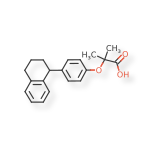
Details
| Stereochemistry | RACEMIC |
| Molecular Formula | C20H22O3 |
| Molecular Weight | 310.3869 |
| Optical Activity | ( + / - ) |
| Defined Stereocenters | 0 / 1 |
| E/Z Centers | 0 |
| Charge | 0 |
SHOW SMILES / InChI
SMILES
CC(C)(OC1=CC=C(C=C1)C2CCCC3=CC=CC=C23)C(O)=O
InChI
InChIKey=XJGBDJOMWKAZJS-UHFFFAOYSA-N
InChI=1S/C20H22O3/c1-20(2,19(21)22)23-16-12-10-15(11-13-16)18-9-5-7-14-6-3-4-8-17(14)18/h3-4,6,8,10-13,18H,5,7,9H2,1-2H3,(H,21,22)
Nafenopin is a hypolipidemic drug. It is also a peroxisome proliferator. In rats and mice, nafenopin is a nongenotoxic hepatocarcinogen, which induces hepatic DNA synthesis and enzyme induction both in vivo and in hepatocyte cultures in vitro. Hepatic Ca2+ mobilization induced by nafenopin may play an important role in the mechanism by which nafenopin exerts its physiological as well as its tumour promotive activity upon chronic treatment with carcinogenic doses.
Approval Year
PubMed
| Title | Date | PubMed |
|---|---|---|
| Evidence that the capacity of nongenotoxic carcinogens to induce oxidative stress is subject to marked variability. | 2015-05 |
|
| Human receptor activation by aroclor 1260, a polychlorinated biphenyl mixture. | 2014-08-01 |
|
| Genomic models of short-term exposure accurately predict long-term chemical carcinogenicity and identify putative mechanisms of action. | 2014 |
|
| PPARalpha: energy combustion, hypolipidemia, inflammation and cancer. | 2010-04-16 |
|
| Analysis of the heat shock response in mouse liver reveals transcriptional dependence on the nuclear receptor peroxisome proliferator-activated receptor alpha (PPARalpha). | 2010-01-07 |
|
| PRIC295, a Nuclear Receptor Coactivator, Identified from PPARα-Interacting Cofactor Complex. | 2010 |
|
| The Role of PPARα Activation in Liver and Muscle. | 2010 |
|
| Coactivators in PPAR-Regulated Gene Expression. | 2010 |
|
| Role of the nuclear receptors HNF4 alpha, PPAR alpha, and LXRs in the TNF alpha-mediated inhibition of human apolipoprotein A-I gene expression in HepG2 cells. | 2009-12-22 |
|
| A reexamination of the PPAR-alpha activation mode of action as a basis for assessing human cancer risks of environmental contaminants. | 2009-11 |
|
| Regulation of CYP4A expression by bezafibrate in primary culture of rat and human hepatocytes: interspecies difference and influence of N-acetylcysteine. | 2009-10 |
|
| Proteomic study on gender differences in aging kidney of mice. | 2009-04-09 |
|
| Biological Basis of Differential Susceptibility to Hepatocarcinogenesis among Mouse Strains. | 2009-03 |
|
| Are animal models predictive for humans? | 2009-01-15 |
|
| A human hepatocyte-bearing mouse: an animal model to predict drug metabolism and effectiveness in humans. | 2009 |
|
| Genomic profiling reveals an alternate mechanism for hepatic tumor promotion by perfluorooctanoic acid in rainbow trout. | 2008-08 |
|
| Hypolipidemia: a word of caution. | 2008-06-01 |
|
| The peroxisome: still a mysterious organelle. | 2008-04 |
|
| Modulation of receptor phosphorylation contributes to activation of peroxisome proliferator activated receptor alpha by dehydroepiandrosterone and other peroxisome proliferators. | 2008-03 |
|
| The Role of NF-kappaB in PPARalpha-Mediated Hepatocarcinogenesis. | 2008 |
|
| PPAR Regulation of Inflammatory Signaling in CNS Diseases. | 2008 |
|
| The Role of PPARs in Cancer. | 2008 |
|
| Clofibrate treatment in pigs: effects on parameters critical with respect to peroxisome proliferator-induced hepatocarcinogenesis in rodents. | 2007-04-16 |
|
| Triglyceride accumulation by peroxisome proliferators in rat hepatocytes. | 2007-04 |
|
| Suppression of peroxisomal enzyme activities and cytochrome P450 4A isozyme expression by congeneric polybrominated and polychlorinated biphenyls. | 2007 |
|
| Bioactivation of carboxylic acid compounds by UDP-Glucuronosyltransferases to DNA-damaging intermediates: role of glycoxidation and oxidative stress in genotoxicity. | 2006-05 |
|
| [Adolescents and knowledge of sexually transmitted diseases in Tuzla Canton]. | 2006 |
|
| No increase of apoptosis in regressing mouse liver after withdrawal of growth stimuli or food restriction. | 2005-05 |
|
| trans-activation of PPARalpha and induction of PPARalpha target genes by perfluorooctane-based chemicals. | 2004-07 |
|
| Role of apoptosis for mouse liver growth regulation and tumor promotion: comparative analysis of mice with high (C3H/He) and low (C57Bl/6J) cancer susceptibility. | 2004-04-01 |
|
| Regulation of CYP2C11 by dehydroepiandrosterone and peroxisome proliferators: identification of the negative regulatory region of the gene. | 2003-07 |
|
| Differential expression of c-fos and c-myc protooncogenes by estrogens, xenobiotics and other growth-stimulatory agents in primary rat hepatocytes. | 2003-03 |
|
| Dehydroepiandrosterone affects the expression of multiple genes in rat liver including 11 beta-hydroxysteroid dehydrogenase type 1: a cDNA array analysis. | 2003-03 |
|
| The hypolipidemic drug metabolites nafenopin-CoA and ciprofibroyl-CoA are competitive P2Y1 receptor antagonists. | 2003-02-11 |
|
| PPAR alpha and the regulation of cell division and apoptosis. | 2002-12-27 |
|
| Follistatin overexpression in rodent liver tumors: a possible mechanism to overcome activin growth control. | 2002-09 |
|
| Downregulation of lactoferrin by PPARalpha ligands: role in perturbation of hepatocyte proliferation and apoptosis. | 2002-08 |
|
| Modulation by nutrients and drugs of liver acyl-CoAs analyzed by mass spectrometry. | 2002-07 |
|
| Nafenopin-, ciprofibroyl-, and palmitoyl-CoA conjugation in vitro: kinetic and molecular characterization of marmoset liver microsomes and expressed MLCL1. | 2001-12-01 |
|
| Further evidence for the involvement of inhibition of cell proliferation and development in thymic and splenic atrophy induced by the peroxisome proliferator perfluoroctanoic acid in mice. | 2001-10-15 |
|
| Mouse hepatocyte response to peroxisome proliferators: dependency on hepatic nonparenchymal cells and peroxisome proliferator activated receptor alpha (PPARalpha). | 2001-08 |
|
| Peroxisome proliferator nafenopin potentiated cytotoxicity and genotoxicity of cyclophosphamide in the liver and bone marrow cells. | 1997-07-11 |
|
| Differential effect of peroxisome proliferators on rat glutathione S-transferase isoenzymes. | 1996-10 |
|
| Modifications of liver bile acids pool during modulation of rat hepatocarcinogenesis by phenobarbital and nafenopin. | 1994 |
|
| Glutathione S-transferase isoenzyme patterns in different subtypes of enzyme-altered rat liver foci treated with the peroxisome proliferator nafenopin or with phenobarbital. | 1993-11 |
|
| cDNA cloning, chromosomal mapping, and functional characterization of the human peroxisome proliferator activated receptor. | 1993-06-01 |
|
| Tumor promotion by the peroxisome proliferator nafenopin involving a specific subtype of altered foci in rat liver. | 1990-06-15 |
|
| Effects of non-genotoxic hepatocarcinogens phenobarbital and nafenopin on phenotype and growth of different populations of altered foci in rat liver. | 1989 |
|
| Exogenous Cu,Zn-superoxide dismutase suppresses the stimulation of neonatal rat hepatocytes' growth by tumor promoters. | 1984-12 |
|
| Peroxisome proliferation in primary cultures of rat hepatocytes. | 1983-01 |
Patents
Sample Use Guides
The repeated oral administration of nafenopin, a hypolipidaemic compound, at a dose of 100 mg/kg to male C57BL/6, DBA/2, Balb c and C3H mice caused an increase in the specific activity of liver cytosolic epoxide hydrolase, the activity of microsomal epoxide hydrolase was also increased in all except the C3H mice. In the range of 10-200 mg/kg nafenopin the induction of the two hydrolase activities was found to increase with increasing doses of the test compound.
Route of Administration:
Oral
| Name | Type | Language | ||
|---|---|---|---|---|
|
Preferred Name | English | ||
|
Official Name | English | ||
|
Common Name | English | ||
|
Common Name | English | ||
|
Common Name | English | ||
|
Common Name | English | ||
|
Common Name | English |
| Code System | Code | Type | Description | ||
|---|---|---|---|---|---|
|
D009255
Created by
admin on Mon Mar 31 17:34:15 GMT 2025 , Edited by admin on Mon Mar 31 17:34:15 GMT 2025
|
PRIMARY | |||
|
DTXSID8020911
Created by
admin on Mon Mar 31 17:34:15 GMT 2025 , Edited by admin on Mon Mar 31 17:34:15 GMT 2025
|
PRIMARY | |||
|
7449
Created by
admin on Mon Mar 31 17:34:15 GMT 2025 , Edited by admin on Mon Mar 31 17:34:15 GMT 2025
|
PRIMARY | |||
|
093W78U96W
Created by
admin on Mon Mar 31 17:34:15 GMT 2025 , Edited by admin on Mon Mar 31 17:34:15 GMT 2025
|
PRIMARY | |||
|
NAFENOPIN
Created by
admin on Mon Mar 31 17:34:15 GMT 2025 , Edited by admin on Mon Mar 31 17:34:15 GMT 2025
|
PRIMARY | |||
|
CHEMBL1909070
Created by
admin on Mon Mar 31 17:34:15 GMT 2025 , Edited by admin on Mon Mar 31 17:34:15 GMT 2025
|
PRIMARY | |||
|
2927
Created by
admin on Mon Mar 31 17:34:15 GMT 2025 , Edited by admin on Mon Mar 31 17:34:15 GMT 2025
|
PRIMARY | |||
|
C175154
Created by
admin on Mon Mar 31 17:34:15 GMT 2025 , Edited by admin on Mon Mar 31 17:34:15 GMT 2025
|
PRIMARY | |||
|
19592
Created by
admin on Mon Mar 31 17:34:15 GMT 2025 , Edited by admin on Mon Mar 31 17:34:15 GMT 2025
|
PRIMARY | |||
|
SUB09120MIG
Created by
admin on Mon Mar 31 17:34:15 GMT 2025 , Edited by admin on Mon Mar 31 17:34:15 GMT 2025
|
PRIMARY | |||
|
3771-19-5
Created by
admin on Mon Mar 31 17:34:15 GMT 2025 , Edited by admin on Mon Mar 31 17:34:15 GMT 2025
|
PRIMARY | |||
|
100000084432
Created by
admin on Mon Mar 31 17:34:15 GMT 2025 , Edited by admin on Mon Mar 31 17:34:15 GMT 2025
|
PRIMARY |
ACTIVE MOIETY